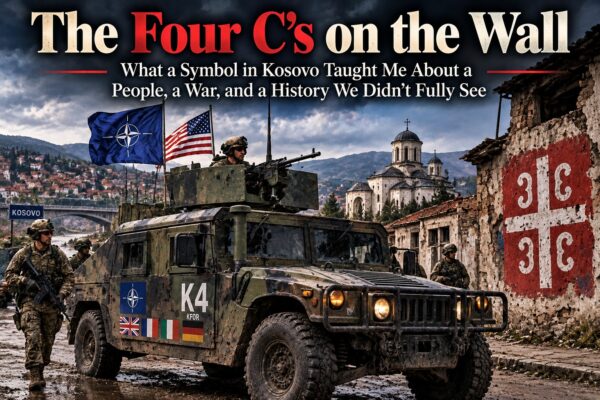
I remember seeing it painted on buildings.
Bosnia. Kosovo. The Balkans.
A cross surrounded by four strange-looking marks—something resembling four C’s facing away from the center.
At the time, I was an American Army officer traveling through a place where seemingly every bridge, village, church, mountain and pile of rocks came with a 600-year backstory. I was also in Albania preparing to go into Kosovo in 1999.
I knew enough to recognize that the symbol meant something Serbian.
What I didn’t understand was just how much history somebody had managed to cram into four little squiggles.
The symbol is called the Serbian cross, and its ancestry reaches back into the Byzantine world. The design derives from the tetragrammatic cross associated particularly with the Palaiologos dynasty of the Byzantine Empire: a cross divided into four quarters containing symbols variously interpreted historically as letters or firesteels. Serbia adopted a related form, just as it adopted another famous Byzantine symbol—the double-headed eagle.
That Byzantine connection matters.
The Byzantines weren’t some mysterious civilization that appeared between Rome and the Renaissance. They were the surviving eastern Roman Empire. Their capital was Constantinople, and their political and religious influence spread throughout the Orthodox Christian world, including medieval Serbia.
Then came the Ottomans.
Constantinople fell in 1453. Serbia ultimately fell under Ottoman rule. Just north of the Danube, Vlad the Impaler was soon conducting his rather enthusiastic campaign to convince Sultan Mehmed II that invading Wallachia was bad for one’s health.
For Serbs, centuries of Ottoman rule became intertwined with Orthodox Christianity, national identity and the memory—part history, part national mythology—of the Battle of Kosovo in 1389.
And eventually those four Byzantine-looking devices acquired a new Serbian interpretation.
They looked like the Cyrillic letter С, pronounced like our English S.
Four of them:
С С С С
They came to represent:
Само слога Србина спасава.
Samo sloga Srbina spasava.
Usually translated:
“Only Unity Saves the Serbs.”
There’s an important historical wrinkle. The motto isn’t an ancient message handed down intact from the medieval Battle of Kosovo, despite later legends connecting it with Saint Sava. The interpretation of the firesteels as four Cyrillic С’s developed during the Serbian national revival of the 19th century. The phrase itself became associated with Serbian writers and nationalist thought during that period.
But by the time I arrived in the Balkans, nobody needed a medieval heraldry professor to explain that the symbol had acquired enormous emotional power.
During the breakup of Yugoslavia, СССС appeared in Serbian nationalist graffiti, on military insignia and on buildings in territories controlled by Serb forces. The Serbian cross and four-C motif was used by the Army of Republika Srpska during the Bosnian War, and contemporary accounts specifically describe the acronym being painted on abandoned houses and walls.
Which explains what I remember seeing.
To an American soldier driving past it, it could look like another piece of Balkan graffiti.
To the person who painted it, however, it could mean something closer to:
We are Serbian.
We are Orthodox.
We remember.
We survive together.
And depending upon where it was painted and who had been driven from that particular building, it could carry a much darker wartime meaning as well. Symbols don’t exist independently of what people do beneath them.
That’s what I didn’t fully appreciate as a young American officer.
We Americans arrived with maps.
The Balkans arrived with memory.
Our maps showed roads, phase lines, checkpoints, borders and towns. Their mental maps contained Byzantium, Ottoman conquest, Kosovo Field, Orthodox monasteries, World War II, Tito, Yugoslavia, ethnic grievances and stories handed down through families.
We could drive through three countries in an afternoon.
Historically, we might have crossed three civilizations.
And there, painted on some concrete wall beside the road, were four little C’s explaining something we couldn’t find on the military map.
Only Unity Saves the Serbs.
You don’t have to endorse the nationalism that eventually attached itself to that slogan to understand its power. In fact, understanding it is precisely the point.
Because military professionals spend enormous amounts of time studying terrain.
Key terrain. Decisive terrain. Restricted terrain.
But sometimes the most important terrain isn’t underneath your boots.
It’s inside somebody else’s head.
Twenty-seven years later, I finally understand what somebody had painted on those walls.
It wasn’t decoration.
It was history telling us that we weren’t the first army to come down that road.
This is Part 2 of a 3-Part Series. Links to this article and subsequent ones are listed below. Links go live on the dates indicated.
October 14: NOV: Kosovo 1: The Bottle, the Battle, and the Bombers: Why Kosovo Was Never Just 1999
October 15: NOV: Kosovo 2: Four C’s on the Wall: The Symbol I Saw but Didn’t Understand
October 16: NOV: Kosovo 3: The Road to Ukraine Crossed the Sava River
If you enjoyed this article, then please REPOST or SHARE with others; encourage them to follow AFNN. If you’d like to become a citizen contributor for AFNN, contact us at managingeditor@afnn.us Help keep us ad-free by donating here.
Substack: American Free News Network Substack
Truth Social: @AFNN_USA
Facebook: https://m.facebook.
Telegram: https://t.me/
Twitter: https://twitter.com/AfnnUsa
GETTR: https://gettr.com/user/AFNN_
CloutHub: @AFNN_USA