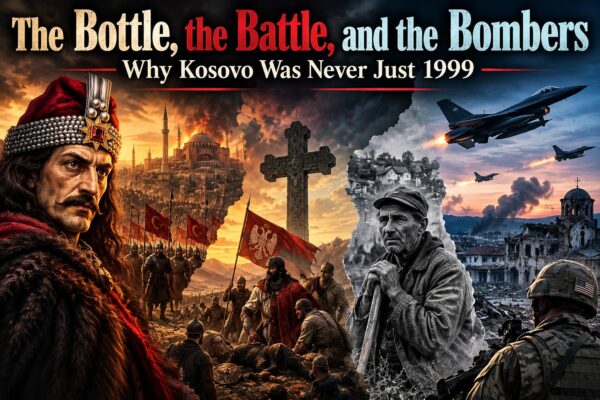
When NATO started bombing Yugoslavia on March 24, 1999, most Americans learned about Kosovo approximately fifteen minutes before forming an opinion about it.
We saw refugees, burning villages, Serbian forces, the Kosovo Liberation Army, Slobodan Milošević and NATO aircraft launching from bases in Europe. President Clinton explained why America was involved, the Pentagon gave briefings, and eventually American soldiers rolled into Kosovo as part of KFOR.
There was just one small problem.
The people who actually lived there had been arguing about Kosovo for roughly 600 years.
To understand why, go back to 1389 and the Battle of Kosovo.
A Serbian-led Christian army confronted the expanding Ottoman Muslim Empire on Kosovo Field. Both sides suffered enormous losses, and both rulers died. Historically, the battle didn’t instantly destroy Serbia. Culturally, however, it became something much larger: a foundational story of Serbian sacrifice, Christian resistance, martyrdom and national identity.
Then the Ottomans kept coming. And coming…
Eventually much of the Balkans fell under Ottoman control for centuries.
Which brings us, strangely enough, to our old friend Vlad the Impaler.
Vlad III ruled Wallachia north of the Danube during the 15th century and spent much of his career maneuvering between Hungary and the Ottoman Empire. In 1462, only nine years after Sultan Mehmed II captured Constantinople and ended the Byzantine Empire, Vlad fought Mehmed using scorched earth, raids, psychological warfare and his notoriously enthusiastic approach to woodworking.
Vlad understood something important about the Balkans:
History there doesn’t disappear just because the battle ends.
Fast-forward five centuries.
Yugoslavia emerged from World War II as a communist federation containing Serbs, Croats, Slovenes, Bosniaks, Macedonians, Montenegrins and Kosovo Albanians. Tito held the contraption together remarkably well (Iron Fist), considering it occasionally resembled a family reunion where everybody remembered who stole whose horse in 1743.
Kosovo received substantial autonomy under Yugoslavia’s 1974 constitution. After Tito died in 1980, however, economic problems, political disputes and competing Serbian and Albanian nationalism increasingly stressed the system.
Then came the bottle.
In 1985, Serbian farmer Đorđe Martinović arrived at a hospital with horrific internal injuries caused by a broken glass bottle.
Martinović said two Albanian men attacked him. Today they’d also be wearing MAGA hats…
Authorities advanced another explanation: that the injury had been self-inflicted during a sexual act.
The investigation became politically radioactive, medical opinions conflicted, and the precise circumstances were never “satisfactorily resolved.”
But politically, that almost stopped mattering.
For many Serbs, Martinović became a symbol of Serbian persecution in Kosovo. The imagery was extraordinarily powerful because an alleged impalement resonated with older memories of Ottoman (muslim) domination and violence.
One injured farmer became a national story, before it could be tweeted or shared on Turdbook.
That’s something Americans sometimes struggle to understand.
We tend to ask, “What happened?”
People living inside ancient ethnic conflicts often ask another question:
“What does this prove about what they have always done to us?”
Those are radically different ways of processing the same event.
By the late 1980s, Milošević was exploiting Serbian grievances and nationalism while Kosovo Albanians increasingly resisted rule from Belgrade. Kosovo’s autonomy was sharply curtailed in 1989. Albanian resistance initially centered heavily on parallel institutions and nonviolent politics, but by the late 1990s the Kosovo Liberation Army was conducting an armed insurgency.
Serbian and Yugoslav security forces responded with increasingly severe operations.
Civilians were displaced. Villages burned. Atrocities occurred. Refugees poured across borders.
By 1999, NATO decided intervention was necessary.
After diplomacy failed at Rambouillet, NATO launched Operation Allied Force, a 78-day bombing campaign intended to force Yugoslav forces from Kosovo and halt the humanitarian catastrophe. Yugoslav forces eventually withdrew, NATO entered Kosovo, and the province came under international administration.
Militarily, we had entered Kosovo in 1999.
Historically, we had entered 1389.
That’s the lesson.
Vlad the Impaler, Ottoman conquest, Serbian legends of Kosovo, centuries of imperial rule, Yugoslavia, Tito, Milošević, Albanian nationalism and even one horribly injured farmer were not disconnected trivia.
They were layers.
By the time an American soldier arrived with a “Flak Jacket,” (we didn’t get body armor until Iraq), an M16A2 and a laminated ROE card, he was standing on top of all of them.
We had to memorize….In Serbian:
“Stani ili ću pucati!“
Cyrillic: „Стани или ћу пуцати!“
Pronounced roughly: STAH-nee EE-lee choo POO-tsah-tee.
It means “Stop or I will shoot!” / “Halt or I’ll fire!”
We Americans like wars with start dates.
March 24, 1999.
Nice. Clean. Put it on the PowerPoint slide.
The Balkans don’t cooperate.
Sometimes the most important question before entering somebody else’s war isn’t simply “Who is fighting?”
It’s:
“How far back do we have to go before we understand why?”
In Kosovo, the uncomfortable answer may be:
A lot farther than 1999.
This is Part 1 of a 3-Part Series. Links to this article and subsequent ones are listed below. Links go live on the dates indicated.
October 14: NOV: Kosovo 1: The Bottle, the Battle, and the Bombers: Why Kosovo Was Never Just 1999
October 15: NOV: Kosovo 2: Four C’s on the Wall: The Symbol I Saw but Didn’t Understand
October 16: NOV: Kosovo 3: The Road to Ukraine Crossed the Sava River
If you enjoyed this article, then please REPOST or SHARE with others; encourage them to follow AFNN. If you’d like to become a citizen contributor for AFNN, contact us at managingeditor@afnn.us Help keep us ad-free by donating here.
Substack: American Free News Network Substack
Truth Social: @AFNN_USA
Facebook: https://m.facebook.
Telegram: https://t.me/
Twitter: https://twitter.com/AfnnUsa
GETTR: https://gettr.com/user/AFNN_
CloutHub: @AFNN_USA