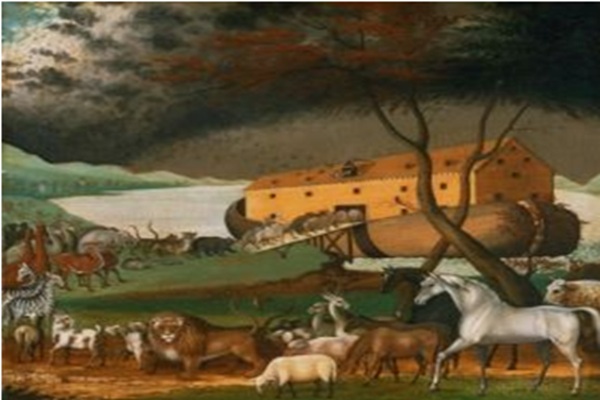
There’s a new expedition searching for Noah’s Ark on Mount Ararat. In the original language in Genesis, “Mount Ararat” is not named. The reference is to the “montains of Ararat,” a term derived from the ancient Kingdom of Uraratu. Some have proposed the term actually meant “highlands.”
While most textual analysis of Genesis puts the Flood a little over 4,000 years ago, it was a world-wide flood that can’t be correct based on archaeology. The city of Jericho, which has multiple Old Testament references, dates back at least 9,000 years. That tells us the Flood could not have been world-wide and had to have happened earlier than the textual analyses of lineages in Genesis suggest. The description of the Garden of Eden in Genesis coupled with the discovery of two extinct rivers place the Garden beneath the waters of the Persian Gulf toward its northern end. Noah would have lived near there., and prior to 8,000 years ago what is now the Persian Gulf was a lush, fertile valley.
The significance of 8,000 years ago is that is when the rising sea broke through the Strait of Hormuz and flooded the valley, creating the Persian Gulf. Sea level was as much as 450 feet lower at the end of the last glaciation, so the Persian Gulf was definitely dry land until then.
Knowing this and assuming Noah had some warning that the waters in the Gulf of Oman were now higher than the lands where he lived, Noah prepared and was ready to take ship when the flood came. I believe this flood is the flood of both Noah and of Gilgamesh – the same event but the tales are based on the two different experiences of these two men.
If “Uraratu” really did mean “highlands,” then at the time it’s likely it was more of a directional reference. When we plot a line from the rough location of the Garden of Eden (based on the description in Genesis) to Mount Ararat (Ağrı Dağı in Turkish), it runs north-northwest. With the waters flooding into the Persian Gulf from the south, this is the direction the Ark would have been pushed, and it would likely have run aground along the coasts of modern Kuwait, Iraq, or the western coast of Iran.
At that time — 8,000 years ago — sea level was 30-60 feet lower than today, so I believe the Ark would have come to rest at the now-underwater “highlands” near Kuwait and Iraq. Further, Noah and his family would have been starting over from scratch. Even if there were plenty of trees to fell in the area, it’s very unlikely they would have abandoned all of that valuable already-hewn timber that the Ark represented. Instead, they’d have lightened it as much as possible, pulled it as far ashore as they could, and salvaged the wood.
Just as many stone structures have been “quarried” for later construction and simply no longer exist, the Ark is forever gone; disassembled as the raw material to build houses, barns, fences, tools, furniture, carts and wagons, fishing boats (somewhat ironically), etc.
Thus the Ark is not and has never been on Mount Ararat and there is nothing of it left. Mount Ararat is not even the name the locals have ever called it, even today. Instead, it’s a name given to it by Europeans in the Middle Ages. So when the Flood happened, there was no such thing as Mount Ararat. That name would be invented by people over a thousand miles away over millennia later.
Instead of looking for the remains of a wooden ship that became the crucial raw materials for people building their lives anew, look instead off the shores of Kuwait and Iraq — indeed the entire Persian Gulf — for the artifacts of the societies that existed before it flooded and the probable locations of the coastal settlements from after the Flood and before they were swallowed by the slowly-rising sea.
If you enjoyed this article, then please REPOST or SHARE with others; encourage them to follow AFNN. If you’d like to become a citizen contributor for AFNN, contact us at managingeditor@afnn.us Help keep us ad-free by donating here.
Substack: American Free News Network Substack
Truth Social: @AFNN_USA
Facebook: https://m.facebook.com/afnnusa
Telegram: https://t.me/joinchat/2_-GAzcXmIRjODNh
Twitter: https://twitter.com/AfnnUsa
GETTR: https://gettr.com/user/AFNN_USA
CloutHub: @AFNN_USA