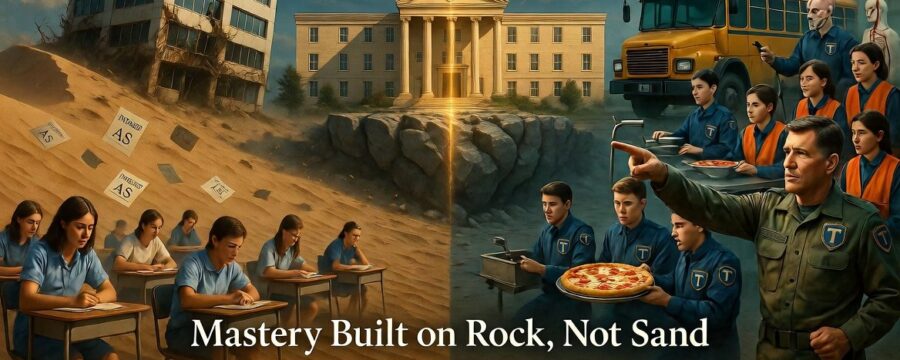
— WHY PROVERBS BEFORE POLICY —
Before I give you a single statistic, a single reform proposal, or a single solution — I want to start where every honest conversation about children has to start. With a question.
What is a school for?
Not what a school does. Not what a school is funded to accomplish. What it is FOR, in the deepest sense of the word.
Solomon answered that question roughly three thousand years ago, and nobody has improved on the answer since.
Proverbs 22:6 — “Train up a child in the way he should go; even when he is old he will not depart from it.”
That Hebrew word for “train” is chanak. It does not mean lecture. It does not mean test. It does not mean sit a child in a desk for six hours, fill their head with disconnected information, stamp a number on their forehead, and call it an education. Chanak means to dedicate. To shape. To form a habit so deep in a person that it becomes their default mode of operating in the world.
The ancient meaning was tied to the palate — a midwife would rub crushed dates on the roof of a newborn’s mouth to stimulate the sucking reflex. The act created an instinct. A practice woven into the body before the mind even had language for it.
THAT is what education is supposed to do. Not fill. Shape.
And then Proverbs 1:7 tells you what the shape has to be built around: “The fear of the LORD is the beginning of wisdom; fools despise wisdom and instruction.” You want to debate the theology? Fine. But even if you strip the scripture to its structural principle, you arrive at the same place every honest educator eventually does: WISDOM BEGINS WITH ACCEPTING THAT THERE IS SOMETHING LARGER THAN YOUR OWN FEELINGS, YOUR OWN PREFERENCES, AND YOUR OWN COMFORT. Reality. Standards. Objective truth.
The current American education system is built on the exact opposite premise. It tells children that their feelings are the measure of everything — that standards exist to serve students, not to prepare them, that failure is a trauma to be avoided rather than a correction to be learned from, and that the greatest cruelty a system can inflict is making a child feel bad about genuine incompetence.
And then we act confused about why the whole thing is collapsing.
I teach Anatomy and Physics at a Career Tech district in Northeast Ohio. Every single student I teach qualifies for free lunch. I wrote both textbooks. I am not writing this from a faculty lounge at Harvard. I am writing it from the front lines of what this system actually does to kids — not in theory, but in that first week of class when I look across a room full of students who “passed” the prerequisites and realize that the kid on the third row cannot tell me the difference between a cell and a molecule.
He passed the course. He learned nothing. That is not a teaching failure. That is a system failure. And I am tired of pretending otherwise.
— THE GRADE INFLATION DISASTER: WHEN AN A MEANS NOTHING —
Let me give you the data, because opinions are cheap and data is not.
At Yale University, approximately 79% of all undergraduate grades are A or A-minus. Harvard? Nearly identical. Brown hit 67% straight A’s in a single year. The mean graduating GPA at Harvard floats around 3.8. Economist Ray Fair, who analyzed Yale’s grading in late 2023, found the pandemic pushed the A-range to 82%. It came down slightly to 79%.
Think about what that means mathematically. If 79% of students are receiving the top grade, you do not have a grading system. You have a participation sticker with Latin on it.
And people want to tell me this is an Ivy League problem. It is not. These are the schools with the most scrutiny, the most data, and the most honest faculty willing to publish the results. Walk into a rural high school in Ohio. Walk into an urban school in Cleveland. Same dynamic. Same pressure. Same outcome.
In my own district, I watch students carry a 17% average for three consecutive quarters and then walk into credit recovery — DURING THE SCHOOL DAY — and erase an entire year of failure in a few weeks. I have had a student look me in the eye and tell me she was going to pass my Anatomy class because “that is what happens every year.” She wanted to be a NICU nurse. Working with premature infants. She could not identify the basic organs of the human body.
She was not a failure. She was a product. She had been trained, expertly, to expect that someone would always catch her before she hit the floor. That expectation was built by the system, one gift D at a time, one credit recovery shortcut at a time, one administrator-pressured grade change at a time.
That is not education. That is a lie told to a child’s face every single year until they believe it. And the moment they hit the real world — a job interview, a college rejection letter, a clinical rotation where patients’ lives depend on what they actually know — the lie meets reality. The results are devastating.
Proverbs 12:17 — “An honest witness tells the truth, but a false witness tells lies.”
We have built an education system staffed almost entirely by false witnesses. Not because the teachers are liars by nature. But because the system has made honesty career-ending and fraud consequence-free.
Jim Quinn’s First Law of Liberalism applies here in full force: liberalism always generates the exact opposite of its stated intent. The Department of Education was created to improve educational outcomes. What we actually got is a multi-trillion-dollar bureaucracy that has inverted every honest incentive in the profession and turned the American high school diploma into something employers treat as meaningless. The opposite. Every single time.
— THE MASTERY MODEL: WHAT ACTUALLY WORKS, AND WHY THE ARMY ALREADY KNEW IT —
Here is the concept nobody in federal education policy wants to admit: the United States Army solved this problem seventy years ago.
FM 7-0 — the Army’s foundational doctrine for Training the Force — does not grade on a bell curve. It does not average test scores. It does not ask whether a soldier “kind of” knows how to do something and call that sufficient. It uses three ratings, tied to specific, observable, MEASURABLE tasks:
T — Trained. The soldier executes the task to standard, under realistic conditions, without assistance. Not mostly. Not on a good day. TO STANDARD.
P — Needs Practice. The soldier understands the task conceptually but cannot execute consistently. This is NOT passing. This is a flag: more work is required before this person gets a weapon and stands next to your son in combat.
U — Untrained. Cannot perform the task. Full stop. No movement forward. No exceptions.
These ratings are tied to a unit’s Mission Essential Task List — the METL. Every task has a defined standard. Every soldier is evaluated against that standard. A unit does not deploy until its critical tasks are rated T. Not averaged to T. Not mostly T. T.
The military — an institution responsible for sending human beings into life-or-death situations — refuses to advance someone who is rated P or U on a critical task. Because they understand something that our school system has systematically unlearned: PARTIAL COMPETENCE IN A LOAD-BEARING SKILL IS NOT COMPETENCE. It is a liability wearing a uniform.
In the system I am proposing, every course is built around Mastery Goals rather than content standards. A Mastery Goal is exactly what it sounds like — a specific, observable, measurable demonstration that a student can perform a defined skill to a defined standard. Not understanding the skill. Not exposure to the skill. Performance. Demonstrated. Repeatable.
Content standards tell teachers what to cover. Mastery Goals tell teachers what students must be able to DO. These are not the same thing. We have spent forty years covering content. It is time to start building competence.
Teachers build their curriculum around Pathways — specific instructional sequences designed to lead students from where they are to the Mastery Goal. Different Pathways can reach the same Goal, because students learn differently and teachers teach differently. But the Goal does not move. The standard does not change based on feelings. A student demonstrates mastery or they do not.
And here is the part that makes this different from every soft-edged “mastery learning” experiment that has been quietly abandoned: a student must pass BOTH a classroom grade AND a trimester mastery test to advance. The grade tells you how they performed across the instructional period. The mastery test tells you whether they can actually do the thing when it counts. One without the other is incomplete information.
Think of it exactly like a military qualification range. You can score brilliantly in weapons training class and still fail to qualify on the live-fire range. Both matter. One is the preparation; one is the proof. You need both. No exceptions.
The trimester mastery test is the state assessment. Administered at the end of each trimester. Not graded — pass or fail. Not used to rank students against each other. Used to verify that demonstrated mastery is real, that it holds up under independent evaluation, and that the transcript reflects something genuine. The state sees the data — not to punish schools, but to identify where the system is failing and apply resources before another generation is lost.
— THE LEVEL SYSTEM: REPLACING GRADES WITH ACTUAL INFORMATION —
Every subject — math, science, writing, history, government, psychology, a career field, a trade — runs on a level system. The level number tells you exactly how many trimesters of sequential, mastered coursework a student has completed in that subject. Not averaged. Not estimated. Completed and verified.
Math Level 1 means the student has demonstrated mastery of one trimester of foundational mathematics. Math Level 12 means twelve trimesters — four years of sequential math, every level earned, none gifted. Math Level 20 means this student has worked through twenty trimesters of mathematics and proven competency at each step.
You do not need a decoder ring. You do not need to call the high school counselor and ask what the grading culture was like at that particular school. The level IS the credential.
A student’s diploma is not a pass/fail document. It is a record — a complete, public accounting of exactly which levels they achieved in which pathways. No minimum level required to graduate. But plenty of minimum levels required to enter specific courses, programs, and career paths.
Want to take Physics? You need Math Level 6 minimum — because physics without algebra is theater, not science. Want to enter the nursing program at a community college? The college publishes its requirements: Writing Level 10, Biology Level 6, Chemistry Level 4, Math Level 8. Transparent. Published. Achievable.
Want to apply for an electrician’s apprenticeship? They want to see Math Level 8 and Physical Science Level 4. Want to be a diesel mechanic? Physics Level 3, Math Level 6, and Diesel Tech Level 4 from the Career Tech pathway. The levels exist across every pathway — academic, technical, and skilled trade.
Here is the beauty of the system as a skill tree. Students do not just move linearly up one column. They branch. A student at Math Level 14 can simultaneously begin Physics Level 1, Chemistry Level 1, and Statistics Level 1 — because all three build on the math foundation already established. A student who reaches Biology Level 5 can branch into Anatomy, Ecology, or Microbiology depending on pathway and interests.
Students who do not have base minimum levels in core areas by the time they start high school are shifted into an intensive remediation and job-skills pathway. Not as a punishment — as an honest conversation: here is where you are, here is what you need, here is the fastest honest path to economic self-sufficiency. Non-skilled labor training is a legitimate pathway. It has more dignity than a fraudulent diploma.
ONLINE SCHOOL FOR HIGH SCHOOL IS NOT ALLOWED IN THIS MODEL. Full stop. High school students do not learn from asynchronous video modules and untimed retakes. They learn from teachers who can read the room, adjust instruction, and catch the moment when something clicks — or does not. You cannot replicate that on a screen. We tried. We have the data. No.
— THE BELL CURVE AND MASTERY: HOW BOTH LIVE IN THE SAME SYSTEM —
This is where most education reformers trip over themselves, because they think mastery learning and bell curve grading are in conflict. They are not. They operate at different levels of the system, and understanding the difference is everything.
Bell curve grading describes the DISTRIBUTION of performance within a trimester. Mastery standards describe the THRESHOLD required to advance. These answer different questions.
The bell curve question is: “How did students perform relative to each other during this instructional period?” In an honest classroom with an honest assessment, you will get a natural distribution. Some students grasped the material quickly and deeply. Most were in the middle. Some struggled. That distribution tells a teacher something true about the effectiveness of instruction, the preparation of students, and the difficulty of the material. It is DATA. It is not a punishment.
The mastery question is: “Did this student meet the defined threshold?” A student who scores in the middle of the bell curve might still pass the mastery test. A student at the top has almost certainly passed. A student at the bottom probably has not — but “probably” is why we have the mastery test.
The two systems work together like this: the trimester grade, shaped by an honest bell curve distribution, gives you the instructional picture. The mastery test gives you the readiness verdict. A student needs BOTH. A student who performs well on the classroom curve but fails the mastery test is not ready. A student who barely passes the classroom grade but somehow passes the mastery test needs a second look — because something in that classroom picture was inaccurate.
The REQUIREMENT for a mandated honest grade distribution — roughly ten percent A range, twenty percent B, forty percent C, twenty percent D, ten percent F — eliminates grade inflation at its source. When teachers are required to produce a distribution that reflects actual variance in performance, there is no longer an incentive to give everyone an A. The A means something again, because not everyone gets one.
And the student at the D level? They get honest feedback: you are not ready for the next level. That is not a life sentence. That is a map. Here is where you are. Here is what you need to work on. Here is what the next trimester’s targeted instruction is going to look like.
Proverbs 27:17 — “As iron sharpens iron, so one person sharpens another.” The bell curve is the sharpening. Every student measured honestly against their actual peers makes the grade mean something.
— THE TIERED SCHOOL STRUCTURE: BECAUSE ONE SIZE FITS NO ONE —
Right now we take every student — the one who reads three grade levels ahead and the one who cannot decode basic sentences — and put them in the same room and act surprised when one is bored out of their mind and the other is lost before the first unit is over.
The tiered structure fixes this. Not permanently. Not punitively. Dynamically.
Picture college athletics. Division I, II, and III. Nobody pretends Alabama and a small Division III program are running the same program. The Divisions reflect where programs actually are — and programs can move between them based on actual performance.
DIVISION I schools serve students who have demonstrated readiness for college-preparatory rigor. The curriculum is demanding, the pace is faster, the expectations are high. Dual enrollment, advanced coursework, preparation for competitive universities. These students are not coddled — they are challenged.
DIVISION II schools serve the capable middle. Students performing at or near appropriate level, building toward state universities, solid career paths, and community college credentials. Real instruction, real expectations, real results.
DIVISION III schools are the Career Technical Education centerpiece. This is NOT a consolation prize. This is where the trades, healthcare support, IT, culinary, automotive, diesel, construction, and a hundred other skilled fields are developed. An electrician making six figures does not need a college diploma. A diesel mechanic keeping the commercial freight network running needs applied physics mastery, not a liberal arts elective. We have spent thirty years telling students these careers were beneath them. We can see the results in every skilled labor shortage in the country.
DIVISION IV is intensive intervention — for students who have significant gaps and need smaller class sizes, specialized instruction, and focused foundational work before they are ready for Division II or III programming.
STUDENTS MOVE. That is the critical piece. A Division III student who builds their math level and demonstrates readiness moves to Division II. A Division IV student who responds to targeted intervention moves up. A Division I student who genuinely cannot sustain the rigor moves to a level where they can actually grow. The division reflects WHERE YOU ARE RIGHT NOW — not who you are forever.
Proverbs 4:18 — “The path of the righteous is like the morning sun, shining ever brighter till the full light of day.” The division is not the destination. It is the current position on the path.
— THE BIG BROTHER/BIG SISTER PROGRAM: THE D STUDENT WHO CHANGES EVERYTHING —
Study hall is dead. When a high school student — a young adult, let’s use that language because it matters — has a free period, we are going to make it mean something.
Every high school student in good behavioral standing has the option to serve as a Big Brother or Big Sister to younger students. The mentorship is structured, supervised, and intentional. The older student works through material with a younger student, tells them about what school is actually like, and teaches the lessons they wish someone had taught them.
Here is what everybody gets wrong about this idea: they assume it is an honor program. It is not. The best mentors in this building are not always the A students. Sometimes the best mentor is the kid who has struggled, who made mistakes, who knows exactly what it feels like to be behind and embarrassed to ask for help. The D student who genuinely cares about that third-grader understands the third-grader in ways no honor roll student has ever had to.
Some of my most academically challenged students are also some of the most caring human beings I have ever met. They show up for people. They have empathy that comes from experience, not theory. What they lack is a reason to show up for themselves — because school has never given them a role where their presence made a difference to someone else.
Give them a little kid who looks up to them. Watch what happens.
This is not charity. This is a PIPELINE. The student who spends a trimester mentoring a second-grader in reading comprehension learns more about phonics, vocabulary, and comprehension strategies than they absorbed in three years of being on the receiving end of instruction. Teaching is the deepest form of learning. We know this. We should use it.
Proverbs 11:25 — “A generous person will prosper; whoever refreshes others will be refreshed.” When a student commits to teaching it, they have to actually know it.
And these kids WANT to come to school when school is where they matter. When school is where a seven-year-old’s face lights up because THEY are here. That changes everything about attendance, about engagement, about the will to keep going on the days when nothing else is working.
— DISCIPLINE: ORANGE JUMPSUITS AND REAL CONSEQUENCES —
I have watched the discipline conversation in education devolve into a competition to see who can remove the most consequences from student behavior while still pretending the word “accountability” has meaning.
We are going to try something different. We are going to do what the real world does.
When a young adult — and that is what a high school student is — makes a mistake that rises to the level of in-school consequence, the consequence is real. Community service. Orange vests. Beautification of the school grounds, the local park, the neighborhood. Alongside the resource officer, who is a consistent, respected presence in this program — not as a threat, but as a model of what professional accountability looks like.
You use the porta-john. You take a sack lunch. You work.
This is not punitive for its own sake. This is preparation. Because if a 17-year-old commits the same offense in the same neighborhood ONE YEAR LATER, this is exactly what happens — except it is not a resource officer standing next to them. It is a corrections officer. And the orange vest is not voluntary.
The school’s job is to let students experience the consequence of poor choices in a controlled, survivable environment — one where the stakes are contained, where there is still a path forward, and where the lesson is delivered while there is still time to change the trajectory.
Proverbs 19:18 — “Discipline your children, for in that there is hope; do not be a willing party to their death.”
The resource officer is not the enemy in this model. The resource officer is one of the most important adults in the building. They know these kids. They see them in both contexts — in school and in the community. A resource officer who builds relationships is an early warning system for escalation, a mentor for students who have never had a stable adult in their life, and a bridge between the school culture and the community the school exists to serve.
The objective is not to traumatize. The objective is to make the connection between choices and consequences undeniable, in a setting where the student still has options. That is more compassionate than releasing them into the world with the illusion that there are no consequences for anything.
— CAREER TECH RUNS THE SCHOOL: THE SELF-SUSTAINING MODEL —
The Diesel Technology program works on the school’s bus fleet. Not as a field trip. As the actual maintenance program for actual vehicles that actual students ride. The work is real. The safety standards are real. The consequence of a mistake is real in a way that a textbook problem never can be. And the fleet maintenance cost — which currently goes to outside vendors — stays inside the school.
The Automotive Technology program works on school vans and administrative vehicles. Same principle. Real work. Real stakes. Real savings to the district’s operating budget.
The Construction Technology program builds things. Actual things. Repairs to the facility. Maintenance projects. Community building projects that the school submits bids for — and wins — because the labor cost is covered by instructional hours rather than contractor invoices.
The Health Technology program staffs the school’s substance abuse prevention and intervention program. Students with training in health occupations, supervised by licensed professionals, become a first layer of outreach in a crisis that is destroying communities across Northeast Ohio right now. This is not students playing doctor. This is students being given real responsibility in a supervised setting where their skills are applied to a real community need.
And then there is the lunch program. FROZEN LUNCHES IN A SCHOOL ARE AN EMBARRASSMENT.
The United States Army feeds tens of thousands of troops every day in dining facilities — DFACs — that produce fresh food from scratch. Not from a Sysco bag of pre-formed chicken patties. FROM SCRATCH. I have eaten in military DFACs in multiple environments including a combat zone. I can tell you that the quality, the nutrition, and the respect for the people eating that food is higher than almost anything I have seen in an American school cafeteria.
Our schools are feeding children — developing human beings whose brains require consistent, quality nutrition to learn — frozen processed food that would embarrass a mid-grade fast food restaurant.
The Culinary and Baking programs in a properly designed school ARE the lunch program. Not as an experiment on Fridays. As the operating kitchen for every meal, every day. Students learn to prep, to cook, to follow food safety protocols, to manage a production kitchen on a schedule. These are marketable skills in one of the largest employment sectors in the country.
Pizza. Every day, there is a pizza option. Made fresh. By the slice. You know what it takes to make a school pizza? A commercial salamander, quality ingredients, and students who have been taught the basics. Pizza by the slice is cheap to produce, loved universally by students, and a perfect daily production task for a culinary program learning portion control, consistency, and time management. The quality of school lunch affects academic performance in ways that are documented, replicated, and studiously ignored by districts locked into food service contracts. Feed them like they matter, because they do.
The Career Tech programs collectively reduce the school’s operating costs, provide real-world training, generate community goodwill, and produce students with demonstrable skills that employers can evaluate without a translator. The school is not just a building where learning happens. The school becomes a functioning economic entity that serves its community in measurable, practical ways.
— WHAT COLLEGES AND EMPLOYERS DO WITH THIS —
A college receives a transcript that looks nothing like what they are currently wading through. No GPA. A level list.
Math Level 14. Writing Level 11. Biology Level 8. Chemistry Level 5. Physics Level 4. Culinary Arts Level 6. History Level 7. Government Level 4. Psychology Level 3.
Every admissions officer knows instantly: this student has worked through fourteen trimesters of sequential mathematics and demonstrated mastery at each level. This is verifiable. This is consistent across every school in the state using this system, because the standards are the same and the state assessment is the same. A Math Level 14 from a rural district in Ohio and a Math Level 14 from a suburban district in Columbus mean the same thing.
Colleges publish their course and major requirements in levels. Engineering? Math Level 16 minimum, Physics Level 6, Chemistry Level 5. Nursing? Biology Level 6, Chemistry Level 4, Math Level 8, Writing Level 10. English Lit? Writing Level 14, History Level 8. Transparent. Published. Consistent. Students know exactly what target they are working toward.
An employer looks at an applicant’s level record and sees immediately which skills are strongest, which career pathway was pursued, and whether the applicant has the specific foundation their position requires. None of them care what your GPA was. They care what you can do.
For the student who finishes school without reaching the levels their target career or college requires: post-secondary level improvement programs exist — evening classes, community college courses, workforce development programs — all available at the student’s own expense, on their own timeline, all of which feed back into the same level record. You never stop being able to improve the transcript. You just have to do it on real terms.
— THE COMMUNIST GOALS AND THE DEPARTMENT OF EDUCATION —
On January 10, 1963, Congressman Albert Herlong read into the Congressional Record a list of 45 Communist Goals for America. Goal Number 17 reads: “Get control of the schools. Use them as transmission belts for socialism and current Communist propaganda. Soften the curriculum.”
I am not calling any individual a communist. I am pointing at a mechanism. When a federal agency tells local districts what curriculum to implement, what social frameworks to adopt in classrooms, what diversity mandates to enforce, and withholds funding from schools that resist compliance — the mechanism of Goal 17 is operational. Whatever you call it.
The Constitution mentions education exactly ZERO times. The Tenth Amendment reserves undelegated powers to the states and to the people. Education was never a federal function — not by oversight. By design.
The Department of Education was created in 1979. Before it existed, American students competed internationally at a level we have not matched since. We have spent forty-six years and trillions of dollars proving that federal involvement in local education produces the same outcome every federal expansion produces: more bureaucracy, more mandates, more money consumed by compliance, and less of anything resembling actual learning.
Quinn’s Twenty-Fifth Law: liberals are great at giving away other people’s money. Specifically yours. Specifically to a department that has produced the exact opposite of what it promised and will demand more funding to address the failures it caused.
Return education to the states. Return it to the districts. Return it to the teachers who are actually in the room.
— A FINAL WORD FROM SOMEONE WHO LIVES THIS —
I have published two textbooks. I taught both courses. I spent 23 years as an Army combat medic. I worked as a civilian paramedic in Cleveland. I now teach in one of the highest-need districts in Northeast Ohio, where every student qualifies for free lunch and where the public schools, by and large, gave up on these kids long before they arrived at my door.
I do not write this from theoretical detachment. I write it because I have watched, in real time, what happens to a child who was lied to by a system that was supposed to prepare them for a world that does not lie.
The world does not give gift D’s. The world does not offer credit recovery for bad decisions. The world does not round up your performance to the nearest passing grade because your parent complained to an administrator.
The world says: can you do this or can you not? And it does not ask twice.
Proverbs 24:3-4 — “By wisdom a house is built, and through understanding it is established; through knowledge its rooms are filled with rare and beautiful treasures.”
We are building schools on sand and calling it a foundation. We are handing children fraudulent credentials and calling it compassion. We are producing a generation that has never been honestly evaluated, never experienced the consequence of genuine failure in a safe environment, and never been given the dignity of a real standard to meet.
Build the house on rock. Hold the standard. Tell the truth. It is the kindest thing we can do.
But what do I know — I am only a science teacher who wrote his own textbooks, spent two decades watching students fail not because they lacked the ability but because every adult in the system found it easier to lie to them than to build them, and who has eaten fresh food in a combat zone DFAC while American children get served a frozen rectangle and told it is chicken.
 Mike Borowski is a medically retired Army combat medic with 23 years of service, including a combat deployment to Iraq, and a high school Anatomy and Physics teacher at a high-need Career Technical district in Northeast Ohio — where he also wrote and published the textbooks for both courses. He runs “Bski’s Classroom,” a platform dedicated to cutting through political noise with data, history, and the kind of blunt honesty that comes from someone who has seen both war and the American classroom up close.
—
X (Twitter): x.com/BskiMike22802
Substack: substack.com/@bskimike22802
YouTube: www.youtube.com/@BskiMike22802
AFNN: https://afnn.us/author/mikeborowski/
If you enjoyed this article, then please REPOST or SHARE with others; encourage them to follow AFNN. If you’d like to become a citizen contributor for AFNN, contact us at managingeditor@afnn.us Help keep us ad-free by donating here.
Substack: American Free News Network Substack
Truth Social: @AFNN_USA
Facebook: https://m.facebook.com/afnnusa
Telegram: https://t.me/joinchat/2_-GAzcXmIRjODNh
Twitter: https://twitter.com/AfnnUsa
GETTR: https://gettr.com/user/AFNN_USA
CloutHub: @AFNN_USA