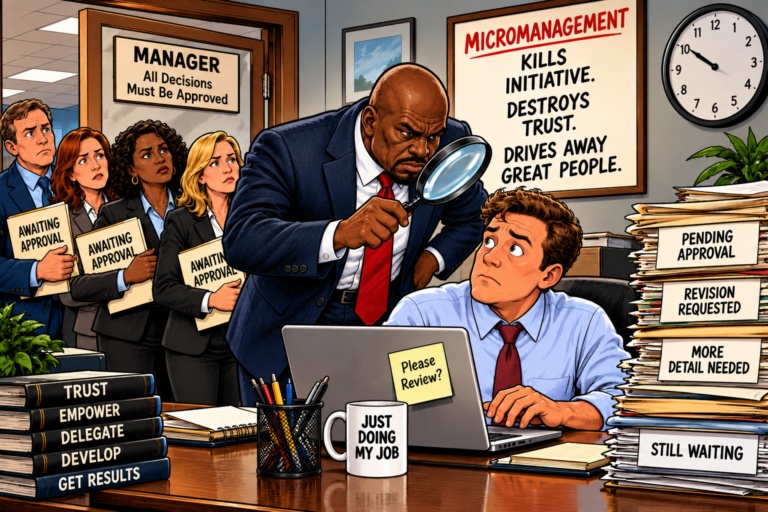
Have you ever worked for a boss who couldn’t resist looking over your shoulder?
You know the type. Every decision requires approval. Every assignment comes with detailed instructions. Every minor problem becomes an opportunity for the boss to demonstrate how things should be done.
And heaven forbid you approach a task differently than the boss would have.
I’ve encountered managers like this throughout my career, and I’ve often wondered why they bothered hiring capable people in the first place.
If you’re going to make every decision, dictate every detail, and personally supervise every step, why not just do the work yourself?
Of course, we know the answer. One person can’t do everything.
Yet some managers spend so much time trying to control what everyone else is doing that they accomplish remarkably little themselves.
That’s not leadership. That’s micromanagement. And it’s usually a sign that something is seriously wrong with the way an organization is being managed.
Let’s be clear about something. There’s nothing wrong with establishing standards, setting expectations, or holding people accountable for their performance.
In fact, those are essential leadership responsibilities.
When I served in the Army, there was no confusion about the importance of standards. Missions had to be accomplished, responsibilities were clearly assigned, and the consequences of failure could be serious.
But effective military leadership also recognizes something that some civilian managers seem to forget: The person closest to a problem may be in the best position to determine how to solve it.
A commander who insists on personally directing every minor action quickly becomes a bottleneck. Decisions slow down, initiative disappears, and subordinates begin waiting for instructions rather than exercising their own judgment.
That isn’t how you develop capable leaders.
And the same principle applies in business.
Imagine hiring an experienced employee, explaining the desired result, and then constantly interrupting to question every decision along the way.
What message does that send?
It certainly doesn’t communicate confidence.
Instead, it tells the employee, “I hired you because I needed your skills, but I don’t trust you enough to use them.”
Over time, that message takes a toll.
Employees become reluctant to make decisions. Creativity suffers because nobody wants to risk doing something the boss might disapprove of. Problems that should be resolved quickly get passed up the organizational chart.
And eventually, the manager complains that nobody takes initiative.
There’s a certain irony in that, isn’t there?
The boss creates an environment where independent thinking is discouraged, then wonders why nobody thinks independently.
Now, I can already hear the objection.
“But what if my employees make mistakes?”
They will.
So will you.
Nobody gets every decision right, and giving people responsibility doesn’t mean abandoning oversight or accepting poor performance.
There are legitimate reasons for close supervision, particularly when someone is inexperienced, learning a new responsibility, or performing work where mistakes could endanger lives or cause serious harm.
The difference is whether that supervision is intended to develop competence or simply maintain control.
A good leader adjusts the level of oversight to the situation and the capabilities of the individual. As people demonstrate sound judgment and reliable performance, they should earn greater responsibility.
A micromanager rarely makes that adjustment.
To the micromanager, the problem isn’t whether employees are capable. It’s whether they are doing things exactly the way the boss prefers.
And that distinction matters.
I’ve found that capable people generally want to take pride in their work. They want to solve problems, contribute ideas, and know that their judgment is respected.
When leaders give them reasonable authority, clear expectations, and appropriate accountability, those employees often accomplish more than anyone anticipated.
But when every decision must pass through the boss, something important gets lost.
Ownership.
People stop thinking of the work as their responsibility and start thinking of it as the boss’s project.
After all, if the boss insists on making every decision, why shouldn’t the boss bear responsibility for the outcome?
That’s a dangerous mindset for any organization.
Leadership isn’t about proving that you can do everyone else’s job better than they can. It’s about building a team capable of succeeding without your constant intervention.
And perhaps that’s what makes micromanagement so revealing.
A manager who needs to control everything may feel indispensable. But a leader who develops capable, confident people creates something far more valuable.
An organization that doesn’t fall apart every time the boss leaves the room.
Dean Gemberling is a West Point graduate, former U.S. Army officer, small business owner, and author of Servant Leadership Made Simple, a practical guide to building trust, strengthening relationships, and developing more effective leaders. Explore his books and leadership insights at DeanGemberling.com.
If you enjoyed this article, then please REPOST or SHARE with others; encourage them to follow AFNN. If you’d like to become a citizen contributor for AFNN, contact us at managingeditor@afnn.us Help keep us ad-free by donating here.
Substack: American Free News Network Substack
Truth Social: @AFNN_USA
Facebook: https://m.facebook.com/afnnusa
Telegram: https://t.me/joinchat/2_-GAzcXmIRjODNh
Twitter: https://twitter.com/AfnnUsa
GETTR: https://gettr.com/user/AFNN_USA
CloutHub: @AFNN_USA