‘Communion’ by J D Vance

I will admit that it’s truly baffling to me that the northeast, the most politically liberal area of our country, is also our most heavily Catholic region, yet our good friends on the left love to spend their time bashing Catholics. It kind of makes me wonder just how actually Catholic they are. Our 46th …

Read more

Ten Days Before the Bulge: A Letter from Colonel Leander L. Doan

December 6, 1944. Somewhere in Germany. Colonel Leander L. Doan sat down and wrote a letter home. He spoke casually of fighting Panzer Lehr and the Adolf Hitler SS Panzer Division, being wounded, surrounded for 36 hours, and watching the men beside him die. Yet there was no bravado, only the quiet matter-of-fact tone of a combat commander doing his duty. What makes the letter extraordinary is that it was written just ten days before the Battle of the Bulge erupted. Doan had survived Normandy, the breakout across France, and the Siegfried Line, but neither he nor his family knew that some of the war’s hardest fighting still lay ahead. Preserved for more than eighty years, this remarkable letter offers a rare glimpse into the mind of a future Major General standing between two of the most consequential campaigns of World War II.

Homeowners Living Behind Enemy Lines In Dying Portland, Tale #97: Keeping Homeless Industrial Complex Funded

Homeowners Living Behind Enemy Lines In Dying Portland, Tale #97: Keeping Homeless Industrial Complex Funded

When Portland officials finally arrived last December, they punished the homeowner instead of removing those who were illegally camping just on the other side of his hedge, the only thing that protected him and his children from the homeless hordes, loud noises, disgusting behavior.

The Human Benchrest: The Enduring Legacy of MAJ Ernie Vande Zande

Ernie Vande Zande was more than a national champion and record-setter; he was the rare competitor who made everyone around him better. Known as “the Human Benchrest,” the Army major and Camp Perry champion combined world-class precision with a quiet willingness to help any shooter who genuinely wanted to improve. His classic article Sights, Wind and Mirage still teaches competitors how to read conditions decades after it was written. Smallbore lost more than a legend when Ernie passed in 2018—it lost a mentor, a gentleman, and one of the finest ambassadors the sport has ever known.

Just how early on did the Democratic staffers realize that Joe Biden was sinking into dementia?

My site has reported, several times, on the anti-Catholic bias of the Democratic Party, including the actions of the federal government investigating “radical traditionalist Catholics”, and that FBI Director Christopher Wray lied under oath about the extent of the program. President Biden was very famously Catholic, frequently attending Mass, even though his policies on transgenderism …

Read more

Khe Sanh: The Siege We Won—and the Narrative We Lost

There’s a reason Khe Sanh still gets brought up in war colleges, smoky VFW halls, and late-night strategy debates. It wasn’t just a battle. It was a live-fire experiment in something we didn’t have a name for yet—what we now call fifth-generation warfare. Not bullets versus bullets. Not even armies versus armies. It was narrative versus reality. And narrative won.

Three Knots, No Excuses: The Lost Skill That Still Saves Lives

There was a time—not that long ago—when a man who couldn’t tie a knot was considered about as useful as a screen door on a submarine. Today, we’ve got people carrying $1,200 smartphones, satellite GPS, and enough titanium gadgets clipped to their belt to look like a walking REI catalog… and they can’t tie a loop that won’t slip under load.

Night Witches and the Art of Terror: How Improvised Bombers Haunted the Wehrmacht After Dark

In 1941, the Soviet Union was being dismantled at industrial speed. Entire armies vanished. Cities fell. Aircraft factories were evacuated east while German armor drove forward. There was no time for elegance. The Red Army needed pilots, aircraft, and pressure on the enemy—immediately. So they did something profoundly unromantic and brutally practical: they took civilians who could fly and turned them into combat airmen.

Two Wings, One Bird: How We Traded a Republic for a Revenue Machine

We like to pretend we live in a fierce two-party system. Red vs. blue. Left vs. right. Cable news gladiators screaming like it’s the Super Bowl of righteousness. But step back far enough and the illusion fades. What you actually see is one bird with two wings—and that bird doesn’t care about your values, your vote, or your virtue. It worships one thing: money.

From Freedom Convoy to Financial Control: The Rise of Instant Compliance

If you want a glimpse of how modern pressure can scale fast, look north to the winter of 2022 and the protests known as the Freedom Convoy. What began as a cross-country movement of truckers opposing cross-border vaccine requirements turned into a broader protest against mandates and restrictions. The response from the Canadian government under Justin Trudeau was decisive: emergency powers were invoked, certain financial accounts connected to the protests were frozen, and law enforcement moved to clear blockades. Supporters called it necessary to restore order; critics saw it as a warning shot—how quickly financial access and mobility can be restricted in a modern, digitally connected system.

The Fog of Fear – Emergency Powers, Permanent Habits: What We Did in COVID

By late 2020, vaccines arrived under emergency authorization. That should have been the turning point—the moment where risk became individualized again. Instead, the dial kept turning in one direction: more control, more pressure, more compliance. By September 2021, the federal government, under Joe Biden, pushed for sweeping mandates, including a requirement aimed at large employers through OSHA. It was framed as necessity. It was enforced as urgency. And it was received, in many corners, as coercion.

The Real Virus: How Fear, Stress, and Certainty Changed Us

You didn’t need a history degree to recognize what was happening during the pandemic—you just needed to pay attention to how quickly ordinary people changed under pressure. Not all at once, not everywhere, but enough to notice a pattern. Stress, fear, and anxiety didn’t just shape policy; they reshaped behavior. And in many cases, they …

Read more

In 1987, Trump predicted this. He explained what needed to be done in Iran. Now he is doing it.

In 1987, Barbara Walters of ABC (then owned by Capital Cities) interviewed Donald and Ivana Trump. He was 41 and they were still married. Walters asked him about Iran, which had a decade earlier had broken international law by seizing the U.S. Embassy and holding all its American employees hostage.

Cognitive Warfare: The Fight You’re Already In (Whether You Know It or Not)

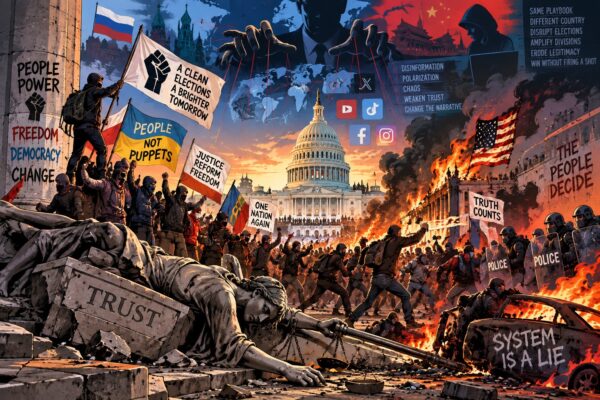
NATO didn’t invent cognitive warfare, but they did something important: they named it. And once you name something, you can’t pretend it isn’t there. Their definition isn’t wrapped in science fiction or Hollywood nonsense. It’s blunt. Cognitive warfare is about influencing or disrupting how people think in order to shape what they do. Not just soldiers, not just leaders—everyone. Entire populations. Allies, adversaries, and increasingly, your own backyard.

Seventeen Pages and the Price of Legitimacy: Restoring Election Confidence Before 2028

In recent election cycles, public trust in the electoral process has measurably declined. Surveys from multiple institutions show that large portions of the electorate—across party lines—harbor doubts about integrity, administration, or transparency. That reality, by itself, is destabilizing. It does not require proof of systemic fraud to create risk. It only requires sustained disbelief.