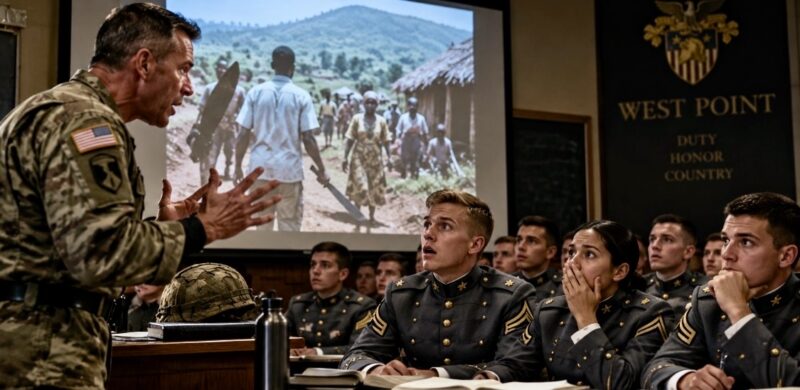
In the 1990s, while attending the United States Military Academy at West Point, I had instructors who had recently returned from deployments to Rwanda. They told us stories about what they had witnessed during one of the most horrific chapters of modern human history.
Our jaws dropped.
These weren’t Hollywood movies, theoretical exercises, or sanitized PowerPoint presentations about the laws of armed conflict. These were professional American soldiers describing what happens when ordinary human beings decide their neighbors are no longer human.
And here’s the disturbing part.
A few years later, I would find myself serving in the Balkans, witnessing the consequences of ethnic hatred in Bosnia, Albania, and Kosovo.
Different continent. Different religions. Different ethnic groups. Same defective human operating system.
Apparently, humanity doesn’t learn very quickly.
In April 1994, Rwanda descended into approximately 100 days of systematic slaughter. By July, an estimated 800,000 people, predominantly ethnic Tutsis along with moderate Hutus, had been murdered.
Think about that number.
Eight hundred thousand human beings.
Not during a world war. Not following a nuclear exchange. Not because an advanced military unleashed some revolutionary weapon system.
Much of the killing was accomplished with machetes, clubs, and other inexpensive implements.
Welcome to the Stone Age, brought to you by modern civilization.
But here’s where the story gets particularly interesting from a military intelligence perspective.
Between January 1993 and March 1994, Rwanda imported approximately 581 metric tons of machetes, according to historical investigations. That quantity has frequently been translated into an estimated 581,000 individual machetes, although the precise number remains disputed.
China was a major source.
Historical records document shipments moving through Kenya, including a significant consignment in October 1993. Wealthy businessmen, including Félicien Kabuga, were involved in procurement networks associated with the extremist political establishment.
The popular story about one giant Chinese ship arriving with thousands of machetes makes for dramatic storytelling. The historical record is more complicated. What matters is that large quantities of inexpensive cutting tools entered a country already experiencing escalating ethnic hatred and political violence.
Now, before someone starts hyperventilating about Chinese machetes, consider something.
A machete is an agricultural tool.
Millions of people use them every day to clear vegetation, harvest crops, and perform ordinary work.
A shovel digs a hole. An axe splits firewood. A hammer drives nails.
And every single one can become a murder weapon.
The tool doesn’t wake up one morning and decide to commit genocide.
The human does.
That’s the uncomfortable truth modern civilization desperately wants to avoid.
We love blaming objects.
Guns. Knives. Machetes. Explosives. Technology.
If only we could regulate the dangerous objects, surely humanity would become peaceful, enlightened, and civilized.
Really?
The Rwandan genocide demonstrated something considerably more disturbing. Give sufficiently motivated human beings cheap tools, organized leadership, relentless propaganda, and permission to hate, and they can accomplish industrial-scale murder without industrial-scale weapons.
The killing was not merely spontaneous tribal violence.
Extremist political leaders organized militias, distributed weapons, prepared lists of intended victims, and used radio broadcasts to spread hatred and encourage murder.
Neighbors killed neighbors.
People who had attended the same schools, shopped in the same markets, and lived alongside one another suddenly became enemies.
Why?
Because someone convinced them that another human being represented an existential threat.
Sound familiar?
Now fast-forward to the Balkans.
Between 1998 and 2000, I served in a region still suffering from the consequences of Yugoslavia’s violent disintegration.
Bosnia. Albania. Kosovo.
Europe, not Africa.
Here, the killing involved modern military weapons, artillery, armored vehicles, and organized armed formations. The conflicts had different histories, political circumstances, and military characteristics.
But underneath those differences was a disturbingly familiar mechanism.
Ethnic identity became a weapon.
Historical grievances became political ammunition.
Religious differences became convenient dividing lines.
And ordinary people were encouraged to view their neighbors as enemies.
Different hardware. Same software.
I watched the consequences of ethnic hatred in Europe after studying its consequences in Africa.
That experience permanently changed how I understand human behavior.
We like to imagine that civilization represents some permanent evolutionary upgrade. We build universities, invent smartphones, launch satellites, and congratulate ourselves for becoming sophisticated.
Meanwhile, the same primitive tribal instincts that fueled ancient massacres remain alive inside our supposedly enlightened brains.
Give those instincts a charismatic leader, a convenient enemy, and a steady diet of propaganda, and watch what happens.
The most dangerous weapon in human history isn’t the machete.
It’s the human mind after someone convinces it that murder is morally justified.
And there’s another lesson from Rwanda that deserves attention.
The warning indicators existed.
Extremist propaganda was circulating. Militias were organizing. Weapons were being distributed. United Nations personnel warned of preparations for mass violence.
Yet the international community failed to intervene effectively.
Intelligence without action is merely historical documentation written before the bodies are counted.
Today, Americans spend enormous amounts of energy arguing about weapons, regulations, and the supposed dangers of ordinary objects.
Meanwhile, we increasingly divide ourselves into political, religious, racial, and ideological tribes.
We dehumanize opponents. We celebrate humiliation. We convince ourselves that our side represents righteousness while the other side represents evil.
No, America is not Rwanda in 1994. Pretending otherwise would trivialize an actual genocide.
But believing Americans are somehow immune to the underlying psychology would be equally foolish.
Here’s my final observation.
Tomorrow, you can walk into Harbor Freight and buy a cutting tool for a few dollars. That same tool might clear brush, repair a fence, or become a murder weapon.
The difference isn’t the steel.
It’s the person holding it.
After Rwanda and the Balkans, I learned something that no textbook could adequately explain.
Civilization is not measured by the sophistication of our technology.
It’s measured by our ability to restrain the savage instincts that technology has never eliminated.
Europe versus Africa. Machetes versus machine guns. Different geography, different equipment, same ancient disease.
Hate equals hate.
And humanity keeps pretending the problem is the hardware.
The real weapon has always been the human being willing to use it.
If you enjoyed this article, then please REPOST or SHARE with others; encourage them to follow AFNN. If you’d like to become a citizen contributor for AFNN, contact us at managingeditor@afnn.us Help keep us ad-free by donating here.
Substack: American Free News Network Substack
Truth Social: @AFNN_USA
Facebook: https://m.facebook.com/afnnusa
Telegram: https://t.me/joinchat/2_-GAzcXmIRjODNh
Twitter: https://twitter.com/AfnnUsa
GETTR: https://gettr.com/user/AFNN_USA
CloutHub: @AFNN_USA