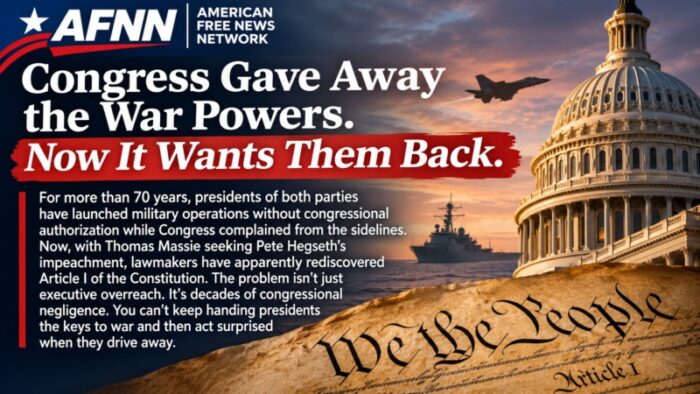
Congress has apparently discovered the Constitution. Somebody alert the Smithsonian. We may have found a document previously believed extinct.
On November 9, Republican Congressman Thomas Massie introduced eight articles of impeachment against Defense Secretary Pete Hegseth, including allegations that the administration violated the War Powers Resolution by conducting military operations against Iran without congressional authorization.
The constitutional question is legitimate. The selective outrage surrounding it is considerably less impressive.
Article I, Section 8 of the Constitution gives Congress the power to declare war. Article II makes the president commander in chief. The Founders deliberately divided these responsibilities because they understood something modern politicians routinely forget: concentrating the power to initiate and conduct war in one individual is dangerous.
Yet for more than seven decades, presidents of both political parties have stretched that division while Congress has watched from the cheap seats.
In 1950, President Harry Truman sent American troops into Korea without a congressional declaration of war or specific authorization. He relied partly on United Nations resolutions. Apparently, international approval could substitute for a vote by America’s elected representatives.
Ronald Reagan invaded Grenada in 1983 without prior congressional authorization. George H. W. Bush invaded Panama in 1989. Bill Clinton conducted a 78-day NATO bombing campaign against Yugoslavia in 1999 without a specific congressional authorization.
Then came Barack Obama and Libya in 2011. When the War Powers Resolution’s 60-day deadline became inconvenient, the administration argued that continued American involvement did not constitute the kind of hostilities covered by the law.
That was some impressive linguistic gymnastics. Apparently, dropping bombs doesn’t necessarily mean you’re participating in hostilities. Depends who’s writing the legal memorandum.
Donald Trump ordered missile strikes against Syria in 2017 and 2018 without specific congressional authorization. Joe Biden conducted strikes against Iranian-backed forces in Syria and Iraq and launched operations against the Houthis in Yemen without obtaining a new authorization.
Different presidents. Different political parties. Same constitutional argument.
To be fair, presidents possess legitimate authority to defend American forces and respond to immediate threats. Congress also authorized major conflicts, including Afghanistan in 2001 and Iraq in 2002. Not every military operation requires a formal declaration of war.
But responding to an immediate threat and conducting a sustained military campaign are not necessarily the same constitutional proposition.
Congress recognized this problem in 1973 when it passed the War Powers Resolution over Richard Nixon’s veto. The law established reporting requirements and generally requires unauthorized hostilities to end within 60 days, subject to a limited withdrawal extension.
Presidents have challenged those restrictions ever since.
And Congress? It has repeatedly demonstrated that complaining about executive overreach is easier than exercising its own constitutional authority.
Which brings us back to Massie and Hegseth.
Massie alleges constitutional violations. Hegseth disputes the accusations and defends the administration’s military operations. Those claims deserve examination on their merits, not automatic acceptance or dismissal based on party affiliation.
But there is a larger institutional problem.
Congress controls appropriations, writes laws, conducts oversight, and possesses the authority to authorize military force. Those are substantial powers, provided its members are willing to exercise them.
Instead, generations of lawmakers have tolerated expanding presidential discretion, particularly when their own party occupies the White House.
The Constitution hasn’t changed. The political willingness to enforce its boundaries has.
If Congress wants its war powers back, perhaps it should begin by consistently exercising them.
Because handing somebody the keys for seventy years and then complaining that he drove away isn’t constitutional leadership.
It’s congressional negligence.
If you enjoyed this article, then please REPOST or SHARE with others; encourage them to follow AFNN. If you’d like to become a citizen contributor for AFNN, contact us at managingeditor@afnn.us Help keep us ad-free by donating here.
Substack: American Free News Network Substack
Truth Social: @AFNN_USA
Facebook: https://m.facebook.com/afnnusa
Telegram: https://t.me/joinchat/2_-GAzcXmIRjODNh
Twitter: https://twitter.com/AfnnUsa
GETTR: https://gettr.com/user/AFNN_USA
CloutHub: @AFNN_USA