
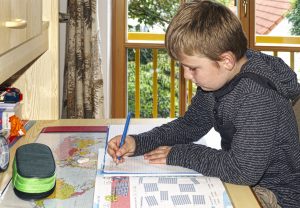
Today, I want to speak to anyone who is interested in homeschooling their children or grandchildren. Homeschooling is extremely overwhelming to begin. Don’t worry, everyone feels that way.
So, the first thing you need to do is find out about the homeschooling laws in your state. If you live in New York, Pennsylvania, Vermont, Massachusetts, or Rhode Island, I am sorry. It’ll be a bigger bother for you but it is doable. Otherwise, the regulations aren’t too onerous. Most states require you to notify the school district you live in that you will be homeschooling your children. The notification letter can differ from state to state but it’s usually pretty basic (name and grade of kid and what subjects you will teach them). Many states require standardized testing or a teacher’s evaluation at the end of the school year. By the end of your first year, you should know other homeschoolers that can tell you how the testing/evaluations work and you can decide what will be best for your family. Otherwise, check out your state’s requirements and make sure you keep copies of anything you submit to the school district.
Your next step is to consider the different methodologies of homeschooling. Homeschooling can look very different from one family to the next. Some families do their schoolwork exclusively online, some don’t use devices at all. Some families follow the schedule and structure of public schools and some have no structure whatsoever.
There are a number of different methodologies of education in the homeschool world. I will highlight the most popular. Traditional homeschooling is the most similar to regular public schooling. It entails textbooks and workbooks and sitting at a table or desk. Classical homeschooling is learning in three phases: in the grammar phase (elementary) students memorize information, in the logic phase (middle school) students begin to learn the reason behind events and information, in the rhetoric phase (high school) students learn to communicate their own thoughts and opinions. The Charlotte Mason method focuses on learning through literature and real-life experiences with a focus on nature studies. Unit Studies teach all the subjects while focusing on one theme like weather or trains, anything that piques the student’s interest. Finally, unschooling is the most untraditional method. Unschooling doesn’t look anything like public school. By eschewing textbooks of any sort and allowing the student to follow their interests, it focuses on teaching a child how to learn, not what to learn.
And most families pick and choose different aspects of these (and other!) methodologies and intermix them. Or they may change methodologies from one year to the next or from one child to the next. As a homeschool parent, I am always assessing the best way for my individual kids and for my family as a whole to “do” school. I, personally, lean toward the Charlotte Mason methodology (especially the literature and foreign languages parts) but we also do some traditional and unit study homeschooling too.
After choosing the methodology that best fits your family and your students, you need to start looking at curriculum. If the methodology part intimidated you, the curriculum options will blow your mind! Homeschooling is not Mom sitting down and writing out worksheets for her children (although it can be!!). There are a zillion different curriculum choices for homeschoolers today. Some curriculum only teaches one subject and some includes the entire set of subjects for a homeschool family. Some curriculums are free and some are over a thousand dollars for just one student. The best source for reviews of curriculum is Cathy Duffy. She does a thorough and unbiased job of explaining what the curriculum entails and delivers and where you can buy it.
After choosing the curriculum and possibly while choosing the curriculum, you should begin to reach out to other homeschoolers in your area. These homeschoolers are so important to your success in homeschooling. They can answer specific questions about homeschooling laws in your state and even how friendly your local school district is to homeschoolers (that can vary widely!). Or you can ask them for curriculum recommendations or even peruse some of their curriculum before you purchase anything yourself. They may even gift you some curriculum they aren’t using. These homeschoolers will be the ones you can ask for suggestions as problems arise in your homeschooling – whether a kid isn’t getting something or something isn’t working well in your curriculum or any number of issues that might come up.
The homeschoolers you meet can also point you toward local groups. Or you may be able to find a local group online or through Facebook or by asking around at your church. Some people join homeschool groups and some never do and many join groups for some years and not for others. Homeschool groups, like everything else, are very different. Some are basically field trip groups. Some are more formal “schools” that meet six hours a day for one to three days each week and many are somewhere between that. Some co-ops teach based on a particular methodology (like Classical). Some co-ops are free, some have a nominal fee, and some require tuition. I think of the typical “co-op” as being a parent-taught, two – three hour per week event where students are usually split into groups by grade and taught various subjects. Also, many private schools allow homeschoolers to pay to take a class or three at their schools if that option works for your family.
The co-ops that teach subjects usually focus on subjects that are more difficult to teach at home. Science, foreign language, public speaking, etc., are all difficult to learn at home with only a student or two at that level. This is where co-ops shine.
When we began homeschooling with my oldest going into kindergarten, we planned for me to do all the teaching until the kids got into the higher maths and sciences and then my husband would teach those subjects. When my husband passed away, I wondered how I would manage those courses. Now, I have found a co-op that excels at sciences and I have him take an online math program that works well for us. So, those subjects are covered and I can focus on teaching the subjects that I am good at.
Finally, it can be overwhelming to obtain resources for your homeschooling needs. For some, curriculum prices can be too much. For others, they want all the lab accessories for high school chemistry, etc. Again, this is where other homeschoolers and homeschool groups can help. If you want something for your student, chances are, some other homeschooler did too and they may now be looking to sell at a used price. Every state homeschool convention I have heard of has a used curriculum and stuff sale, where you can find all manner of used homeschool things at bargain prices. Also, one of the purposes of homeschool groups is to come together to lighten the load for everyone. If chemistry lab equipment is your desire, talk to the other parents about buying it. Or talk to local high schools, retired science teachers, and local businesses who might donate their equipment or their labs for your use.
Look around. You may be surprised what opportunities are available for your student. A homeschool friend of mine’s son has always been fascinated by robotics but neither she nor her husband knew anything about it. Amazingly, by the time her son was in middle school, a robotics program was launched in her small town. It was basically a club and available to any qualified student whether public or homeschooled. Her son has excelled in the program and is applying to colleges with an impressive resume of experience in robotics.
You have the freedom to teach your values and to focus on your student’s interests. You can include spiritual beliefs in your education. You can incorporate as much or as little technology as you want. You are also surrounded by other parents who fiercely guard their right to decide the influences in their children’s lives regarding social media or cultural influences. Most of the homeschool families I know significantly restrict their kids’ access to social media and don’t have to worry about their kids feeling pressured to be on certain sites.
Homeschooling is not a walk in the park. Being with your family constantly can be a strain, especially if you aren’t used to it. It is a financial burden and a significant strain on your time and resources. Outside commitments and activities are always trying to weasel their way in to minimize your schooling time. You have to be focused and committed to doing an excellent job in order to be successful in homeschooling. But it is worth it in so many ways.
This is the fourth article in my series on homeschooling. My previous articles covered: the importance of homeschooling, the threat that homeschooling poses to the Left, and how the Left has put a target on homeschooling. My final article tomorrow will explain how you can help.
Follow AFNN:
Facebook: https://m.facebook.com/afnnusa
Telegram: https://t.me/joinchat/2_-GAzcXmIRjODNh
Twitter: https://twitter.com/AfnnUsa
GETTR: https://gettr.com/user/AFNN_USA
CloutHub: @AFNN_USA