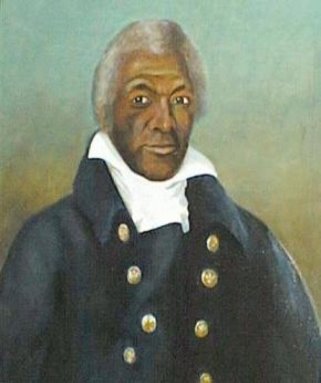
There are many issues with the teaching of American History, one of the largest is the refusal of the Education Departments to record the proven history of how black Americans contributed mightily to the founding and formation of this Nation. Yes, at the time of the Revolution, there was slavery, there was indentured servitude and there were blacks throughout the colonies who were free. Many wanted to fight to earn their freedom, others took the place of their owners, others wanted to stand and fight. It is estimated that over 20% of the Continental Line was filled with black soldiers. One such example of a great American, is James Armistead Lafayette.
Years ago, I put together a program to train Cub Scouts to be Sons of Liberty. We had re-enactors, marshmallow shooters, tri-corn hats, tomahawks and other gimmicks to allow the kids to “experience” the Revolutionary War. To add more depth, I gathered hundreds of computer files of the Revolutionary War paintings from the National Archives, printed them out and made a display. One of the kids asked me about the “slave” holding a horse with an officer seated. I explained that the Officer was Lafayette, and that the black man was not a slave for he was armed. I researched the painting and found the story of James Armistead.
James Armistead is responsible for winning the American Revolution! One would think that fact would be taught throughout the land, that a slave volunteered to serve and fight for freedom. Imagine the kids that would be empowered, knowing that persons of all colors were responsible for the fabric of America, serving as free men to a higher cause. But that seldom happens, so let us turn on a light.
This missive has three components: a slave, a traitor and the rule of law. The slave is James Armistead of Virginia, the traitor is Benedict Arnold and the Rule of Law concerns slavery.
In late 1780, General Lafayette was sent to Virginia with a small force of light infantry to find Benedict Arnold and return him for punishment. Arnold was to be hung for his role in the overthrow of West Point and the capture of Washington. Arnold failed, but he was a traitor to the cause.
In May of 1781, forces of Cornwallis started gathering in Virginia, particularly in Portsmouth. Cornwallis was tasked with finding a suitable port for the British Navy which was free of ice and snow. Lafayette was to shadow Cornwallis and determine his plans. During this time, Lafayette met James Armistead. It might have been a scene from the movie “Patriot” with Mel Gibson, where Yackum made his mark to serve the cause. We do not know. We do know that Lafayette and Armistead became trusted friends.
Lafayette needed information, so he asked Armistead to become a spy and infiltrate the British lines. It should be noted that Governor Lord Dunmore of Virginia, issued a directive to “free” all slaves willing to fight for the British, shortly before sailing to England in 1775. As such, Lafayette believed it reasonable that Armistead would be accepted by the British.
Indeed, Cornwallis believed the story of Armistead, the runaway slave. Armistead became a trusted friend of Cornwallis, leading patrols through the Portsmouth area. Armistead became the head servant to many of the British commanders, resulting in him being privy to utmost secrets.
Cornwallis needed reports on the Americans, so he asked Armistead to spy for the British. Thus began months of back and forth between the lines, delivering secrets to Lafayette and lies to Cornwallis.
In late July 1781, Lafayette sent a letter to Washington outlining the situation in Portsmouth. A few ships remained, but the baggage of Cornwallis had not been taken ashore, something was happening. In early August, Lafayette was informed that Cornwallis was at Yorktown with part of the British fleet. Lafayette sent word to the French ambassador that “If the French army could all of a sudden arrive in Virginia supported by a squadron, we would do some very good things.”
Later in August, Lafayette sent a letter to Washington requesting the American and French armies meet in Virginia with the French navy. The objective was Yorktown.
It turned out that Washington, the French and the fleet had just started to Virginia, probably due to the amount on intel from the Virginia peninsula. 9,000 American troops marched 430 miles, while 7,000 French troops marched 570 miles arriving mid-September without being detected by General Clinton or British spies. The French fleet had sailed from the West Indies to block the Chesapeake Bay entrance. The trap was sprung, Cornwallis was surrounded. Cornwallis was outnumbered, outgunned and outsmarted. He surrendered on October 19th, 1781.
How did it happen? History does not record all the reports, but someone kept Cornwallis at ease. I believe it was Armistead. In his memoirs after the war, Benedict Arnold remarks that he urged Cornwallis to abandon Yorktown, as it could become a trap. But Cornwallis did not trust Arnold, for Arnold had sold out his native country. Cornwallis did trust Armistead, for Armistead was fighting for his freedom as a slave.
Following the end of the war, many black soldiers were given freedom and land grants for service, but not James Armistead. The statue for freedom stated that one needed to fight as a soldier. Armistead was not a soldier, he was a spy, so he did not qualify for freedom.
The Rule of Law was being followed; however, the Rule of Law had an appeal provision. Armistead asked the Marquis de Lafayette for a letter of recommendation. Lafayette agreed, writing a personal letter to the House of Delegates in Virginia:
This is to Certify that the Bearer by the Name of James Has done Essential Services to Me While I Had the Honor to Command in this State. His Intelligence from the Enemy’s Camp were Industriously Collected and Most Faithfully deliver’d. He perfectly Acquitted Himself With Some Important Commissions I Gave Him and Appears to me Entitled to Every reward his Situation Can Admit of.” Done under my hand, Richmond November 21st 1784– Lafayette
James Armistead took this letter and petitioned The General Assembly, but before a final opinion, they adjourned. Armistead applied again in November 1786. The House of Delegates made James Armistead a free man on Christmas Day 1786. For five years, Armistead followed the Rule of Law, knowing that his owner, a member of the House, wanted him free as well.
Later in life, Armistead took the last name Lafayette. In 1824, James was attending a parade honoring Lafayette during his United States tour. Lafayette saw the aging Armistead and halted the parade. He disembarked from his carriage and worked his way thru the crowd. The two warriors embraced and spoke a few words. Two aging men responsible for the freedom of America departed back to their own worlds.
Tom Weaver, Patriot
If you enjoyed this article, then please REPOST or SHARE with others; encourage them to follow AFNN
Truth Social: @AFNN_USA
Facebook: https://m.facebook.com/afnnusa
Telegram: https://t.me/joinchat/2_-GAzcXmIRjODNh
Twitter: https://twitter.com/AfnnUsa
GETTR: https://gettr.com/user/AFNN_USA
Parler: https://parler.com/AFNNUSA
CloutHub: @AFNN_USA