
With the 2024 presidential election less than six months away, squabbles about how Americans elect their president have begun anew.
For those who may have forgotten what they learned in civics classes (if indeed, anybody still learns about civics in today’s schools) presidential elections consist of both a popular vote and an electoral college.
The Founding Fathers created the Electoral College as a compromise between electing the president via a vote in Congress or a popular vote only.
On one side were those who feared a popular vote would result in the “tyranny of the majority.” They argued that the presidential election needed to be safeguarded against uninformed or uneducated voters by putting the final decision in the hands of electors who were most likely to possess the information necessary to make the best decision in a time when news was not widely disseminated.
Those on the other side felt that allowing only a few people in Congress to vote for the president would result in a privileged class selecting the president. They argued that made the president more of a potentate or sovereign and less of a president legitimately elected by the people.
The compromise between these two views was the Electoral College, which contains 538 electors. Each state is allowed one elector for each Representative in the House and for each Senator in the Senate, with the exception of Washington DC, which is allowed a total of three electors as established by the Twenty-Third Amendment.
That means the most populous states, such as California or Texas, have more electoral votes than less populous states, such as Montana or Wyoming.
Check out this map, which shows how many electors each of the 50 states have in 2024.

At first glance, it seems the founding fathers arrived at a logical and workable compromise by creating the Electoral College.
Not so fast, say critics who hate that a candidate can win the popular vote but still lose the election if he or she does not get a minimum of 270 electoral votes.
They argue that the Electoral College essentially nullifies the popular vote and that the fairest way is to allow one vote for one person when it comes to choosing a new president.
Most recently, the debate over the continued use of the Electoral College resurfaced during the 2016 presidential election, when Donald Trump lost the general election to Hillary Clinton by over 2.8 million votes and won the Electoral College by 74 votes.
The official general election results show that Trump received 304 Electoral College votes and 46.09% of the popular vote (62,984,825 votes), and Hillary Clinton received 227 Electoral College votes and 48.18% of the popular vote (65,853,516 votes).
Prior to the 2016 election, there were four times in US history when a candidate won the presidency despite losing the popular vote: (1) 1824 (John Quincy Adams over Andrew Jackson); (2) 1876 (Rutherford B. Hayes over Samuel Tilden), (3) 1888 (Benjamin Harrison over Grover Cleveland), and (4) 2000 (George W. Bush over Al Gore).
In some 230 years of our nation’s history, the popular vote winner has lost the electoral vote only five times in some 50 presidential elections.
Supporters insist that proves the system is working. They argue that the Electoral College was created to protect the voices of the minority from being overwhelmed by the majority’s will. They insist that if the election depended solely on the popular vote, then candidates could limit campaigning to heavily populated areas or specific regions. To win the election, presidential candidates need electoral votes from multiple regions, and therefore, they build campaign platforms with a national focus, meaning that the winner will actually be serving the needs of the entire country.
Tina Mulally, a South Dakota House of Representatives member, recently declared that the Electoral College protects small states like South Dakota and that a national popular vote would be “like two wolves and a sheep deciding what’s for dinner.”
She introduced a resolution passed by South Dakota’s legislature: “The current Electoral College system creates a needed balance between rural and urban interests and ensures that the winning candidate has support from multiple regions of the country.”
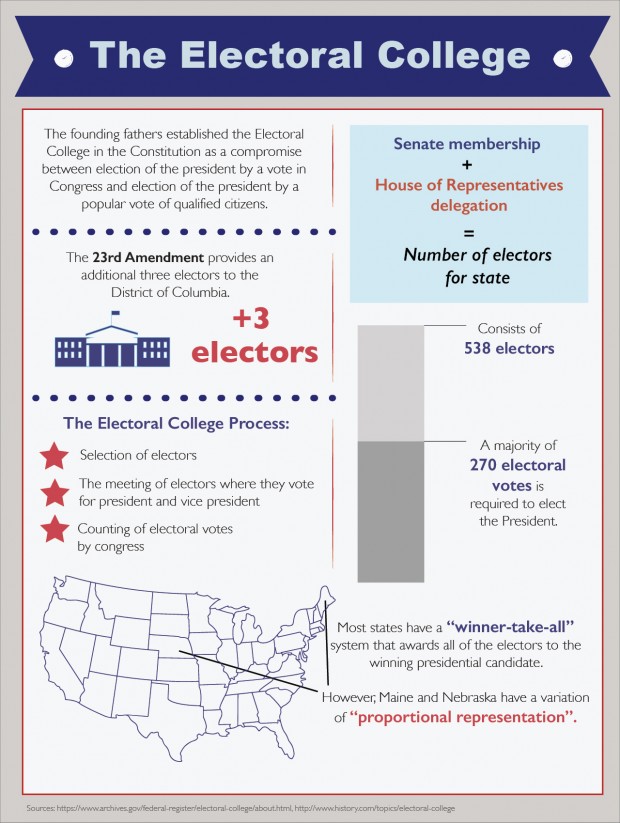
Abolishing the Electoral College completely would require a constitutional amendment involving two-thirds approval from both houses of Congress and approval by 38 states – a process very unlikely to happen in today’s highly partisan environment.
Despite that legal obstacle, there is an ongoing movement at the state level to end the Electoral College system in national elections and replace it with a popular vote. Currently, 17 states and the District of Columbia support the proposed change, but fewer than 38 states required to pass a constitutional amendment.
Given that obstacle, a few states are embracing a new plan to create a binding national popular vote for president without amending the Constitution. That plan is called the National Popular Vote Interstate Compact. It was created by Stanford University computer science professor John Koza. The idea is to award each state’s electoral votes to the national popular vote instead of the state popular vote winner.
The Koza proposal has gained support in 10 states and the District of Columbia. However, these states and Washington D.C. are all strongly blue, and most states controlled by Republicans do not support the change.
The plan eliminates the Electoral College and the reasons for its existence by simply bypassing it.
So the presidential election of 2024 will, without a doubt, be decided by whomever collects the most votes in the Electoral College.
The Founding Fathers seem to have devised a reliable and equitable procedure for determining who wins the presidency.
It’s worked for more than 200 years. Why change it?
–30–
(Ronald E. Yates is a U.S. Army veteran, an author, a former Chicago Tribune foreign correspondent, and Professor and dean Emeritus of Journalism at the University of Illinois.)
His website: http://www.ronaldyatesbooks.com/
If you enjoyed this article, then please REPOST or SHARE with others; encourage them to follow AFNN. If you’d like to become a citizen contributor for AFNN, contact us at managingeditor@afnn.us Help keep us ad-free by donating here.
Substack: American Free News Network Substack
Truth Social: @AFNN_USA
Facebook: https://m.facebook.com/afnnusa
Telegram: https://t.me/joinchat/2_-GAzcXmIRjODNh
Twitter: https://twitter.com/AfnnUsa
GETTR: https://gettr.com/user/AFNN_USA
CloutHub: @AFNN_USA
Patriot.Online: @AFNN
The Electoral College has saved the republic twice this century, in 2000 and 2016.
We can only hope that the Electoral College saves our republic again in November–especially now that the Democrats have imported another 11-12 million voters since Biden stole the White House in 2020.