
It’s been half a century since John Gall published Systemantics: How Systems Work and Especially How They Fail, and guess what? Everything he predicted has come true—spectacularly. If Gall were alive today, he’d probably be sipping his coffee, shaking his head at modern society, and saying, “Told you so.” His humorous yet scathing critique of systems—that they inevitably grow beyond their purpose, fail spectacularly, and often end up serving themselves—has aged like fine wine. Or maybe more like fine irony, because we’ve spent the last fifty years proving him right. The man was essentially the Atlas Shrugged of systems theory: Ayn Rand wrote about the collapse of economies; Gall chronicled the collapse of everything else.
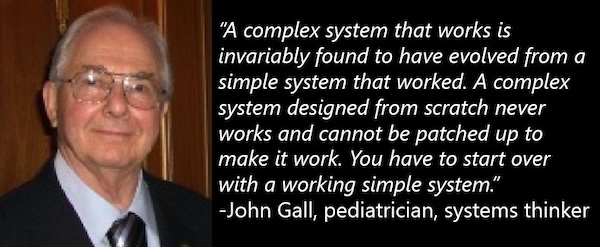
Let’s start with Gall’s first big “law”: systems always grow in complexity until they no longer serve their original purpose. Sound familiar? Look no further than modern healthcare. What was once a simple process of doctor-heals-patient has ballooned into an oppressive nightmare of insurance codes, endless paperwork, and administrative bloat. Want to see a specialist? Better bring three forms of ID, a notarized letter, and at least four hours of your life to burn. Somewhere, John Gall is laughing as he points out that the system now exists primarily to perpetuate itself, not to help you.
Then there’s Gall’s second prophecy: systems fail in the most gloriously unexpected ways. Remember when Facebook was just about poking your friends and sharing pictures of your dog? Fast-forward to today, and we’ve got social media algorithms weaponizing political polarization and spreading misinformation faster than you can say, “deepfake.” Gall warned us about this: the unintended consequences of any system are usually more impactful than the intended ones. Facebook was supposed to bring the world together. Instead, it gave us the great tribal divide and a front-row seat to our own societal implosion. Nice work, Zuck.
Gall’s influence can even be found in our Atlas Shrugged-style economic absurdities. Ayn Rand imagined a dystopian world where overregulation and self-serving bureaucracies destroy innovation. Gall simply explained how it actually works. Exhibit A: modern government programs. From stimulus checks sent to dead people to public transit projects that run decades over schedule and billions over budget, Gall’s principle that systems often become an exercise in their own inefficiency couldn’t be clearer. The real kicker? No one in charge ever seems surprised when these failures happen. It’s almost like they planned it this way. (Cue conspiracy theorists whispering “deep state.”)
Ultimately, the past fifty years have done nothing but confirm Gall’s theory: we’re really bad at designing systems, and once they’re in place, they seem to evolve into monsters of inefficiency. Whether it’s education, healthcare, or technology, systems continue to grow, fail, and self-perpetuate exactly as Gall predicted. At least we can laugh about it—because if we didn’t, we’d have to cry. Gall wasn’t just a systems theorist; he was a reluctant prophet of dysfunction. And as the world keeps proving him right, you can almost hear him in the distance, muttering, “Good luck fixing this mess.”
If you enjoyed this article, then please REPOST or SHARE with others; encourage them to follow AFNN. If you’d like to become a citizen contributor for AFNN, contact us at managingeditor@afnn.us Help keep us ad-free by donating here.
Substack: American Free News Network Substack
Truth Social: https://truthsocial.com/@AFNN_USA
Facebook: https://m.facebook.com/afnnusa
Telegram: https://t.me/joinchat/2_-GAzcXmIRjODNh
Twitter: https://twitter.com/AfnnUsa
GETTR: https://gettr.com/user/AFNN_USA
CloutHub: @AFNN_USA