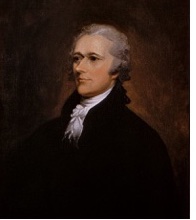
Editors Note: The major purpose of American Free News Network, is education; education on American Civics and how our government is supposed to work. John Parillo has put forth a stellar effort to explain not only what the Framers did when they wrote our Constitution, but why.
Ed
Continuing with the discussion of the impeachment process that was started in Federalist 65, Hamilton addresses the concern that having the Senate act as court for the proceedings violates the principle of separation of powers. The Founders were careful to minimize the role of the Executive to the enforcement of laws, the Congress to the writing of laws, and the Judiciary to the interpretation of laws. To be certain, each branch overlaps the others as well.
The Executive influences law by virtue of its veto authority and the Judiciary by ensuring that no law violates the principles set forth in the Constitution. In the case of impeachment, the entire authority lies within the legislative branch. This power is split within the legislative branch between the House and Senate and Hamilton addresses this decision here.
The separation of impeachment authority prevents any group of people from being both accuser and judge and “and guards against the danger of persecution, from the prevalency of a factious spirit in either of those branches.”[1] Furthermore the two thirds requirement in the Senate, presumably the more mature body, is yet another “security to innocence”. In this process as well as in criminal proceedings for individual citizens, the Founders stacked the deck on behalf of the defendant. Hamilton points out that the state Senate, the state supreme court, and the chancellor of the state hold all the power for impeachment in his home state of New York, and yet they were objecting to this much more measured process.
The second objection to the Senate’s impeachment power is that it is, along with their role in approving treaties, the concentration of too much power in one body. That power, as well as the fact that Senators are not elected by the people, give it something of an aristocratic flavor. But the Senate is limited in its legislative power in that the House is responsible for “originating money bills”. This safeguard has been eroded over time. While the Senate acts as the judge and jury in the case of impeachment, it cannot initiate the process. It falls upon the President to select judges and ambassadors, and the Senate’s role is limited to advice and consent.
A last objection is that since the President and the Senate work together to make treaties, if they were to join the “Executive in betraying the interests of the nation in a ruinous treaty, what prospect, it is asked, would there be of their being made to suffer the punishment they would deserve”? Hamilton dismisses this concern by pointing out that the two thirds Senate requirement for treaty approval would make that hypothetical unlikely.
As to the possibility that the impeachment could be used against the entire “House of Representatives, sacrificing the interests of the society by an unjust and tyrannical act of legislation”, Hamilton argues against such “punishment for acts done in a collective capacity” and goes on to point out that “security to the society must depend on the care which is taken to confide the trust to proper hands”. In other words, it is up to us to choose our leaders carefully or else we risk no less than the security of our society.
Indeed.
- All quotes are from https://guides.loc.gov/federalist-papers/text-61-70 ↑
To read all of John Parillo’s work on the Federalist Papers, check here.
If you enjoyed this article, then please REPOST or SHARE with others; encourage them to follow AFNN. If you’d like to become a citizen contributor for AFNN, contact us at managingeditor@afnn.us Help keep us ad-free by donating here.
Substack: American Free News Network Substack
Truth Social: @AFNN_USA
Facebook: https://m.facebook.com/afnnusa
Telegram: https://t.me/joinchat/2_-GAzcXmIRjODNh
Twitter: https://twitter.com/AfnnUsa
GETTR: https://gettr.com/user/AFNN_USA
CloutHub: @AFNN_USA
The idea that the US Senate is a more mature “body” disappeared with the passage of the 17th Amendment. With a publicly elected Senate; the electees (Senators) are extremely susceptible to the power of money and the lobby. This has also created a quasi permanent hierarchy and even power brokering. Sans the 17th Amendment; Senators represented the States as they should. Maturity in a body would make it more deliberative; which the current body is not. Some of the Senators are there just to collect a paycheck and do nothing.
Excellent response. Personally, I favor the direct elections of Senators rather than them being chosen behind closed doors. The diminution of the Senate has more to do with the folks elected than the selection process. If they wanted to maintain “distinguished elder” status it would be easy to so do. They choose to not act that way. That can of worms is open and it is too bad.
I agree Gul,
And we addressed the folly of the 17th amendment here
https://afnn.us/2022/05/15/federalist-59/
With our current situation, one without federal law being followed – an Invasion, Fraudulent Elections, an unrestrained Executive, an Absent Congress, the defects in our system are apparent. What was written in the Federalist Papers matters not for a Constitution that left out the People’s Ultimate Control short of following the Declaration of Independence again.
The Constitution is not a Bible ! Our federal system has been under going distortions for over ten decades regardless of it. We inherent something we did not consent to. We hold less sway over its continuance each year. I could go on.
Truth of our precarious era reveals the structural deficiencies so much, the phrase “It is against Federal Law to use this product inconsistent with its labeling.” needs to be amended to it.