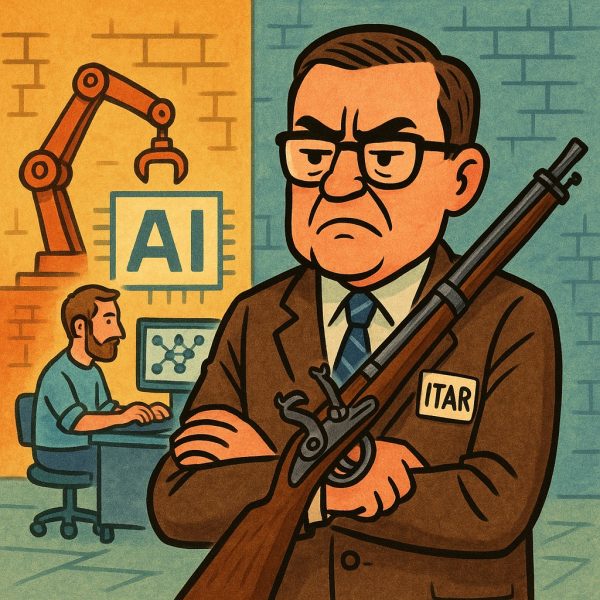
Let’s start with the basics: ITAR — the International Traffic in Arms Regulations — was created in the 1970s to stop Soviet spies from sneaking American missiles out in suitcases. It made sense back then. The battlefield was tanks, jets, rifles, and radios. Power was measured in steel and gunpowder.
Fast-forward fifty years, and our government is still treating the musket like it’s the atom bomb. You can’t ship a thermal scope overseas without a mountain of paperwork. You can’t sell night vision to a Canadian trapper without the State Department breathing down your neck. But you can ship AI training clusters, autonomous drone software, and quantum chips to foreign labs with barely a hiccup in customs.
That’s the logical mismatch: Washington is guarding the past while the future walks right out the front door.
The Old Guard
ITAR is supposed to “protect national security” by keeping defense technology out of foreign hands. Fair enough. But look at what it actually covers:
• Thermal optics
• Night-vision scopes
• Precision triggers
• Ballistic computers
• And, yes, the occasional tank part
Meanwhile, the real weapons of the 21st century — data, code, chips, and algorithms — are traded like candy bars. We’ve built a wall around the barn, but the herd’s been grazing in the cloud for years.
The New Battlefield
The most dangerous weapons today aren’t bullets. They’re bits.
A supercomputer trained on the right data can cripple power grids, fly swarms of autonomous drones, or write propaganda better than any spy ever could.
But our laws? They’re built for hardware — for things you can drop, kick, or shoot. The same government that treats a $2,000 thermal sight like a state secret lets $20 billion worth of AI chips cross oceans without blinking. It’s as if we’re frisking the drummer while the bank robber loads the van.
Why It’s Broken
Three reasons:
1. Bureaucratic inertia. It’s easy to regulate what you can see. ITAR was written when “cyber” still meant “wires.”
2. Corporate greed. Big Tech doesn’t want export limits on its golden goose. AI and chips are global cash cows, so Congress stays quiet.
3. Short-term thinking. We’ve decided to sell the blueprints for tomorrow to keep Wall Street happy today.
It’s all business — until the code we exported comes back weaponized against us.
The Grand Irony
We’ve built laws that make it illegal to share a rifle scope with a Canadian friend, yet we train foreign students in quantum computing and AI weapons modeling at our best universities — legally.
ITAR guards the physical trigger.
EAR (its weak-sister counterpart) lets the digital trigger float freely.
And when the next war is fought in code, not cartridges, we’ll realize we spent fifty years guarding the wrong door.
Conclusion
America still thinks in gunpowder while the world fights in gigabytes.
We protect the rifles, but export the algorithms.
We restrict scopes, but sell the satellites.
We guard the iron, but give away the intellect.
It’s like standing at the drawbridge with a sword while the enemy flies drones overhead.
The truth? ITAR isn’t bad — it’s just obsolete. We need a Digital ITAR for the new age, one that protects the code, chips, and data that actually define power today.
Until then, we’re just guarding muskets in a world run by machines.
If you enjoyed this article, then please REPOST or SHARE with others; encourage them to follow AFNN. If you’d like to become a citizen contributor for AFNN, contact us at managingeditor@afnn.us Help keep us ad-free by donating here.
Substack: American Free News Network Substack
Truth Social: @AFNN_USA
Facebook: https://m.facebook.com/afnnusa
Telegram: https://t.me/joinchat/2_-GAzcXmIRjODNh
Twitter: https://twitter.com/AfnnUsa
GETTR: https://gettr.com/user/AFNN_USA
CloutHub: @AFNN_USA