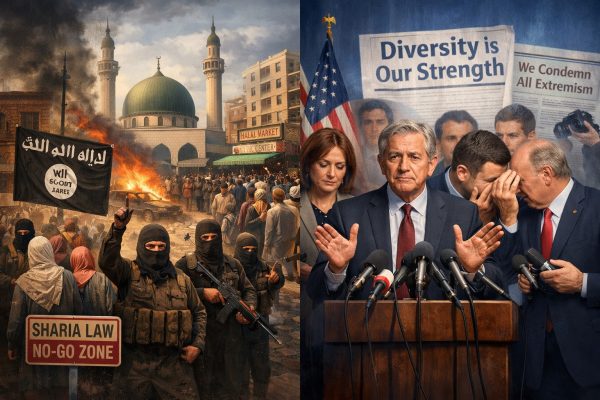
The West is not fighting radical Islamism—and that is precisely why it is losing. While Islamist movements wage a long war measured in generations, demographics, and ideological endurance, Western politicians fight short wars measured in polling data, donor pressure, and media optics. One side plans for the future. The other is terrified of the present. History is unforgiving to civilizations that confuse denial with virtue.
Radical Islamist movements are not improvising. They are not reacting randomly to Western policy, nor are they simply another flavor of extremism. They are rooted in a coherent political-religious ideology with law, governance, social discipline, and a clear understanding of time. Groups across the Islamist spectrum have written openly about gradualism: advancing influence patiently through culture, institutions, intimidation, and legal pressure rather than immediate conquest. Violence is a tool—but often the punctuation mark, not the sentence.
Western leaders know this. Intelligence services have documented it for decades. Yet politicians refuse to say it plainly, because naming the ideology creates immediate political risk. So instead we get euphemisms: “all extremism,” “isolated actors,” “community tensions.” The ideology disappears from official language even when it is central to the act. This is not ignorance; it is risk avoidance dressed up as prudence.
That dishonesty carries a cost.
When attackers explicitly invoke religious-political slogans, officials rush to explain why those words don’t mean what they obviously mean. When intimidation shuts down speech, art, or public life, authorities frame it as “sensitivity” rather than coercion. When fear produces self-censorship, leaders praise tolerance instead of enforcing the law. Each time, the message to radicals is the same: pressure works.
Assimilation used to be the West’s quiet strength. Immigrants were welcomed, but the expectation was clear—learn the language, obey the law, accept the civic order. Today, that expectation is treated as offensive. Assimilation has been replaced with “coexistence,” even when coexistence means parallel norms that undermine equal law, free speech, and women’s rights. This isn’t inclusion; it’s fragmentation.
Europe has lived with the results for years. Authorities under-policed sensitive areas, downplayed organized exploitation, and ignored intimidation because confronting it risked accusations of bigotry. Scandals that should have been stopped early metastasized because officials chose reputation management over enforcement. Each episode was explained as an exception. Together, they form a pattern of institutional retreat.
Demography amplifies that retreat. Islamist movements think in generational terms—family, fertility, inheritance, social pressure. Western governments rarely do. Immigration is treated as a humanitarian gesture or an economic lever, not a civilizational question of scale, integration capacity, and long-term cohesion. Large inflows are absorbed into already-fragile neighborhoods without the requirements or resources to integrate them. Time does the rest.
Politicians avoid this conversation because it forces uncomfortable tradeoffs. Enforcing the law evenly means confronting intimidation. Limiting migration means saying no. Demanding assimilation means asserting that a host culture exists and matters. Each action carries short-term political costs, so each is postponed—until the costs compound.
Radical Islamists do not have this problem. They are not constrained by elections, donor cycles, or reputational panic. They can afford patience. They can lose battles and still win the war, because they understand that intimidation, silence, and delay are victories in themselves.
The West keeps telling itself that refusing to name the problem is the same as solving it. It is not. It is surrender by bureaucracy.
This is not a war against Muslims. Millions of Muslims live peacefully in Western societies and want the same security and freedom as everyone else. But pretending that an explicitly political, expansionist ideology does not exist—or that it is morally equivalent to every other fringe belief—is strategic malpractice. It hands the advantage to those who are honest about their goals while we argue about vocabulary.
Civilizations do not collapse because they are conquered overnight. They collapse because their leaders lose the will to defend the rules that made them successful. The long war is not being won with bombs or ballots alone. It is being won through denial, delay, and cowardice at the top.
And every year we refuse to fight it honestly, the price of doing so rises—quietly, predictably, and relentlessly.
If you enjoyed this article, then please REPOST or SHARE with others; encourage them to follow AFNN. If you’d like to become a citizen contributor for AFNN, contact us at managingeditor@afnn.us Help keep us ad-free by donating here.
Substack: American Free News Network Substack
Truth Social: @AFNN_USA
Facebook: https://m.facebook.com/afnnusa
Telegram: https://t.me/joinchat/2_-GAzcXmIRjODNh
Twitter: https://twitter.com/AfnnUsa
GETTR: https://gettr.com/user/AFNN_USA
CloutHub: @AFNN_USA