My state Senator runs a column in our local paper every month, updating her constituents on Idaho government business. In her most recent article, she explained that the big topic in this year’s legislative session is: Who runs Idaho, Idahoans, or Washington D.C.? I suspect it’s a question every state is wrestling with now. I find the debate rather karmic, considering that all 50 states have spent the last century surrendering their ability to govern themselves.
For the first 125 years of our republic, the states had a role in federal legislation. The House of Representatives was designed to represent the people, and the Senate was designed to represent the states – with Senators appointed by state legislatures. But the states gave up their seat at the Congressional table in 1913 when they ratified the 17th Amendment. Now Senators are chosen by, and represent, the people, not the states. That was the first blow to state control over state business.
A second blow came in 1942 with a Supreme Court decision. Article I, Section 8, Clause 3 of the Constitution authorizes Congress to regulate interstate commerce – commerce which crosses state lines. But in Wickard v. Filburn, the Supreme Court did a novel re-interpretation of “interstate.” They decided that “interstate commerce” wasn’t limited to business happening across state lines – it also included business that could happen across state lines. They ruled that the federal government could regulate Roscoe Filburn’s wheat production, even though he only produced it for his own use. He wasn’t selling it across state lines, but since he could, the court held that he was subject interstate commerce regulation.
Oh Nellie! Did that open the flood gates for federal tampering with state business.
Article I of the Constitution gives Congress the enumerated power of legislation – which it has used aggressively, absent state involvement (see Article 17). Its legislative overreach has been facilitated by binding judicial re-interpretation of the Constitution.
Now:
- The Environmental Protection Agency controls what products we can produce and sell.
- The Department of Education controls what we teach in school.
- The US Department of Agriculture controls our farming.
- The Department of Health and Human Services controls our medical care.
- The Department of the Treasury controls our banking.
- The Department of the Interior controls our land.
- The Department of Energy controls our electricity.
- The Department of Labor controls our employment relations.
- The Department of Transportation controls our movement.
- The Department of Housing and Urban Development controls our home financing.
In 2012, the Supreme Court even undercut state law enforcement. In Arizona v. United States, they ruled that even if a President creates chaos in a state (refusal to enforce immigration law), the state is prohibited from taking corrective action.
The ultimate test of state rights came in 2020. In response to a pandemic, the federal government ordered businesses, schools, and even churches closed.
Given all the above, what part of any state, is the state in control of? Not much, I would say.
While they debate state sovereignty, our legislature is pointing at the 10th Amendment – the amendment that gives power to the states and the people. But the 10th Amendment is not the final word on state rights. It has been changed by 237 years of legislation and judicial interpretation.
If any state would like to control themselves, it will take more than pointing at the 10th Amendment. It will require action to legally reestablish the state authorities which have been surrendered for the past century.
If the states want a seat at the federal legislative table, it will take an amendment.
If the states want to override horrendous judicial interpretations, they can hope the court changes its mind, or they can impose an amendment.
If the states want the ability to nullify regulatory overreach, they can hope Congress starts self-limiting, or they can impose an amendment.
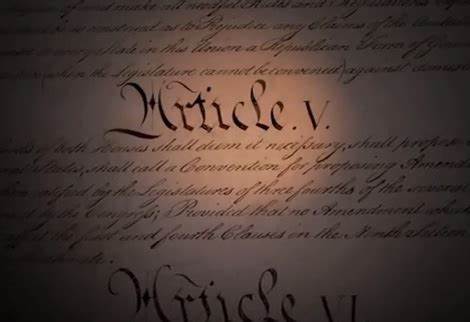
The second clause of Article V provides the states with a means to initiate the amendment process, without Congress’ consent. It simply requires 34 states to band together, asserting their authority over Washington, by calling for an Article V convention. So far, 19 states have joined the convention of states coalition.
Unfortunately, my state (Idaho) has voted “no” to joining the coalition in each of its last two legislative sessions. I find it ironic that the Idaho legislature is demanding that Washington leave us alone, while refusing to participate in any action to back up such a demand. Unfortunately, we’re not alone.
Author Bio: John Green is a retired engineer and political refugee from Minnesota, now residing in Idaho. He spent his career designing complex defense systems, developing high performance organizations, and doing corporate strategic planning. He is a contributor to American Thinker, The American Spectator, and the American Free News Network. He can be reached at greenjeg@gmail.com.
If you enjoyed this article, then please REPOST or SHARE with others; encourage them to follow AFNN. If you’d like to become a citizen contributor for AFNN, contact us at managingeditor@afnn.us Help keep us ad-free by donating here.
Substack: American Free News Network Substack
Truth Social: @AFNN_USA
Facebook: https://m.facebook.com/afnnusa
Telegram: https://t.me/joinchat/2_-GAzcXmIRjODNh
Twitter: https://twitter.com/AfnnUsa
GETTR: https://gettr.com/u