If you want to understand why the Balkans keep bleeding, stop pretending it’s complicated. It isn’t. It’s brutal, repetitive, and human. The story begins in 1054 with the Great Schism, when Christianity split into Roman Catholicism in the West and Eastern Orthodoxy in the East. That theological divorce hardened into culture, language, law, and loyalty. The Balkans sat right on the fault line. They didn’t get to choose a side. They became the seam where civilizations ripped each other apart.
Fast-forward a few centuries and the Ottoman Empire arrives, bringing Islam, imperial rule, and a governing system that didn’t erase Christian identity—it weaponized it. Faith became legal status. Conversion meant privilege. Refusal meant taxes, humiliation, or worse. And sometimes worse meant spectacle. Power didn’t just kill; it taught lessons.
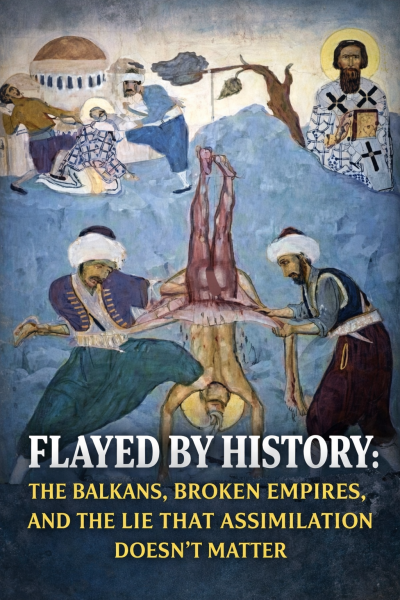
That’s where Bishop Teodor of Vršac enters the story. In the late 1500s, he backed the Banat Uprising—an Orthodox revolt that mixed faith, identity, and survival against Ottoman authority. When the rebellion failed, mercy was not on the menu. Teodor wasn’t quietly executed. He was flayed alive. Skin peeled from flesh, publicly, deliberately. Not because the Ottomans were uniquely evil for their time, but because empires understand symbolism. You don’t flay a man to punish him. You flay him to terrify everyone who remembers him.
A painting of that execution still hangs in Serbia today. It’s not there for shock value. It’s there because when courts don’t record crimes, memory does. When institutions fail, art becomes testimony. The exposed muscle isn’t gore—it’s a receipt. This is what unchecked power looks like. This is the cost of refusing to submit. And the Balkans never forgot.
That’s the part modern commentators miss when they wave away Balkan violence as “ancient hatreds.” These weren’t abstract grudges. They were lived systems. For centuries, the region was ruled by empires that never integrated their subjects into a shared civic identity. Catholic Croats looked west to Rome and Vienna. Orthodox Serbs looked east to Constantinople and Moscow. Muslim communities were tied to Ottoman structures. Religion wasn’t just belief; it was citizenship, law, and survival. Identity was not optional. It was inherited like debt.
Then nationalism arrived in the 19th century and made everything worse. When empires weakened, people didn’t suddenly become liberal individualists. They reached for the only identity that had endured: tribe, faith, memory. Borders were drawn with rulers in distant capitals, not with consent on the ground. Villages were mixed. Loyalties were not. Violence followed predictably.
Yugoslavia tried to freeze all of this under socialism. Tito didn’t solve identity; he put it in a pressure cooker. Religion was suppressed, nationalism was scolded, history was silenced. It worked—until it didn’t. When the state weakened in the 1990s, identity didn’t politely reemerge. It detonated. The wars followed the same ancient fault lines, almost embarrassingly so. Orthodox, Catholic, Muslim—again. Same map, new rifles.
Now here’s the uncomfortable part modern Western societies don’t want to hear.
We are importing people from regions shaped by this history and pretending assimilation is optional. It isn’t. Multicultural states without shared legitimacy fracture. That’s not ideology—it’s historical observation. Suppressing identity doesn’t erase it. Ignoring it doesn’t neutralize it. When institutions fail, people fall back on tribe, faith, and memory every single time.
The Balkans prove this over and over. You can’t build a stable society where groups live side by side but answer to different moral authorities, historical narratives, and loyalties. That doesn’t produce diversity. It produces parallel societies waiting for stress.
The United States used to understand assimilation instinctively. Come here, keep your food, your music, your holidays—but adopt the civic culture. Shared law. Shared norms. Shared loyalty. That wasn’t cruelty. It was glue. Now we pretend that expecting newcomers to adapt is oppression, while history screams the opposite lesson.
Bishop Teodor wasn’t flayed because he was different. He was flayed because he refused to dissolve his identity into an empire that offered coexistence without equality. The lesson isn’t about hatred. It’s about cost. Societies that refuse to demand a shared culture don’t become enlightened. They become Balkanized.
The Balkans are not a relic of the past. They are a preview of what happens when identity outlives institutions—and no one is brave enough to say assimilation matters until it’s far too late.
If you enjoyed this article, then please REPOST or SHARE with others; encourage them to follow AFNN. If you’d like to become a citizen contributor for AFNN, contact us at managingeditor@afnn.us Help keep us ad-free by donating here.
Substack: American Free News Network Substack
Truth Social: @AFNN_USA
Facebook: https://m.facebook.com/afnnusa
Telegram: https://t.me/joinchat/2_-GAzcXmIRjODNh
Twitter: https://twitter.com/AfnnUsa
GETTR: https://gettr.com/user/AFNN_USA
CloutHub: @AFNN_USA