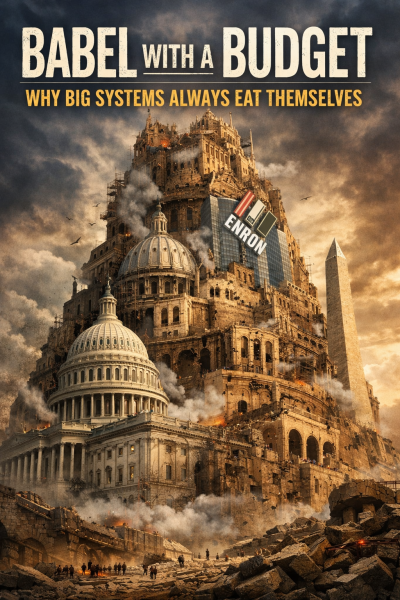
Every generation rediscovers the same uncomfortable truth and then immediately ignores it: certain human things do not scale.
Trust doesn’t scale.
Wisdom doesn’t scale.
Moral courage definitely doesn’t scale.
But paperwork? Paperwork scales beautifully.
So we keep building Towers of Babel—just with better branding, larger budgets, and more acronyms. Corporations, governments, military bureaucracies, international institutions—all convinced that if we just add one more layer, one more committee, one more compliance office, the tower will finally reach heaven.
Spoiler alert: it never does.
The biblical Tower of Babel wasn’t about architecture. It was about centralization of power without humility, unity without accountability, and ambition without restraint. Humans decided they could engineer permanence, meaning, and control—so God didn’t smite the bricks. He confused the people. Because the real failure point was never the structure. It was the humans inside it.
Modern bureaucracy proves that lesson daily.
Bureaucracies begin with noble intentions. Coordination is necessary. Systems are useful. Procedures prevent chaos. But somewhere between “helping the mission” and “protecting the mission,” the system mutates. Its primary function quietly changes.
The modern bureaucracy has two core objectives:
Preserve your position in the machine
Preserve the machine itself
Everything else is negotiable.
This is how mission statements become wall art. This is how failure gets rewarded with promotion. This is how truth becomes “unhelpful,” “untimely,” or “outside the scope of this working group.”
The larger the organization, the more survival instincts replace moral ones. Accountability diffuses across layers. Responsibility becomes a group project, which means no one actually owns the outcome. Decisions are made by committees designed not to be right, but to be defensible.
And defensibility is not the same thing as truth.
Greed doesn’t disappear in big systems—it gets dressed up as “stakeholder interests.” Pride rebrands itself as “institutional legacy.” Cowardice hides behind process. Ego flourishes in stovepipes, where information is currency and withholding it becomes power.
Stovepipes aren’t failures of design. They are features. They protect turf, budgets, promotions, and narratives. They ensure no one person sees the full picture—because seeing the full picture might require moral action, and moral action is risky.
Bureaucracies hate risk unless it’s someone else’s.
The irony is rich: the same institutions that demand obedience and conformity are the loudest evangelists for “innovation.” But innovation threatens hierarchy. Innovation exposes inefficiency. Innovation creates winners and losers—and bureaucracies exist to make sure no one loses too publicly.
So innovation becomes a conference. Or a pilot program. Or a glossy report that gets shelved once the funding cycle ends.
PowerPoint never overthrows anything.
This is why massive systems eventually rot from the inside. Not because the people are uniquely evil—but because they are uniquely human. Multiply normal human flaws across thousands or millions of people, add distance from consequences, and shield everything with policy—and you don’t get excellence. You get inertia with a pension plan.
History shows this pattern over and over. Empires collapse not from external pressure first, but internal calcification. Armies lose not because they lack equipment, but because they lose honest feedback. Corporations fail not because they lack capital, but because no one is allowed to tell the CEO the truth.
The tower grows taller, but the foundation hollows out.
What actually works—always, across cultures and time—are smaller, tighter systems built on shared values, personal accountability, and leaders willing to risk position for principle. Effective military units, healthy churches, resilient communities, and successful startups all share one trait bureaucracy cannot mass-produce: character.
Character does not scale. It must be cultivated person by person.
That is why every attempt to replace virtue with structure eventually collapses. You can regulate behavior, but you cannot regulate conscience. You can mandate compliance, but you cannot legislate courage. And when systems forget that, they don’t fail dramatically—they fail bureaucratically. Slowly. Expensively. With memos explaining why failure is actually progress.
Babel didn’t fall because humans aimed too high.
It fell because they believed structure could replace humility.
Modern towers will fall the same way. Not with fire. Not with drama. But under the crushing weight of their own paperwork—while everyone inside insists the machine is functioning exactly as designed.
If you enjoyed this article, then please REPOST or SHARE with others; encourage them to follow AFNN. If you’d like to become a citizen contributor for AFNN, contact us at managingeditor@afnn.us Help keep us ad-free by donating here.
Substack: American Free News Network Substack
Truth Social: @AFNN_USA
Facebook: https://m.facebook.com/afnnusa
Telegram: https://t.me/joinchat/2_-GAzcXmIRjODNh
Twitter: https://twitter.com/AfnnUsa
GETTR: https://gettr.com/user/AFNN_USA
CloutHub: @AFNN_USA