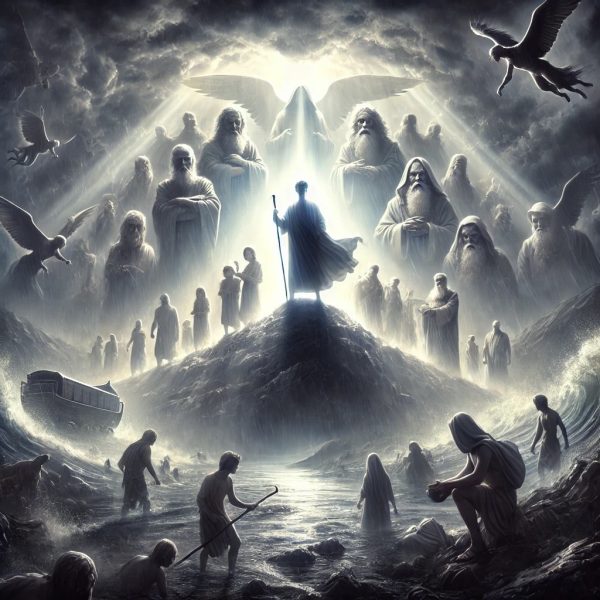
The phrase “Noah was a righteous man, blameless in his generations” (Genesis 6:9) has sparked significant theological discussion about its meaning. While many interpret it as a reference to Noah’s moral character, some scholars, such as Dr. Michael Heiser, suggest it could also imply genetic purity. This interpretation is rooted in the context of Genesis 6:1-4, which describes the “sons of God” (commonly understood as fallen angels) mating with human women and producing the Nephilim, a race of giants. The resultant corruption of humanity, both morally and physically, required divine intervention to preserve the human lineage and fulfill God’s plan for redemption.
Genesis 6:5-7 describes a world consumed by wickedness, with humanity’s thoughts “only evil continually.” Dr. Heiser, in The Unseen Realm, argues that the corruption introduced by the fallen angels extended beyond moral depravity to genetic manipulation. The Nephilim, described as “mighty men of old, men of renown” (Genesis 6:4), were likely hybrid beings who defied the natural order. Heiser and other scholars propose that Noah’s “blameless” status in his generations indicated that his lineage had not been tainted by this angelic interference, making him uniquely qualified to carry humanity forward after the flood.
The preservation of Noah’s family was crucial not only for humanity’s survival but also for God’s redemptive plan. Genesis 3:15 foreshadows the coming of the Messiah, who would crush the serpent’s head. If the human genome had been entirely corrupted, this promise could not have been fulfilled. Heiser emphasizes that the actions of the Watchers (fallen angels) in Genesis 6 represent a deliberate attempt to thwart God’s plan by introducing chaos and destruction. The flood, then, was both an act of judgment and a measure to reset creation, preserving a pure human lineage through Noah.
The Book of Enoch, a non-canonical text referenced by early church fathers and possibly alluded to in Jude 1:6, provides additional details about the Watchers and their rebellion. It describes their teaching of forbidden knowledge, such as metallurgy, weapon-making, and sorcery, which further corrupted humanity. While not part of the biblical canon, Dr. Heiser acknowledges the cultural and theological significance of Enoch in understanding the worldview of ancient Jewish readers. The book aligns with the idea that the Nephilim and their angelic fathers sought to undermine God’s creation, necessitating divine judgment.
In conclusion, Noah’s purity in his generations was likely both moral and genetic, a necessary safeguard against the widespread corruption introduced by the Watchers and their offspring. This interpretation, advanced by scholars like Dr. Michael Heiser, highlights the cosmic battle between divine order and rebellious chaos. The flood was not merely a punishment for sin but a decisive act to preserve the human race for God’s redemptive purposes. Through Noah, the promise of Genesis 3:15 was upheld, ensuring the eventual arrival of Jesus Christ, the ultimate solution to the corruption of sin and rebellion.
Article 2: “Post-Flood Giants: The Persistent Influence of the Nephilim”
Genesis 6:4 states, “The Nephilim were on the earth in those days—and also afterward.” This cryptic phrase has led many scholars to question how the Nephilim or their influence persisted after the flood, which was meant to wipe out corruption and reset humanity. While the Bible doesn’t provide a direct explanation, it suggests that the Nephilim’s legacy endured, reemerging in the form of giants such as the Anakim, Rephaim, and Goliath. This raises questions about whether their survival was due to genetic remnants in Noah’s family line, divine intervention, or a secondary rebellion of fallen angels.
The Anakim, mentioned in Numbers 13:33, were described as giants who terrified the Israelite spies sent to survey Canaan. These descendants of the Nephilim were said to make the Israelites feel “like grasshoppers” by comparison. Similarly, the Rephaim are referenced throughout the Old Testament, including in Deuteronomy 2:10-11, as formidable warriors inhabiting the land of Canaan. Goliath, the Philistine giant defeated by David in 1 Samuel 17, is often connected to this lineage, representing the enduring conflict between God’s chosen people and the corrupted offspring of the Nephilim.
The persistence of these giants suggests that the corruption of humanity was not entirely eradicated by the flood. Some scholars propose that this could have occurred through Ham’s lineage, as his descendants settled in regions later associated with the giants. Others speculate that another incursion of fallen angels may have occurred after the flood, though this idea lacks explicit biblical support. Regardless of the mechanism, these post-flood giants continued to pose a spiritual and physical threat to God’s people.
God’s commands to the Israelites to destroy certain groups in Canaan, such as the Anakim and Rephaim, take on new meaning in this context. These commands are often viewed as harsh, but if these groups carried the genetic legacy of the Nephilim, their destruction may have been necessary to preserve humanity’s purity and ensure the fulfillment of God’s redemptive plan. This perspective frames these battles as part of the larger cosmic conflict between God’s order and the rebellion of the fallen.
Understanding the persistence of the Nephilim sheds light on the broader narrative of the Bible, where the forces of corruption and rebellion continually clash with God’s plan for redemption. The giants of Canaan serve as a reminder that sin and corruption, even when seemingly eradicated, have a way of reemerging. It is only through God’s intervention that true restoration and purity can be achieved.
Article 3: “The Watchers’ Forbidden Knowledge: A Legacy of Corruption”
The Book of Enoch provides a detailed account of the Watchers’ rebellion, highlighting their role in introducing forbidden knowledge to humanity. These fallen angels taught humans skills and technologies that advanced civilization but also corrupted it. This legacy of forbidden knowledge is described in Enoch 8, where Azazel is said to have taught humans metallurgy, the crafting of weapons, and the creation of ornaments and cosmetics. While these skills were practical advancements, they also promoted violence, vanity, and moral degradation.
The Watchers’ teachings extended to sorcery and astrology, enabling humans to engage in practices that defied God’s order. These new abilities, while seemingly empowering, placed humanity on a dangerous path of self-destruction. For instance, the introduction of weapons escalated violence, while sorcery opened spiritual doors to demonic influences. Dr. Michael Heiser notes that the Watchers’ actions reflect an intentional corruption of God’s creation, as their knowledge was used to undermine divine order and encourage rebellion.
This narrative resonates with the biblical principle that knowledge, when divorced from God’s guidance, leads to destruction. In Genesis 3, humanity’s first sin involved seeking knowledge (the fruit of the Tree of the Knowledge of Good and Evil) outside of God’s will. Similarly, the Watchers’ teachings gave humanity knowledge it was not spiritually prepared to handle, resulting in widespread corruption and divine judgment through the flood.
The ethical implications of this story are profound. The misuse of knowledge is a recurring theme throughout history, from the development of destructive technologies to the exploitation of scientific advancements. This biblical account challenges believers to seek God’s wisdom and discernment in how knowledge is applied. It also serves as a cautionary tale about the dangers of seeking power or understanding outside of God’s will.
Ultimately, the story of the Watchers’ forbidden knowledge reinforces the idea that humanity thrives only when aligned with God’s plan. The rebellion of the Watchers and the corruption they introduced illustrate the consequences of rejecting divine guidance. As humanity continues to advance in science and technology, the lessons of Genesis 6 and the Book of Enoch remain relevant: knowledge without righteousness leads to destruction, but wisdom rooted in God brings life and restoration.
If you enjoyed this article, then please REPOST or SHARE with others; encourage them to follow AFNN. If you’d like to become a citizen contributor for AFNN, contact us at managingeditor@afnn.us Help keep us ad-free by donating here.
Substack: American Free News Network Substack
Truth Social: @AFNN_USA
Facebook: https://m.facebook.com/afnnusa
Telegram: https://t.me/joinchat/2_-GAzcXmIRjODNh
Twitter: https://twitter.com/AfnnUsa
GETTR: https://gettr.com/user/AFNN_USA
CloutHub: @AFNN_USA