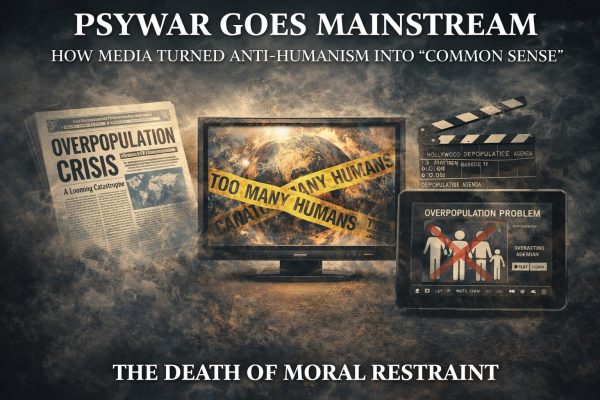
Psywar Goes Mainstream: How Media Turned Anti-Humanism Into “Common Sense”
By the 1980s and 1990s, the ideology had outgrown academia. It entered culture.
This is how psywar works: you don’t argue the premise—you embed it.
Film, television, and literature stopped asking whether humans were the problem and started asking how many humans were too many. Environmental messaging quietly shifted from stewardship to guilt. Children were framed as carbon footprints. Population decline was reframed as progress.
By the time a line like “Overpopulation is the greatest threat to the 21st century” appears in a show like Travelers, it isn’t presented as an opinion. It’s treated as settled truth.
That’s narrative warfare.
The audience isn’t meant to debate it. They’re meant to absorb it.
This worldview produces a specific moral inversion:
• Abortion becomes an environmental good
• Euthanasia becomes compassion
• Suicide becomes autonomy
• Depopulation becomes virtue
And because the framework rejects God, there is no external moral limit. Ethics are no longer grounded in divine order, but in outcomes. If fewer people equals a “healthier planet,” then any means that achieve that outcome can be justified.
This is why the ideology spreads so easily. It feels responsible. It feels moral. It flatters the believer as enlightened while quietly teaching them to despise humanity—including themselves.
This was the second death: the death of moral restraint.
If you enjoyed this article, then please REPOST or SHARE with others; encourage them to follow AFNN. If you’d like to become a citizen contributor for AFNN, contact us at managingeditor@afnn.us Help keep us ad-free by donating here.
Substack: American Free News Network Substack
Truth Social: @AFNN_USA
Facebook: https://m.facebook.com/afnnusa
Telegram: https://t.me/joinchat/2_-GAzcXmIRjODNh
Twitter: https://twitter.com/AfnnUsa
GETTR: https://gettr.com/user/AFNN_USA
CloutHub: @AFNN_USA