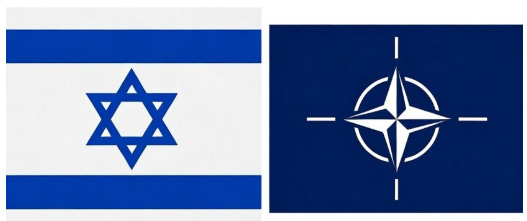
President Trump has put US allies in NATO on notice about providing security for ships transiting the Strait of Hormuz. He has also condemned specific NATO countries for denying use of NATO air bases and other facilities in support of Operation Epic Fury (the Iran rescue that is ongoing).
It is a useful exercise to compare what the only real Epic Fury ally (Israel) has in the way of military capabilities versus what selected NATO countries could bring to the table – particularly with all the antisemitism percolating on social media in support of IRI regime narratives (not to mention the absurd claims that President Trump is “Netanyahu’s bitch”). The comparisons below are instructive – and perhaps may be even shocking for some.
1. Military Manpower

2. Ground Forces and Combat Divisions

3. Air Power

4. Naval Forces

5. Missile Inventories

6. Drone Inventories

7. Logistics and Strategic Mobility

8. Ammunition Stores and Manufacturing

9. Nuclear and Strategic Deterrence

10. Overall Assessment

CONCLUDING THOUGHTS
Consider the above comparisons in the context of the populations of each of the countries as noted below:
- Israel: Approximately 10.18 million (official estimate at the start of 2026, according to Israel’s Central Bureau of Statistics).
- France: Approximately 69.08 million (total for the French Republic as of January 1, 2026, including overseas territories; metropolitan France alone is around 66.8 million).
- UK: Approximately 69.5–69.9 million (provisional mid-2025 estimate: 69.49 million; mid-2026 projection around 69.93 million).
- Germany: Approximately 83.6–84.1 million (mid-2026 projection around 83.64 million).
- Italy: Approximately 58.9–59.1 million (mid-2026 projection around 58.93 million; 2025 end-of-year around 58.93–59.1 million).
- Spain: Approximately 47.9–49.6 million (mid-2026 projection around 47.85 million; official 2025/early 2026 estimates up to 49.57 million, reflecting recent growth from immigration).
- Poland: Approximately 37.5–38.1 million (mid-2026 projection around 37.84 million).
Then there are these key analytical takeaways across all the preceding dimensions compared:
Israel’s qualitative advantage is extraordinary but bounded by scale. The IDF combines Western-grade firepower with indigenous innovation, making it exceptionally agile in high-intensity and asymmetric environments. Its F-35I Adir variant is uniquely superior to standard F-35s because Israeli engineers integrated their own electronic warfare systems, weapons, and avionics into the aircraft. No European air force has an equivalent degree of platform customization at that level.
The missile defense asymmetry is stark. Israel’s four-layer active defense system — Iron Dome, David’s Sling, Arrow 2, and Arrow 3 — is the only one of its kind operationally proven in the world. During the June 2025 conflict with Iran, Iron Dome together with Israel’s multi-layered missile defense system intercepted approximately 86–90% of incoming threats AJC despite Iran firing over 500 ballistic missiles. No EU nation has anything approaching this architecture. Germany, through its Arrow 3 purchase, is beginning to build toward it, but the current conflict has placed Israeli interceptor inventories under severe strain, with roughly 80% of Arrow 2 and Arrow 3 stocks estimated as expended by early 2026.
European naval power is where the EU clearly dominates. France and the UK together field three aircraft carriers, 11 nuclear attack submarines, eight ballistic missile submarines, and a genuine blue-water global presence. Israel’s navy is tailored entirely for regional littoral warfare and deterrence via its submarine fleet’s believed second-strike nuclear role.
The ammunition crisis is Europe’s Achilles heel. In just the first three months of 2024, Russia produced what NATO produced in an entire year, giving Russia a four-to-one advantage. Europe’s ammunition industry has only one factory in Poland currently producing TNT — meaning essentially all of European artillery ammunition production depends on a single explosives facility. Annual European ammunition production capacity has risen from around 300,000 rounds in 2022 to a projected 2 million by end of 2025 — a real improvement, but still well short of wartime consumption rates seen in Ukraine.
Poland is the most consequential emerging military power in the EU. Poland’s defense spending is set to rise to 4.7% of GDP in 2025 — the highest in NATO — and it has doubled the size of its armed forces in a decade. Its artillery rocket inventory (211 MLRS systems) is the largest in the EU, and it is the only non-US country to field the Patriot PAC-3 system. Its naval and strategic airlift gaps, however, remain significant.
The bottom line: Israel wins on per-unit quality, combat-tested doctrine, missile defense, cyber/ISR integration, and drone warfare maturity. The six EU nations combined win decisively on aggregate mass, strategic nuclear deterrence, blue-water naval power, and industrial base depth. A unified EU military — which does not exist — would substantially outmatch Israel in raw capability. But as individual nations, none matches Israel in qualitative combat effectiveness per soldier, per aircraft, or per platform.
Read that last sentence again. Lo,’ how the mighty have fallen! Regarding NATO, the US-Israeli coalition doesn’t have much to pick from to support Epic Fury operations. Getting them to secure and police the Strait of Hormuz in their own interests is a first step.
Israel is more than pulling its weight in Operation Epic Fury, given its size. The antisemites can pound sand.
The end.