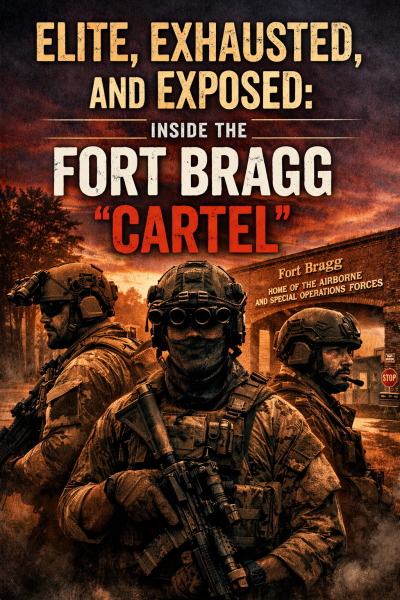
Seth Harp’s, “The Fort Bragg Cartel,” is built around a real, unsettling case that anchors the entire narrative: the December 2020 deaths of two soldiers at Fort Bragg—Master Sgt. William “Billy” Lavigne, a Delta Force operator, and Chief Warrant Officer Timothy Dumas, a logistics (quartermaster) officer tied to Special Forces units. Both were found shot in a remote training area. The pairing alone raises eyebrows inside the military: one man from the most elite operational tier, the other from the supply and accountability side of the house. Those lanes don’t normally intersect socially, much less end together in a homicide scene.
Harp uses this incident as the spine of his book, widening outward into a broader examination of deaths, overdoses, and misconduct cases connected to the installation. His thesis is not simply that crime occurred—that is undisputed—but that a pattern exists, and that the conditions of two decades of continuous war created an environment where certain individuals could operate outside normal accountability. High operational tempo, repeated deployments, and a culture built on autonomy and trust, he argues, can become a double-edged sword. What enables elite units to succeed overseas can, if left unchecked, obscure problems at home.
The details surrounding Dumas are particularly important to Harp’s narrative. By the time of his death, Dumas had already fallen hard. He had been removed from his position, pushed out of the Army, and had effectively lost his career and pension, a dramatic fall for a warrant officer entrusted with property accountability. In that role, he would have had visibility into weapons systems, equipment flows, and supply records—exactly the kind of access that, if abused, could facilitate diversion or concealment. Harp leans heavily on this background, suggesting that Dumas was not just a disgruntled former officer but potentially someone entangled in deeper misconduct, including alleged drug activity and threats to expose wrongdoing. Some accounts referenced in the book describe him as having written communications that hinted at blackmail or insider knowledge, though how much of that is substantiated versus inferred remains part of the ongoing debate.
Lavigne, on the other side of the equation, represents the archetype of the modern special operations warrior—highly trained, repeatedly deployed, and operating in environments where the rules are fluid and the stakes are lethal. Harp portrays him as both elite and troubled, a man shaped by years of war who may have carried that weight back home. Whether readers accept that portrayal depends largely on how much credence they give to the sources and interpretations presented.
This is where the book becomes divisive. The term “cartel” is provocative, and Harp uses it more as a conceptual framework than a strictly defined criminal organization. Critics argue that the evidence does not conclusively demonstrate a coordinated trafficking network within special operations forces. Supporters counter that the accumulation of incidents, relationships, and anomalies points to something more than coincidence. The truth likely sits somewhere in between: real events, real misconduct in some cases, but a level of systemic coordination that remains unproven.
Where the book succeeds—regardless of where one lands on its conclusions—is in highlighting a broader misunderstanding that extends well beyond Fort Bragg. Military forces are not law enforcement. They are designed to apply violence in pursuit of national objectives, often in ambiguous environments where decisions are made quickly and with incomplete information. Law enforcement operates on an entirely different model: evidence-driven, procedurally bound, and accountable to civilian courts. When policymakers blur that line—expecting warfighters to behave like investigators, or assuming that combat-tested leadership automatically translates into domestic accountability—they create a gap. That gap is where problems fester.
Harp’s narrative, anchored by the deaths of Lavigne and Dumas—one an elite operator, the other a fallen quartermaster who had already lost his career and pension—forces readers to confront uncomfortable questions. Not just about what happened on a single night in 2020, but about how institutions manage the human consequences of prolonged war. Whether or not there was ever a “cartel,” the conditions he describes are real. And ignoring those conditions because the label is controversial would be missing the point entirely.
If you enjoyed this article, then please REPOST or SHARE with others; encourage them to follow AFNN. If you’d like to become a citizen contributor for AFNN, contact us at managingeditor@afnn.us Help keep us ad-free by donating here.
Substack: American Free News Network Substack
Truth Social: @AFNN_USA
Facebook: https://m.facebook.com/afnnusa
Telegram: https://t.me/joinchat/2_-GAzcXmIRjODNh
Twitter: https://twitter.com/AfnnUsa
GETTR: https://gettr.com/user/AFNN_USA
CloutHub: @AFNN_USA