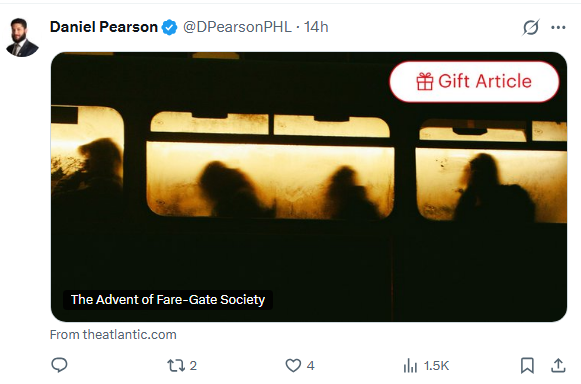
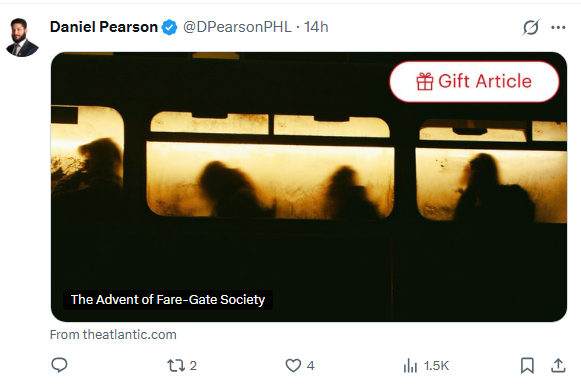
 My good friend Daniel Pearson — OK, OK, I’ve never actually met him, but even though he’s mostly liberal, he’s a common sense and decent kind of guy, the kind of guy you’d be happy with whom to sit down and drink a cup of Wawa coffee — an editorial writer and columnist with The Philadelphia Inquirer gave his Twitter — I still refuse to call it 𝕏 — followers a gift article from The Atlantic, on a subject that’s near and dear to his heart, public transportation, and the plague of fare-jumping which has cost the Southeastern Pennsylvania Transportation Authority, SEPTA, millions of dollars in lost revenue, something which puts it in real jeopardy.
San Francisco Solved Metro Vandalism With One Neat Trick
The age of the fare-gate society is here.
By Henry Grabar | Monday, April 20, 2026 | 1:26 PM EDT
Vandals have done some senseless stuff on Bay Area Rapid Transit. They have removed the fire extinguishers from the station walls and sprayed them all over the place, for example. But what particularly vexed Alicia Trost, the chief communications officer for the train system that connects San Francisco, Oakland, and San Jose, was their destruction of map display cases at stations across the system: “You could not see the maps for years.”
I do not know if the embedded link will take readers to the gift article, but if you click on the illustration, it will take you to Mr Pearson’s tweet, which does have the gift article link.
Now you can. In August, BART completed the installation of new fare gates at station entrances and exits: Six-foot-tall saloon-style doors, made of plexiglass with metal frames, have replaced the waist-high barriers of the 1970s that were easy to duck or jump. The new gates have compelled more riders to pay their fare—revenue is projected to rise by $10 million a year. They have also led to an enormous drop in vandalism. Workers spent nearly 1,000 fewer hours cleaning up after unruly passengers in the six months following the gates’ installation, compared with the six months before. Crime on BART fell by 41 percent last year. Most fare beaters may be just trying to get a free ride, but most vandalism was apparently committed by fare beaters.
This is a success story with lessons for all types of public spaces. Call it “fare-gate theory”: To protect the shared rooms of communal life, human intervention isn’t always necessary, affordable, or desirable. Instead, physical and technological obstacles—an architecture of good behavior—can keep out bad actors and deter the worst impulses of everyone else.
It might seem obvious that addressing fare evasion is an important priority for mass-transit systems struggling with both revenue and a perception of disorder. But in San Francisco and other cities, the question of how riders access the subway—and how they behave on it—has been ensnared by vitriolic debates about fairness, poverty, mobility, social standards, and policing. One left-wing argument is that fare enforcement of any kind is a waste of money that instead could be spent improving commutes and helping low-income residents access the city. That’s part of the logic behind New York Mayor Zohran Mamdani’s pledge to make city buses free. Many transit officials, however, insist that fare enforcement is necessary not just to generate revenue but to maintain standards of decorum that make riders feel safe.
There’s considerably more at the original.
 We noted, last July, an article about fare evasion on SEPTA in the Inquirer. The transit authority had significantly increased fare enforcement, but this was the real money line as far as I was concerned:
Transit Police Chief Charles Lawson said the agency has learned so far that the majority of fare evaders are everyday working residents — nurses, lawyers, even city employees with free passes, who, in a rush to catch the train, or out of habit after not paying in recent years, step over the turnstiles.
In other words, a whole lot of people who could pay — nurses in the City of Brotherly Love can easily make over $50 an hour — just didn’t. Some of them are now getting busted, charged with theft of services, which can cost them up to a $300 fine, all to beat a $2.90 fare. SEPTA riders could pay the fare for 100 trips, and it would be less than a $300 fine.
Translation: some “nurses, lawyers and city employees with free passes” are just plain stupid.
It does blow the argument about poverty being the problem out of the water, at least financial poverty. There is, however, a poverty of civility involved, a poverty which allowed the vandalism documented on BART to occur and be left to linger. I’m no one special, and like many other poor people, I grew up without a father after my eighth birthday, but I was still never drawn to graffiti — I noted my disgust to senseless graffiti in Athens here — or other senseless vandalism. I’ve had to take the subway or bus very infrequently in my life, almost always away from home when I did, but not only did I never try to bypass the fares, it never even occurred to me to try.
There was one very frustrating gate for the Paris Metro at the bottom of the Channel Tunnel station 🙁 , and while I might have said darn and heck and shoot at the time, I still paid the fare to get through, and finally the gate cooperated!
Mr Pearson wrote:
People can yell and stomp their feet as much as they want, but the data is extraordinarily clear. Enforce the fare and other forms of bad behavior also decline. Let it go and bad behavior explodes. Septa must avoid the urge to soften penalties in the future.
Think about this. SEPTA and BART, and other public transit agencies are adding fare gates which are harder to jump, to step over, because the earlier turnstile designs simply assumed that people were honest and wouldn’t try to evade fares. Previous lack of enforcement meant that the consequences of bad behavior were removed, but people ought to have some basic honesty in the first place. We shouldn’t have to build evasion-resistant fare gates; we should have people simply paying the fare automatically, because it’s the right thing to do.
How and when did we get away from that?
__________________________________
Follow me on Twitter! Check out my website, The First Street Journal, for stories not on American Free News network.
_________________________________
If you enjoyed this article, then please REPOST or SHARE with others; encourage them to follow AFNN. If you’d like to become a citizen contributor for AFNN, contact us at managingeditor@afnn.us Help keep us ad-free by donating here.
_________________________________
Substack: American Free News Network Substack
Truth Social: @AFNN_USA
Facebook: https://m.facebook.com/afnnusa
Telegram: https://t.me/joinchat/2_-GAzcXmIRjODNh
Twitter: https://twitter.com/AfnnUsa
GETTR: https://gettr.com/user/AFNN_USA
CloutHub: @AFNN_USA