President Trump restores the honor to a man toppled by the George Floyd hysteria
Listen my readers, I know you did hear of the famous ride of Paul Revere.
Today you will become aware then of the famous ride of a Delawarean.
Caesar Rodney is a Founding Father, a title that is as alive today as it was on July 2, 1776, when he cast the vote in the Continental Congress to have all 13 colonies declare independence from the Crown.
He rode 70 miles through the backwoods from Wilmington to Philadelphia during a thunderstorm at night to cast the vote that broke the deadlock in the Delaware delegation. He did not see the ride as the big deal it was.
His patriotism went back to participation in the French and Indian War followed by opposition to the Stamp Act, which placed a tax on paper. Benjamin Franklin objected that it hit printers hardest. John Adams viewed it as an effort to “strip us in a great measure of the means of knowledge, by loading the Press, the colleges, and even an Almanack and a News-Paper, with restraints and duties.”
But what sold the public on opposition was the slogan “No Taxation Without Representation”—words that ring true today.
Rodney was in Dover, Delaware (at his Byfield plantation east of town), on July 1, 1776, primarily because he was handling official duties as Brigadier General of the Delaware militia and addressing Loyalist unrest.
The other two members of the Delaware delegation were split on independence. Thomas McKean avidly advocated independence.
George Read was so wishy-washy that he could be the Senate Republican Leader today. He believed the colonies were not ready and that reconciliation with Britain might still be possible. He also believed the Islamic Republic will give up its atomic bomb ambitions if we talk nice and make our women wear black hoods.
OK, you caught me. I made the last part up.
And to be fair, Read joined the others and pledged his life, his fortune and his sacred honor when he, too, signed the Declaration of Independence. Had the British prevailed, the government would have hanged every one of those 56 men who made that pledge.
Historians who condemn these men as slaveholders overlook just what they risked to bring forth on this continent, a new nation, conceived in Liberty, and dedicated to the proposition that all men are created equal.
Rodney’s midnight ride brought unanimity to the declaration. Delaware would not become a haven for Loyalists and the British Army. McKean sent word to Rodney to get that vote. So he saddled up and headed to Philadelphia—in the middle of the night.
To be honest, Rodney didn’t think much about the ride other than it was exhausting and he was glad to arrive in time to cast his vote.
In a letter to his brother, Thomas, on July 4, 1776, Caesar Rodney wrote, “I arrived in Congress (tho detained by thunder and Rain—) time Enough to give my Voice in the Matter of Independence . . . . It is determined by the Thirteen United Colonies without even one dissenting Colony.”
Years later in 1813, McKean wrote to Rodney’s nephew, “I met [Rodney] at the State-house door, in his boots and spurs, as the members were assembling . . .”
McKean recounted that Rodney then voted for independence and said, “As I believe the voice of my constituents and of all sensible and honest men is in favor of Independence and my own judgment concurs with them, I vote for Independence.”
Well, that was not quite how it played out. That fall, voters in Kent—his home county—rejected Rodney as a delegate to the state constitutional convention and the new General Assembly.
By November 1776, the Delaware General Assembly removed Rodney (and Thomas McKean) as delegates to the Continental Congress, replacing them with more conservative figures like John Dickinson and John Evans.
But two years later, public opinion swung back and voters elected Rodney governor.
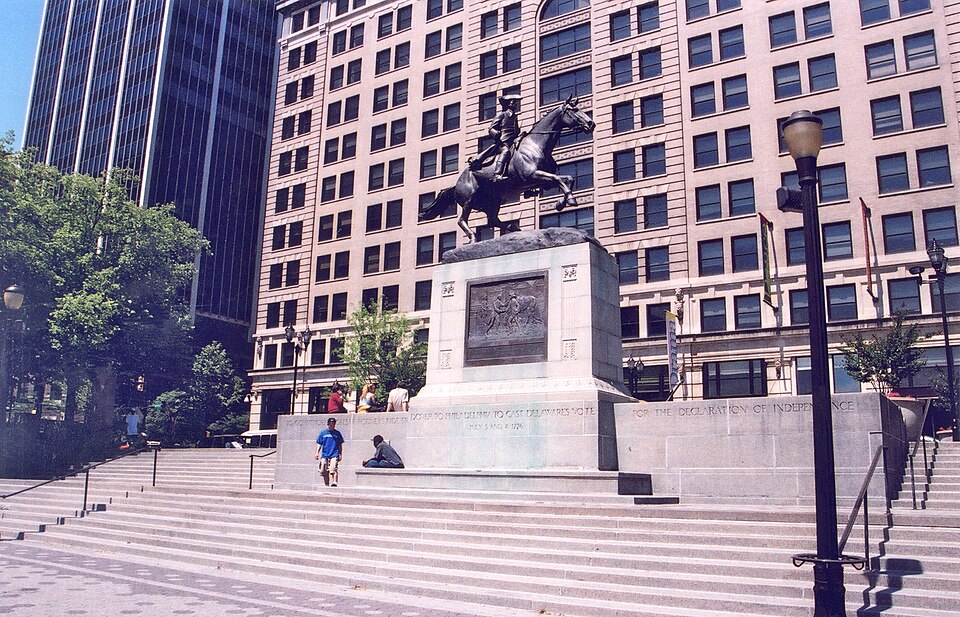
Rodney’s death in 1784 was little noted and he was buried in an unmarked grave, having never married or had children. Over time, people noticed his ride. In 1923, Civil War General James Harrison Wilson headed an effort to raise money to fund a statue to Caesar Rodney.
Wilson was 23 and an 1860 graduate of West Point when the Civil War began. He helped end the war as a general four years later, defeating Nathan Bedford Forrest in the Battle of Selma. Later, Wilson also helped capture Jefferson Davis, but Delaware has not honored Wilson.
When Obama went to Selma with black leaders to celebrate the 50th anniversary of a civil rights march, he failed to note that it was the 150th anniversary of the Battle of Selma, which actually helped free the slaves.
But Delaware honored Rodney with the statue for 97 years, until Saint George Floyd died in Minneapolis. On June 12, 2020, Democrat Mayor Mike Purzycki of Wilmington, Delaware, reacted by ordering the removal of the Caesar Rodney equestrian statue. Purzycki also removed a statue of Columbus.
The mayor put them in storage.
Delawareans resisted the pressure to rename Caesar Rodney High School, home of the Riders. And the mayor is no longer the mayor.
On Saturday, Interior Secretary Doug Burgum tweeted:
As we approach America’s 250th anniversary, President Trump has been committed to celebrating and acknowledging the full breadth of our nation’s history, including the story of Caesar Rodney and his pivotal ride in July 1776.
Despite being gravely ill with a cancerous condition that caused him constant pain, he rode through a violent storm to cast Delaware’s deciding vote for American Independence.
Today, the National Park Service staff returned his statue to Freedom Plaza. By telling the full story, every triumph, every challenge and every step towards a more perfect union we strengthen our shared understanding and ensure that future generations inherit not just the land we love, but the truth of the journey that brought us here.
The statue is now in Washington, DC, not Wilmington.
All this virtue signaling about statues has changed my Northerner mind. Keep the Confederates statues. Lose the tributes to drug dealers and users.
* * *

The best journalists are boozers. Of course, the worst are boozers, too. My hat is off to the ladies who took home the booze after a would-be assassin ended the White House Correspondents Dinner.
Jimmy Kimmel made a video pretending he was the star of the White House Correspondents Dinner. USA Today decided to publicize the Fake Monologue, tweeting, “Jimmy Kimmel took brutal shots at President Trump in a mock White House Correspondents Dinner, which will not have a comedian in attendance.”
Even if he went it would not have a comedian in attendance.
So what did the Darling of Disney’s ABC say? “𝘔𝘳𝘴. 𝘛𝘳𝘶𝘮𝘱, 𝘺𝘰𝘶 𝘩𝘢𝘷𝘦 𝘢 𝘨𝘭𝘰𝘸 𝘭𝘪𝘬𝘦 𝘢𝘯 𝘦𝘹𝘱𝘦𝘤𝘵𝘢𝘯𝘵 𝘸𝘪𝘥𝘰𝘸.”
Adam Carolla was the comic on The Man Show. Kimmel wasn’t even a good straight man. But the talent that mattered in this case was one the public will never discover. He’s the Barack Obama of Comedy—as vain as he is talentless.
As for security, the Secret Service did its job. The assailant never made it inside the ballroom. The agents have not been paid in 10 weeks thanks to John Thune’s refusal to invoke the Byrd Rule and pass the Homeland Security budget with just 50 votes (JD Vance would break the tie).
You can subscribe to Don’s Daily Substack Here.
This article first appeared on Don Surber’s Substack. Reprinted here with permission.
If you enjoyed this article, then please REPOST or SHARE with others; encourage them to follow AFNN. If you’d like to become a citizen contributor for AFNN, contact us at managingeditor@afnn.us Help keep us ad-free by donating here.
Substack: American Free News Network Substack
Truth Social: @AFNN_USA
Facebook: https://m.facebook.com/afnnusa
Telegram: https://t.me/joinchat/2_-GAzcXmIRjODNh
Twitter: https://twitter.com/AfnnUsa
GETTR: https://gettr.com/user/AFNN_USA
CloutHub: @AFNN_USA