Analysis from a constitutional conservative perspective
The state enters this debate from a position of genuine fiscal strength, as fiscal year 2025 ended with a $63 million operating surplus — $41 million in excess revenues and $22 million in unspent appropriations — with reserve funds growing toward nearly half a billion dollars. Governor Rhoden characterized this as evidence of “disciplined financial management,” and by conventional metrics, it is. The state has avoided the debt spirals that plague blue-state governance, maintained no income tax, and run lean budgets for over a decade.
Let us examine the issue in some detail from a constitutional conservative perspective.
THE FUTURE FUND
The Future Fund is the epicenter of the controversy. Administered by the Governor’s Office of Economic Development (GOED), it functions as a discretionary grant and incentive pool used to attract businesses to South Dakota. In late 2025, GOED awarded more than a million dollars in grants to aid commercial endeavors including the SDSU-affiliated Dakota BioWorx and Watertown’s Calvin Industrial Park.
From a constitutional conservative standpoint, however, the mechanism is as important as the outcomes. Governor Rhoden signed an executive order in January 2026 establishing formal guidelines for how his administration will award and oversee Future Fund grants — an acknowledgment that formal protocols were previously absent or insufficient. The governor’s own words — “I support economic growth, but growth should not be reckless” — implicitly concede that recklessness had been possible under the prior structure.
The measure to take authority from the governor’s office alone was called a “compromise” by some legislators, even as calls to dismantle the program entirely gained traction — and the gridlock it produced spotlighted a deepening divide between lawmakers, the governor’s office, and the state’s business establishment over the proper role of government in commerce.
A constitutional conservative must ask: why does the disbursement of public funds require only executive discretion? The appropriations process exists precisely to give the people’s elected representatives oversight of how tax dollars are spent. When a fund bypasses that process and vests sole authority in one executive office, it concentrates power in a manner that the framers of separation-of-powers doctrine would recognize as dangerous — not because the current governor is corrupt, but because the structure invites corruption regardless of who holds the office.
Sen. Mykala Voita made this point directly: “The Future Fund has no legislative oversight and bypasses the appropriations process — this needs to STOP.” Voita invoked Jefferson’s formulation of “wise and frugal government” and made the free-market case that the Fund represents government picking winners and losers in the private economy.
CRONY CAPITALISM VS. FREE MARKETS
The most intellectually serious objection to South Dakota’s economic development apparatus – and the core philosophical problem – is not that it is corrupt — though corruption risks are real — but that it is structurally incompatible with a free market.
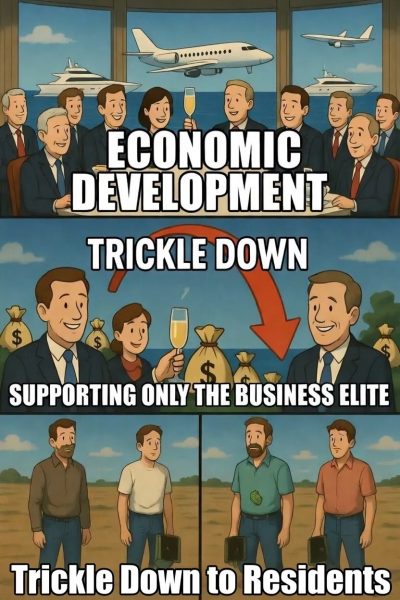
Critics have argued that “Economic Development” projects are mostly boondoggles that elected officials use to reward donors and buy votes, and that when it comes to Other People’s Money, no one really seems to care how carefully it gets spent.
Senator Voita’s argument goes further and deserves full engagement. She poses the scenario: if an existing business owner has built a company from the ground up — paying taxes, complying with regulations, pursuing the American dream — and then a competitor arrives with a large state grant, is that a level playing field? “The money for the grant that this large competitor came from your unemployment tax dollars,” she writes. “That is the reality of the Future Fund.”
This is not a fringe argument. It is a classically liberal, constitutionally grounded objection to government interference in market competition. When the state subsidizes one competitor over others, it:
- Distorts price signals that would otherwise guide capital allocation
- Disadvantages locally established businesses who received no such subsidy
- Requires taxpayers — including those same disadvantaged businesses — to fund the advantage given to their new competitor
- Creates incentives for businesses to pursue political relationships rather than productive efficiency
South Dakota Voices has argued that economic development “takes tax dollars from a large number of people and funnels that money to a few ‘special companies,’” and that the two basic types — TIF financing and Future Fund grants — both operate as mechanisms of selective subsidy.
The GOED’s role as intermediary compounds this problem. In some cases money from GOED goes from one community organization to another before finally reaching a “special business” — a chain of intermediaries that reduces transparency and multiplies opportunities for preferential treatment.
OUT-OF-STATE AND FOREIGN BENEFICIARIES
A constitutional conservative’s concern about state sovereignty and the interests of South Dakota citizens is sharpened considerably by who receives these development subsidies. Who is actually being served?
Some recipients of Future Fund and GOED assistance have foreign ownership — Smithfield Foods (China), CJ Schwans (Korea), Manitou (France) — meaning local businesses and South Dakota citizens are being compelled to subsidize foreign companies and foreign countries.
The case of CJ Schwans received pointed attention: taxpayers were reportedly providing what critics characterized as a $69 million handout to a Korean company — with the added concern that such arrangements often include pathways to import foreign workers, which critics argue depresses wages for South Dakota citizens.
This leads to a compound injury: the state uses public money to attract a large foreign-owned employer, that employer may pay wages insufficient to support families in the local cost of living, and those workers then qualify for taxpayer-funded SNAP, Medicaid, and subsidized housing. Critics have argued that this is a mechanism by which full-employment economic development creates labor shortages, legally imports foreign workers, and overloads public schools while crushing the taxpayers of South Dakota — a lose-lose-lose dynamic.
From a constitutional conservative view, this is not “economic development.” It is a transfer of wealth from South Dakota working families to multinational corporations, laundered through the language of job creation.
The lobbying dimension matters here. Out-of-state business interests and their South Dakota intermediaries have strong financial incentives to maintain the current system. Property tax pressures dominate kitchen-table conversations, social media amplifies suspicion and fuels activism, and a new wave of lawmakers — many elected in the aftermath of bruising fights over carbon pipelines — are challenging the decades-old model of government-backed economic development. The carbon pipeline fight itself was a case study in out-of-state capital using federal tax credits (not South Dakota’s natural comparative advantage) to justify projects that required overriding South Dakotan property rights.
TAX INCREMENT FINANCING (TIF)
TIF is the local-government parallel to the Future Fund, and it carries its own set of constitutional conservative concerns, including hidden costs to existing taxpayers.
In TIF arrangements, companies and developers receive cash payouts and are exempt from property taxes for long periods. During the tax exemption period, the taxpayers cover the extra costs of community services that the development generates — and this is particularly problematic when business or residential density increases, bringing more children into schools, more use of roads and bridges, and more construction pressure.
This is a classic externalization of costs. The developer captures the upside (the built asset, the revenue stream) while existing property taxpayers absorb the infrastructure and service costs that the new development creates. From a constitutional conservative standpoint, this inverts the proper relationship between government and the governed: it is the people who pay for the benefit of the few.
Critics note that TIF grifts take taxpayer money and give it to developers, enabling property taxes to increase so that cities and counties can spend even more money — a dynamic that is the opposite of fiscal conservatism, even when dressed in pro-business language.
CONCLUDING THOUGHTS
This ends Part I. Part II will cover data centers, reserve funds, the pro-development counter argument, and legislative reform efforts.
The end.
If you enjoyed this article, then please REPOST or SHARE with others; encourage them to follow AFNN. If you’d like to become a citizen contributor for AFNN, contact us at managingeditor@afnn.us Help keep us ad-free by donating here.
Substack: AmericanFreeNewsNetworkSubstack
TruthSocial:@AFNN_USA
Facebook: https://m.facebook.com/afnnusa
Telegram: https://t.me/joinchat/2_-GAzcXmIRjODNh
Twitter: https://twitter.com/AfnnUsa
GETTR: https://gettr.com/user/AFNN_USA
CloutHub: @AFNN_USA