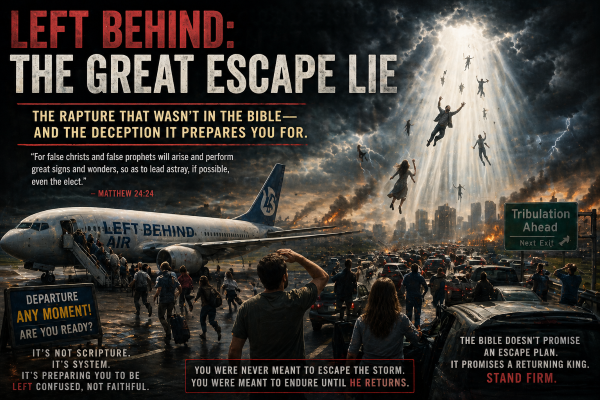
There’s a version of Christianity that reads like a spiritual fire drill: alarms go off, believers vanish, chaos ensues, and the faithful watch the disaster from a safe distance—preferably with a heavenly concession stand. It’s clean. It’s comforting. It’s wildly popular.
It’s also not what the text actually says.
Michael S. Heiser spent years pointing out the awkward truth that the modern, pre-tribulation “rapture” isn’t ancient doctrine rediscovered—it’s a relatively recent theological invention. The system most people assume is baked into the Bible shows up centuries late, largely tied to John Nelson Darby and the 19th-century appetite for tidy timelines.
That doesn’t make it automatically false. But it should make you nervous about treating it like first-century Christianity.
Because the early church—the people who actually read these letters without study Bibles and prophecy charts—weren’t sitting around expecting a quiet exit before things got ugly. They were expecting the opposite. Persecution. Pressure. Endurance. The kind of life that doesn’t sell well in paperback but shows up repeatedly in the New Testament.
So where did the “we’re out of here” doctrine come from?
It leans heavily on 1 Thessalonians 4:17—the famous “caught up” passage:
“Then we who are alive… will be caught up together with them in the clouds to meet the Lord in the air…”
Cue the disappearing act, right?
Not so fast.
Heiser drills into the word “meet” (Greek: apantēsis), and here’s where the entire escape narrative starts to wobble. In the ancient world, that word wasn’t used for evacuation. It was used when a city’s citizens went out to greet a returning king—and then escorted him back in.
That’s not a helicopter extraction. That’s a welcoming procession.
Same verse. Completely different direction.
The text describes believers going out to meet Christ—and returning with Him. Not blasting off into permanent exile while Earth sorts itself out like a bad group project.
Then there’s the other favorite: Matthew 24—“one taken, one left.” If you grew up on prophecy charts, you were told “taken” equals saved, “left” equals doomed.
Except Jesus ties that moment to the days of Noah.
Quick quiz: in Noah’s story, who gets “taken”?
Not the righteous. The ones taken are swept away in judgment. The ones left are the ones preserved.
That flips the whole modern reading on its head.
And now the system has a problem.
Because once you stop importing assumptions into the text and actually follow the context, the neat little escape hatch starts looking less like doctrine and more like wishful thinking with a publishing deal.
Which brings us to the uncomfortable part nobody likes to print on a bumper sticker:
The New Testament does not prepare believers for evacuation.
It prepares them for endurance.
That’s consistent across the board—Jesus, the apostles, the early church. The expectation isn’t “you’ll be removed before suffering.” It’s “you will face it—and remain faithful anyway.”
Not exactly the stuff of blockbuster prophecy fiction.
And that’s where Heiser’s warning cuts deeper than a theological debate.
Because bad theology doesn’t just make you wrong—it makes you vulnerable.
If you build your entire expectation on:
“I won’t be here when things go bad”
…what happens when things go bad and you’re still here?
Faith doesn’t get tested—it gets blindsided.
Confusion sets in. Panic follows. And suddenly, anyone offering a clean explanation, a new framework, or a convenient “you misunderstood everything” narrative gets a much more receptive audience.
That’s not a coincidence. That’s a setup.
Scripture never promised believers an exit strategy. It promised a returning King.
There’s a difference.
One says:
“You won’t have to deal with it.”
The other says:
“You will—but it won’t win.”
Heiser wasn’t trying to strip hope out of the equation. He was trying to relocate it—away from a theological escape pod and back where the text actually puts it: in the return of Christ and the endurance of His people.
Because historically, God doesn’t always pull His people out of the fire.
More often, He carries them through it.
Which is a lot less comfortable—and a lot more consistent with everything the New Testament actually says.
So if your end-times plan looks like a divine Uber ride out of chaos, you might want to reread the fine print.
Because the mission briefing doesn’t say “stand by for extraction.”
It says stand firm.
If you enjoyed this article, then please REPOST or SHARE with others; encourage them to follow AFNN. If you’d like to become a citizen contributor for AFNN, contact us at managingeditor@afnn.us Help keep us ad-free by donating here.
Substack: American Free News Network Substack
Truth Social: @AFNN_USA
Facebook: https://m.facebook.com/afnnusa
Telegram: https://t.me/joinchat/2_-GAzcXmIRjODNh
Twitter: https://twitter.com/AfnnUsa
GETTR: https://gettr.com/user/AFNN_USA
CloutHub: @AFNN_USA