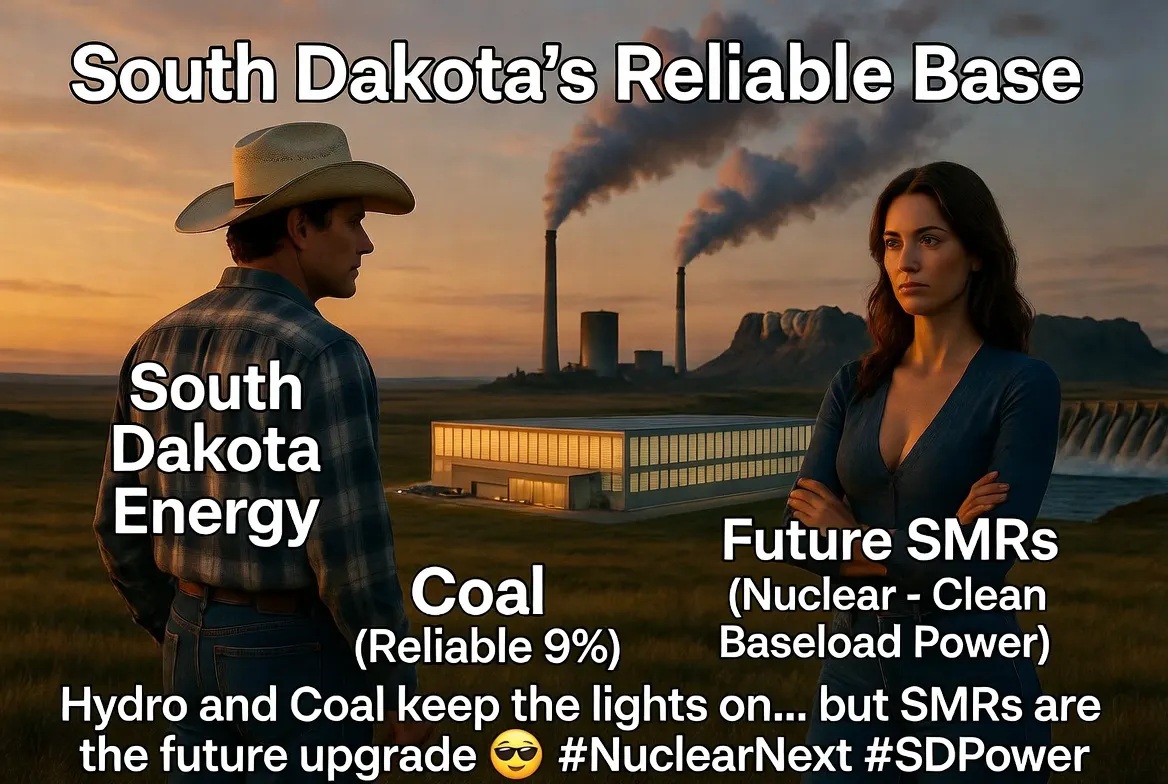
Wind and solar are NOT the long-term answer
South Dakota stands at an energy crossroads. The explosive growth of data center development, driven by the artificial intelligence revolution and the insatiable demand for cloud computing, is converging with longstanding agricultural and industrial energy needs to strain the state’s grid in ways that cannot be managed through inertia or wishful thinking.
Governor Rhoden recognized this plainly during the Tri-State Governors Conference last summer, where he highlighted the heightened power demands of the data center and AI age and expressed serious interest in nuclear energy — particularly the emerging class of small modular reactors (SMRs) that are gaining traction across the country as a scalable, dispatchable, and increasingly cost-competitive baseload solution.
This is not merely a utility planning question. It is a question of economic sovereignty, national security, and the responsibility of state government to ensure that South Dakotans — not distant federal regulators, not out-of-state energy conglomerates, and not well-connected green energy lobbyists — are the primary beneficiaries of the state’s energy future.
Let’s examine the issue in some detail.
STATUS
Governor Rhoden is seeking funding for a nuclear feasibility study, as recommended by his Governor’s Resilience and Infrastructure Task Force, which called for the study as part of “an all-of-the-above energy approach.” Currently, South Dakota produces zero nuclear energy within its borders, though approximately 4% of the electricity consumed in the state is nuclear power imported from elsewhere.
South Dakota is also one of only 11 states that has not entered into an agreement with the federal Nuclear Regulatory Commission to assume authority over radioactive materials — a gap in state regulatory capacity that any serious nuclear development strategy must address early.
WHY SO-CALLED “GREEN” ENERGY CANNOT SOLVE THE LONG-TERM GRID PROBLEM
Proponents of wind and solar energy often point to South Dakota as a renewable success story, and on the surface, the numbers seem impressive: the state produces roughly twice the electricity it consumes, with wind energy in particular generating significant surplus power for export. But this statistical flattery conceals a fundamental and disqualifying flaw — surplus intermittent power is not the same as reliable power, and the distinction matters enormously when lives, livelihoods, and entire industries depend on the grid.
The Intermittency Problem: You Cannot Legislate the Wind or the Sun
Wind turbines generate electricity when the wind blows at the right speed — not too slow, not too fast. Solar panels generate electricity when the sun shines — not at night, not during cloud cover, and with dramatically reduced output during South Dakota’s long winters. These are not engineering problems that innovation will eventually solve; they are physical realities that no amount of federal mandate or activist optimism can change.
The consequence is stark: every wind farm and solar installation on the South Dakota grid must be backed up, in full, by dispatchable power sources that can come online instantly when renewables go dark. This means that the true cost of green energy is never just the cost of the wind turbine or solar panel — it is the cost of that installation plus the full backup capacity required to ensure the lights stay on. Ratepayers in South Dakota and across the nation are effectively paying twice: once for the renewable source and once for the conventional backup that must always stand ready. This is not a conservative talking point; it is basic electrical engineering and grid operations reality.
South Dakota’s existing grid already exports its surplus renewable energy to neighboring states. That export capacity is economically valuable, but it tells us nothing about the state’s ability to meet peak industrial demand with firm, dispatchable power. A new data center or a large agricultural processing facility cannot run on “surplus when available.” They need power on demand, 24 hours a day, 365 days a year. Wind and solar, without massive and as-yet-economically-unproven battery storage, simply cannot provide that.
The Subsidy Problem: Privatizing Profit, Socializing Cost
From a constitutional conservative standpoint, one of the most objectionable features of the green energy regime is the extraordinary system of taxpayer-funded subsidies that props it up. Federal Production Tax Credits, Investment Tax Credits, and a labyrinth of state-level incentive programs have artificially inflated investment in wind and solar by shifting enormous financial risk from private developers onto ordinary taxpayers and ratepayers. Without these subsidies — which have been repeatedly extended and expanded by Congresses of both parties — much of the current wind and solar buildout would be economically unjustifiable.
This is a fundamental perversion of free market principles. Conservatives rightly believe that energy investment decisions should be driven by economics — by what actually produces the most reliable power at the lowest real cost to consumers — not by which energy sources have the most politically connected lobbying operations in Washington. When government picks winners through the tax code, it does not create wealth; it redirects it, punishing efficient producers and rewarding politically favored ones. South Dakota should be deeply skeptical of energy strategies that depend on the continued generosity of a federal government that is $36 trillion in debt and that may not sustain these subsidy levels indefinitely.
The Hidden Cost Nobody Talks About: Decommissioning and Retirement
Perhaps the most dishonest element of green energy project economics is what is almost universally left out of the ledger: the cost of decommissioning. Wind turbines have a functional lifespan of roughly 20 to 25 years. Solar panels degrade meaningfully within 25 to 30 years. When these installations reach end of life, someone must pay to remove them — thousands of tons of fiberglass turbine blades that cannot be recycled, acres of solar panels containing cadmium, lead, and other hazardous materials that cannot simply be landfilled without environmental consequence.
The decommissioning liability for wind and solar projects nationally runs into the tens of billions of dollars, and the financial structures of most green energy projects either dramatically underestimate these costs or leave them as contingent liabilities with no dedicated funding. In many cases, the limited-liability corporate structures used by renewable developers mean that when the bill comes due, the original investors are long gone and the cost falls on landowners, local governments, or state taxpayers. South Dakota lawmakers should demand full, actuarially sound decommissioning bonds from any wind or solar project operating in the state — and should examine critically whether existing projects have adequately provisioned for this obligation.
The Land Use Problem: Industrial Scale at the Expense of Agricultural Sovereignty
South Dakota is an agricultural state. Its land is its heritage and its economic engine. Industrial-scale wind and solar development requires enormous acreage — wind farms in particular consume land at a rate orders of magnitude greater than conventional or nuclear power plants per unit of energy produced. As these installations multiply, questions arise about their long-term impact on agricultural land use, property values, and rural community character. These are not abstract concerns; they are legitimate property rights and local sovereignty issues that conservatives should take seriously, even when the energy source in question is politically fashionable.
THE CASE FOR SMALL MODULAR REACTORS
Against this backdrop, the case for nuclear energy — and specifically for SMRs — is compelling on conservative principles. A single typical nuclear reactor produces as much electricity as two coal or natural gas plants, or three to four renewable resource-based plants combined. SMRs are designed to be smaller, modular, factory-fabricated, and far less capital-intensive than traditional large-scale nuclear plants. They offer firm, dispatchable baseload power that operates independently of weather conditions, requires no backup, and produces no carbon emissions — without requiring taxpayers to subsidize an inherently unreliable technology.
SMRs are not without challenges. Upfront capital costs, while lower than traditional nuclear plants, remain substantial. The regulatory timeline through the Nuclear Regulatory Commission is lengthy, though a number of SMR designs have made significant licensing progress in recent years. The question of spent nuclear fuel storage remains unresolved at the national level, though it is worth noting that the entire volume of spent nuclear fuel produced in the United States over six decades of commercial nuclear power could fit within a single large-box retail store — a waste management challenge that is physically manageable, if politically neglected.
The SMR feasibility study recommended by the Governor’s Task Force is precisely the right first step: prudent, empirical, and consistent with the conservative commitment to evidence-based governance rather than ideological energy fashion. Before committing to any specific technology or investment, South Dakota should know the numbers — the costs, the timelines, the regulatory requirements, and the economic structure that would best serve the state’s interests.
TRADEOFFS AND CONSERVATIVE GUARDRAILS
An all-of-the-above energy strategy, properly understood, does not mean an equal-weight or subsidy-equal strategy. It means rationally assessing what each energy source can and cannot do, what it actually costs when all costs are counted, and what role it can legitimately play in a grid that must first and always be reliable. In South Dakota’s case, that honest assessment points toward dispatchable baseload capacity — gas, nuclear, or both — as the foundation, with renewable energy playing a supplementary role where it is economically justified without subsidies.
Several conservative guardrails should govern any further energy policy development in South Dakota:
First, the state should resist any pressure to use public subsidies to underwrite private data center energy needs. Data centers are private, profit-seeking enterprises. If they choose to locate in South Dakota, they should bear the full cost of the power infrastructure their operations require. The correct model is for large industrial customers to be designated “interruptible customers” during peak demand periods and to invest in their own backup generation rather than socializing their demand onto existing residential and agricultural ratepayers.
Second, if nuclear development is pursued, it must be structured to benefit South Dakotans first. Any public investment, regulatory cooperation, or infrastructure development should be conditioned on power pricing, local workforce requirements, and governance structures that ensure the state’s citizens — not distant shareholders or federal bureaucrats — capture the primary value.
Third, South Dakota should move deliberately toward entering a regulatory agreement with the Nuclear Regulatory Commission, as 39 other states have done, to take appropriate state-level authority over radioactive materials. Ceding this regulatory space entirely to the federal government is inconsistent with the Tenth Amendment principles that should guide South Dakota’s relationship with Washington.
CONCLUDING THOUGHTS
Here is a positional statement from a constitutional conservative perspective.
Energy independence and grid reliability are not peripheral policy concerns — they are national security imperatives and economic sovereignty issues of the first order. A state that cannot reliably power its own economy is a state that has surrendered a fundamental dimension of self-governance.
The fashionable green energy consensus, for all its political momentum and federal subsidy support, cannot deliver what South Dakota’s grid actually needs: firm, dispatchable, weather-independent baseload power at a price that does not depend on perpetual taxpayer subsidy. Wind and solar have a role in South Dakota’s energy mix, but that role must be sized honestly — accounting for backup costs, retirement liabilities, and subsidy dependence — rather than through the distorted lens of federal tax incentives and activist energy modeling.
Next-generation nuclear energy, especially SMRs, represents a genuinely conservative energy option: technologically proven at scale, environmentally responsible, economically viable without permanent subsidy, and capable of delivering the reliability that modern industry and a growing state economy demand.
Governor Rhoden’s interest in nuclear feasibility is sound, and studies should be accelerated. But the broader lesson is this: South Dakota’s energy future must be built on the honest economics of reliable power, not on the political economics of subsidized intermittency.
The end.
StuinSD is a reader-supported publication. To receive new posts and support his work, consider becoming a free or paid subscriber.
This article originally appeared in Stu Cvrk’s Substack. Reprinted here with permission
If you enjoyed this article, then please REPOST or SHARE with others; encourage them to follow AFNN. If you’d like to become a citizen contributor for AFNN, contact us at managingeditor@afnn.us Help keep us ad-free by donating here.
Substack: American Free News Network Substack
Truth Social: @AFNN_USA
Facebook: https://m.facebook.com/afnnusa
Telegram: https://t.me/joinchat/2_-GAzcXmIRjODNh
Twitter: https://twitter.com/AfnnUsa
GETTR: https://gettr.com/user/AFNN_USA
CloutHub: @AFNN_USA
The storage issue is a quick fix. This is what eminent domain is there for. Tell Nevada that Yucca Mountain now belongs to the federal government, here is a check, tough if you don’t like the Harry Reid Toxic Waste Disposal Site is operational from now till the end of time.