This is the opening image of Portland’s Mexican Consulate.
In December 2004, a colleague and I attended a meeting at the Mexican Consulate in downtown Portland, Oregon. Why were two attorneys attending this meeting? We were both elected members of the Oregon State Bar’s House of Delegates and were curious about a planned partnership between the Bar and the Consulate,^ which was in violation of federal law. At the meeting, they were discussing Matricula Consular ID cards for Mexican citizens who were living illegally in the USA and how the State of Oregon was honoring this form of ID to provide welfare benefits, work permits, etc. I don’t remember any other details of the meeting other than the meeting’s leader refusing to answer my “does the State of Oregon provide you with any funds?”
FINALLY!!!!!!!!!!!!!
The US Department of State is launching a review of Mexico’s 53 consulates in the United States amid heightened scrutiny of their use by the Mexican government to meddle in US domestic politics and promote mass migration.
The State Department did not specify what the review would examine, but acknowledged that it could result in the closure of some consulates. In a statement, Assistant Secretary of State for Global Public Affairs Dylan Johnson noted, “Department of State is constantly reviewing all aspects of American foreign relations to ensure they are in line with the President’s America First foreign policy agenda and advance American interests.”
The State Department’s review comes amid renewed scrutiny over Mexico’s use of its consulates to subvert American sovereignty. In “The Invisible Coup: How American Elites and Foreign Powers Use Immigration as a Weapon,” published earlier this year, investigative journalist Peter Schweizer noted, “Across America, the Mexican government, through its more than fifty consulates, is blatantly interfering in our domestic politics, working with American political advisors to turn legal and illegal migrants inside the US into a political force to wield for their benefit.” Schweizer has called on the Department of State to investigate and close Mexico’s consulates.
Schweizer noted Mexico’s large number of consulates in the United States, explaining, “The United Kingdom and China have six and seven consulates in the United States. Mexico has 53 and, just to put this in context, just in the state of Arizona, they have four consulates. So they have almost as many in the state of Arizona as Great Britain has in the entire United States.”
Despite regularly touting its support for “mutual respect” in foreign relations, Mexico has repeatedly taken an adversarial stance toward the United States and meddled in its politics. For example, in 2021, it filed a lawsuit in federal court seeking to hold American firearms manufacturers responsible for cartel violence in Mexico. an assault on the Second Amendment. Additionally, its leaders have threatened to directly intervene in American elections, openly promoted an open-borders US immigration policy, and even campaigned in American cities to rally Mexican migrants against a pro-American immigration policy.
Ultimately, Schweizer explains, “Mexico’s interest in mass migration results from its hopes of reclaiming or reconquering … the territories it lost to us in the nineteenth century,” citing senior Mexican leaders who have voiced this objective. By promoting migration to the United States, Mexico is engaging in “organized political subversion, with people being wielded as tools to undermine our country’s sovereignty.”
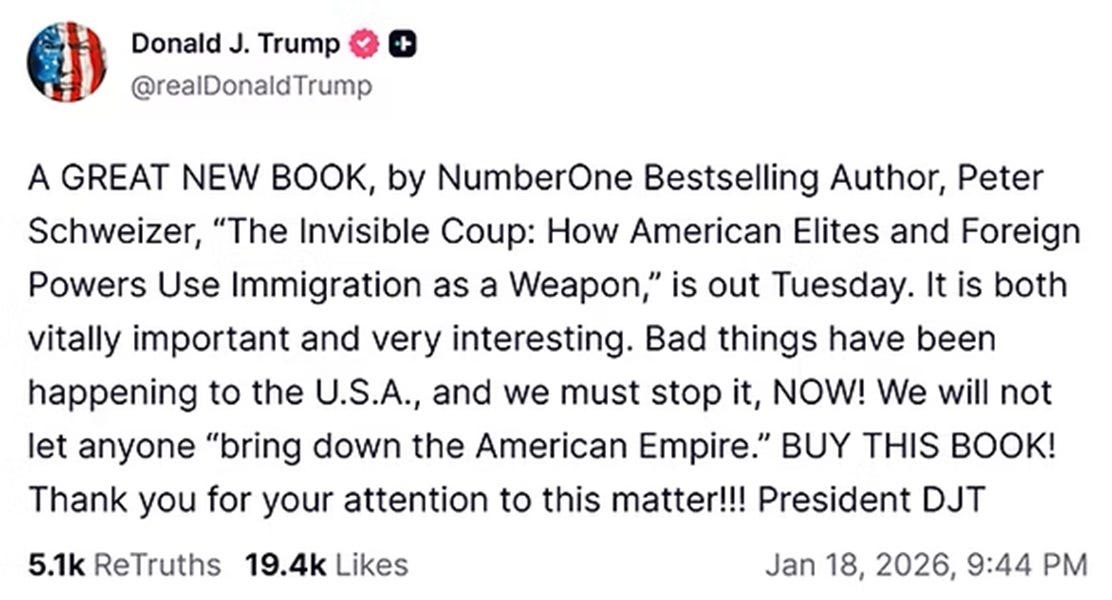
ARE COURTS FINALLY WAKING UP?
Others are beginning to recognize these subversive efforts, as well. On April 24th, the US Fifth Circuit Court of Appeals voted 10-7 to overturn a temporary injunction imposed by a lower court on Texas Senate Bill 4, a 2023 law criminalizing illegal migration. For example, Judge James Ho defended Texas’ law by explaining that “nations have long weaponized migration to harm other nations,” and that “the United States has become one of the most popular targets of these threats,” of weaponized mass migration, including from Mexico to advance its revanchist goals.
Quoting from “The Invisible Coup: How American Elites and Foreign Powers Use Immigration as a Weapon” by Peter Schweizer, Judge Ho continued: Similarly, “Mexico’s interest in mass migration results from its hopes of reclaiming or reconquering … the territories it lost to us in the nineteenth century.”… The former President of the Mexican Senate, for example, recently declared that “Los Angeles is migrant land,” and parts of America are “occupied territories,” so Mexico should “once again demand the recovery of these territories.”… And Russia is actively encouraging Mexico in this regard.
Revanchist describes a government policy aimed at reclaiming a territory they believe to be theirs, or restoring a country’s former borders and status, usually following a war, treaty, or geopolitical shift. The term comes from the French word revanche, which simply means “revenge.”
If our adversaries are going to weaponize mass migration to harm America as well as other countries, our elected officials are entitled to respond accordingly. Schweizer’s research demonstrates how mass migration poses an existential threat to the United States. More broadly, globalist forces are using mass migration to erode American independence and promote open borders & world government.
The State Department’s review of Mexico’s consulates is long overdue and hopefully, it will only be the first step toward protecting US sovereignty and deterring weaponized migration from Mexico.
COMMON USES & RECOGNITION OF MATRICULA CONSULAR ID CARDS
Because the card requires verified proof of Mexican citizenship and a local address in the USA, it acts as a critical lifeline for daily administrative tasks. Its acceptance depends entirely on state laws and institutional policies:
Banking: Many major US financial institutions accept the card as valid secondary identification to open checking or savings accounts and home mortgages. Decades ago Bank of America proudly announced that they would honor these cards as a form of identification for bank accounts and loans.
Driving and Insurance: Blue States’ Departments of Motor Vehicles (DMVs) accept the Matrícula Consular as proof of identity to apply for a driver’s license. Some non-standard auto insurance providers also accept it to issue policies; however, most illegals do not have auto insurance AND Blue States do not enforce the law which requires American drivers to have auto insurance.
Local Governance and Law Enforcement: Various municipal police departments, utility companies, and school districts recognize the card to verify identity during interactions.
Federal Contexts: The US Department of Homeland Security (DHS) and federal agencies generally do NOT accept the card for official federal identity verification or standalone immigration purposes.
Follow me on X Diane L. Gruber
Democrat Who Lives In Mexico Runs For US Congress, Urinates On Trump’s Star

In his book “The Invisible Coup: How American Elites and Foreign Powers Use Immigration as a Weapon,” Peter Schweizer reveals that 15 elected members of Mexico’s Chamber of Deputies (Similar to the US House.) live full time in the United States. Their duties …
^The intense public scrutiny and administrative debates surrounding state agencies, local organizations, and the Matrícula Consular ID cards reached a major turning point across the United States, and specifically within Oregon, in 2004. By 2004, the federal government was actively auditing how these identification cards were being utilized nationwide. In July 2004, the US Government Accountability Office (GAO) issued a comprehensive report evaluating the growing acceptance of Matrícula Consular cards by state governments, local law enforcement, and financial institutions.
This was the exact period when local elected officials, state representatives, and members of the Oregon State Bar’s House of Delegates began formally raising questions about the legality of state funding, welfare alignment, and planned institutional partnerships involving the Mexican Consulate in downtown Portland. The core controversy regarding structural partnerships and state recognition of the consular ID cards heavily solidified in late 2004.
The author, Diane L. Gruber, is a First Amendment advocate who writes for Substack. She calls her Substack newsletter America First Re-Ignited. Follow me on X @DianeLGruber.
If you enjoyed this article, then please REPOST or SHARE with others; encourage them to follow AFNN. If you’d like to become a citizen contributor for AFNN, contact us at managingeditor@afnn.us. Help keep us ad-free by donating here.
Substack: American Free News Network Substack
Truth Social: @AFNN_USA
Facebook: https://m.facebook.com/afnnusa
Telegram: https://t.me/joinchat/2_-GAzcXmIRjODNh
Twitter: https://twitter.com/AfnnUsa
GETTR: https://gettr.com/user/AFNN_USA
CloutHub: @AFNN_USA
Patriot.Online: @AFNN