The bag of vegetables magically appeared on our front porch along with beer. I looked around for angels and wisemen.
Then I turned to my wife, saying, “Ray, is this heaven?”
She looked at me flatly. “Who’s Ray?”
You have to worry about this woman.
So, we brought the vegetables inside and commenced admiring the produce. Admiring beautiful things is every bit as euphoric as experiencing them.
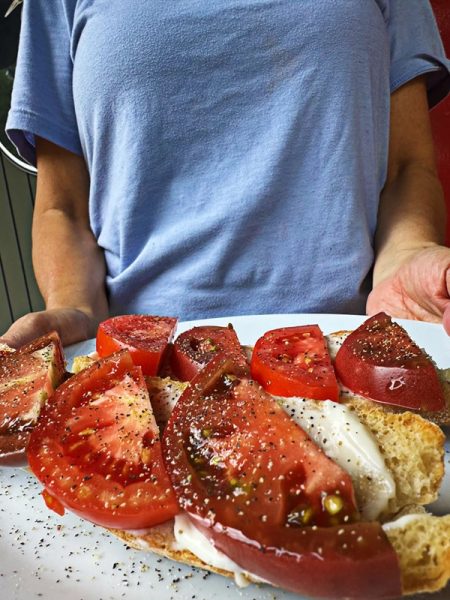
We held the heirloom tomatoes in our hands, and just appreciated the mere weight of them.
Oh. Has there ever been anything more heavensent than a homegrown tomato? I lifted it to the light. It was so round, so firm, so fully packed.
“Look at this thing,” I said, gently caressing its supple curves.
My wife yanked the tomato from my hands. “Go take a cold shower.”
All other tomatoes were equally as glorious. Bright crimson skin, beautiful little stems, each fruit with little bits of gnarl on the surface.

Everyone knows the best tomatoes have gnarl on the outside. This gnarl is rarely talked about, rarely appreciated, but it’s important. Good gnarl gives the tomato personality, and makes the tomato an individual.
Gnarl comes in different variations. There’s “catfacing,” which is the grayish brown puckering and scarring portion at the blossom end of a tomato. Usually the bottom. Catfaced tomatoes are misshapen and lovely, and often taste like cherubs singing Handel.
Then there’s “zippering.” This effect is a zipper-like scar on the tomato. My mother used to grow tomatoes; she said this happens when the flower’s stamen sticks to the side instead of shedding cleanly. A zippered tomato is worth driving across at least four state lines.
And of course, there are the beautifully decadent common growth cracks. There is nothing like a good growth crack. These cracks travel along the side of the tomato, growing with the tomato throughout its lifetime, transforming the fruit into the same rounded, full-figured, clefted shape often found in Sports Illustrated Swimsuit editions.

Sadly, you can’t find tomatoes with growth cracks in supermarkets. This is because cracks are considered imperfections. Food sellers want everything to be pretty and perfect, so they give us tomatoes shellacked in a quarter-inch of wax, with skin like an armadillo, the flavor of a commercial brick, and no crack showing.
In fact, almost everything you buy today looks perfect. Also, everything you see on television appears perfect. Every image you see on social media is perfect. When did we get rid of imperfections in our culture?
I, for one, miss imperfection. I have a weakness for imperfect things. Maybe it’s because I am one.
Even so, I love imperfections. I miss watching television and seeing imperfect people who look like normal people. What happened, for instance, to elderly people on TV? Why aren’t there any Aunt B’s, Granny Clampetts, and Fred Sanford’s? Did producers round them up and carry them off to Sumter County, Florida? Isn’t ANYONE trying to market to older people? Don’t older people BUY STUFF? And more importantly, why am I writing IN ALL CAPS?
Today, the media has conveniently ignored the aging process. Photos filters and smartphone photography can correct liver spots, skin blemishes, saggy jowls, and wrinkles. Skin is re-textured and smoothed. Teeth are whitened. Lighting is perfect by algorithms before the photo is even snapped.
It’s not just phone cameras that eliminate imperfections. There are real-life filters, too. Each year, 1.58 million cosmetic procedures are performed and 28.2 million minimally invasive procedures.
Writing has been perfectionized, too. Natural human speech was once clunky, littered with pauses, lots of typoes, and ahkward frasing. But all that’s been erased.
Today, software anticipates what I mean to say, fixing my grammatical mishaps in realtime. In fact, while typing that last sentence, the computer repeatedly changed “grammatical mishaps” to “aromatic starships,” “automated pork chops,” and my favorite: “traumatic kneecaps.”
The era of the rough draft is over.
Likewise, music is losing its human soul. AI effects like auto-Tune and quantization have changed the game. Singers can sing flat, drummers can miss the beat by milliseconds, and you don’t even have to have a band anymore, the computer can write your song, play your song, then go out back with all the other musician computers and smoke computerized cigarettes in the alley.
Speaking of music, the annual number of college music majors who can actually play a musical instrument has dramatically dropped in the last five years. Degrees in music technology and digital audio composition are skyrocketing. Music professors lovingly refer to these students as “laptop majors.”
And if all this isn’t bad enough, Major League Baseball is considering an AI umpire.
I don’t mean to depress you. I suppose these things are all just part of living in a perfect world. Everything looks great. Everything feels great. Everything appears sparkly and flawless.
But don’t forget the subtle beauty of unsterilized imperfection. As you go about your day today, let your quirks show. Be proud of every wrinkle, blemish, and scar you own—you earned them fair and square. In other words, when you’re out there among the human race, don’t be afraid to show a little crack.
Thanks for the tomatoes, John and Karen.

Questions: SeanDietrich@gmail.com
Visit the Sean of the South Website
Find out where you can see Sean live.
Originally published on Sean’s website. Republished here with permission.
If you enjoyed this article, then please REPOST or SHARE with others; encourage them to follow AFNN. If you’d like to become a citizen contributor for AFNN, contact us at managingeditor@afnn.us Help keep us ad-free by donating here.
Substack: American Free News Network Substack
Truth Social: @AFNN_USA
Facebook: https://m.facebook.com/afnnusa
Telegram: https://t.me/joinchat/2_-GAzcXmIRjODNh
Twitter: https://twitter.com/AfnnUsa
GETTR: https://gettr.com/user/AFNN_USA
CloutHub: @AFNN_USA