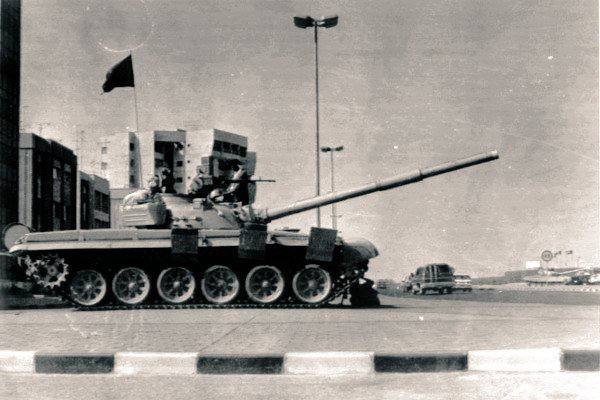
Iraq invasion of Kuwait, 1990.
Sun Tzu, famous Chinese War scholar, stated: “If you know neither the enemy nor yourself, you will succumb in every battle.” Identifying correctly the Center of Gravity (COG) is critical to strategic victory. The U.S. COG has always been public and political fragility while the Iranian COG is the survival of the Iranian Revolutionary Guard Corps (IRGC) and its continued ability to protect the structures of the Islamic Republic.
The U.S. is second to none when it comes to military dominance, but the paradox is that tactical success can still result in strategic defeat—in fact, our expert ability to break things and kill people has more often than not resulted in accomplishing worse than nothing. During Command and General Staff College, I wrote a paper on the Vietnam War which concluded: “The Vietnam experience taught us that nations dependent on the ‘will of the people’ cannot pursue wars of attrition to the same extent as totalitarian regimes. Therefore, democratic republics must especially heed General Douglas MacArthur’s wise counsel when he addressed a joint session of Congress on April 19, 1951: ‘But once war is forced upon us, there is no alternative than to apply every available means to bring it to a swift end. War’s very object is victory—not a prolonged indecision. In war, indeed, there can be no substitute for victory.’” Not heeding our Vietnam experience in Afghanistan, over a period of 20 years of prolonged indecision, we replaced the Taliban with the Taliban, a clear U.S. strategic defeat, which puts into question our political elites’ historical introspection and self-awareness. In these and other conflicts, our enemy, through attrition, outlasted us, and broke down our COG—the public and political will to continue fighting.
What about our COG in the Iran conflict with public polls indicating majority opposition to the Iran War, and no bi-partisan political support? Rather than shoring up public support over time and seeking Congressional approval as previously done, the Iran War became the first “post-deliberative” war in American history, ensuring that our COG was especially weak. The icing on the cake was initiating this attack a few months before Congressional elections, ensuring an artificial political time-limit to operations that should be guided instead by goal accomplishment. Our Founders entrusted to Congress the decision to Declare War (Article 1, Section 8), and previous large scale military operations have involved congressional authorization. Such public and political “buy-in” buttresses our COG—without it, there is immense political risk and pressure to quickly off-ramp operations, declare a “victory” masking a strategic defeat, and dispense with the patience and the use of all means necessary to solve a problem once and for all.
The problem with “mowing the grass” operations is that the American public and political class get bored or outraged by mundane repetitive military ops which essentially “kick the can down the road,” while making the adversary more immune at each iteration—the equivalent of “what doesn’t kill me makes me stronger.” We saw this in Vietnam, Afghanistan and Iraq twice—first, with Saddam Hussein whose Iraq was bombed on a regular basis for years after Gulf War I. This only prolonged the suffering until the U.S. invaded with enough force to topple the regime but not enough force to effectively occupy the country. Then we continued to “mow the grass” until we finally took decisive action against ISIS. In Afghanistan, we “mowed the grass” for 20 years until we finally gave up. “Mowing the Grass” is a strategy of indecision, no-win forever wars, making the enemy stronger over time, and severely destroying our COG. The question to ask is: are we entering a period of appeasement with the new MOU or mowing the Iranian grass for a long period of time by periodically bombing them and blockading their ports? Both Courses of action are sub-optimal. It appears that the Iranians, just like the Vietnamese, and Afghanis, are simply waiting us out to achieve strategic victory.
In prolonged conflicts when the US is politically unwilling to use all means necessary to destroy an enemy completely, the passage of time always benefits the other side. This phenomenon is developing in real time in the Iran conflict. Our decapitation campaign simply hardened the regime and effectively turned over control to the nuclear happy IRGC. It was the old Khamenei with his Fatwa who resisted IRGC pressure to build the nuclear bomb—with him gone and the IRGC in full control, there are no longer any disincentives for Iran to race for the bomb, notwithstanding the new MOU. We also see that Iran has discovered a new strategic tool in the closing of the Straits of Hormuz. Just the fact that Iran can now play the game of opening and closing the Straits at will, and disrupting the World economy at its whim, is a strategic victory. Our additional blockading of the Straits only added to the economic pain and our Navy was held hostage south of Hormuz playing Iran’s game of causing havoc to energy markets. The shelving of the vaunted Project Freedom demonstrated that our Navy did not have the diplomatic and political backing to conduct an air-tight blockade of the Straits. Our weak COG affected our ability to persuade allies and to line up our military resources to attain the permanent objective of destroying the IRGC and the Islamic Republic.
The theocratic regime clearly deserves to disappear. It is a menace to all its neighbors and consistently murders its own people en masse, but the question of whether it poses an imminent or long-term threat to the U.S. is secondary to our political willingness to marshal sufficient forces to end the regime. As a student at the Army War College in 2013, I wrote the following: “Preemptive strikes would not destroy Iran’s nuclear capability but would make Iranian retaliation in every available theater a certainty. The U.S. would then have to choose between failure and full-scale invasion/occupation. An invasion imposing democracy ostensibly to prevent a nuclear crisis is fraught with unpleasant dilemmas such as nationalistic guerilla resistance, lack of international support, the ethics of exit, and resourcing challenges in a time of national fiscal crisis. Post-invasion, there would be no guarantee of democracy or international peace.” With the signed MOU, the decision point between failure and full-scale invasion has tipped in favor of the former because of our weak COG.
The MOU anticipates a final agreement that constricts future military operations, obligates the U.S. to police Israel’s actions, requires termination of all sanctions and the development of a plan providing $300 million to the Islamic Regime. Iran simply “reaffirms” that it will not develop nuclear weapons, something the Ayatollahs always affirmed. This MOU is arguably much worse than the status quo ante-bellum, and significantly, provides the Regime time and money, essential for its survival. Therefore, Iran may well abide by this agreement, but why should we trust them with any agreement? Iran’s modus operandi is clearly enshrined in the Shia Islam concept of Taqiya: “Based on Muhammad’s example of breaking the treaty after two years, by citing a Quraish infraction, the sole function of the ‘peace-treaty’ (hudna) is to buy weakened Muslims time to regroup for a renewed offensive. Muhammad is quoted in the Hadith saying: ‘If I take an oath and later find something else better, I do what is better and break my oath (see Sahih Bukhari V7B67N427).’” Consequently, at a time it deems advantageous, maybe after the next elections, Iran could easily renege on any Hormuz and nuclear “promises” at a time when we are consumed with other crises and are unable to respond. Trying to make a solid “agreement” under such presuppositions and circumstances is a fool’s errand, and historically, the U.S. has played the role of the fool.
A boots-on-the-ground invasion (by US and/or coalition troops) would have been fraught with challenges as mentioned above but was nevertheless the only means to effectuate regime collapse—thinking otherwise and imagining uprisings by severely frightened and suppressed civilians was strategy by wishful thinking and woeful preparation. The lopsided MOU, masking U.S. strategic defeat, is the inevitable consequence of a strategy that ignored strategic reality and the respective COGs. A better and more constitutionally faithful course of action would have been to shore up our COG by letting our people and politicians debate the nature of the threat, and if a decision was made to engage, to do so with such overwhelming force, necessarily including ground troops, as to destroy the existence of the Islamic Republic. Starting this War with minimal public support has resulted in the replacement of Khamenei with a more hardline Khamenei and the future portends either a no-win forever war or an agreement lopsided in Tehran’s favor.
Those who argue that we were somehow victorious are victim to hubristic thinking and the body count mentality of Vietnam. Counting the number of replaceable regime leaders and destroyed enemy weapons systems was the myopic message coming out of the Pentagon. Destroying more of the enemy’s toys of War, while ignoring strategic reality, does not a Victory make.
The likely final agreement, Taqiya-made to be broken in time, cementing the existence of an Islamic Republic intent on revenge and secret development of a nuclear bomb, and more determined to ruthless internal suppression, and assertive control over the Straits of Hormuz, is the opposite of a strategic victory. Such an outcome is the result of failing to understand ourselves enough to buttress our COG, and equally critically, to understand the nature of the enemy and its COG. It would have been better not to commence hostilities at all. As George Santayana stated, “Those who cannot remember the past are condemned to repeat it.”
COL (Retired) Albert R. Veldhuyzen spent 29 years in the U.S. Army Judge Advocate General’s Corps and significant time deployed in the Middle East during Operations Iraqi Freedom, Freedom’s Sentinel in Afghanistan, and Operation Inherent Resolve to crush the Islamic State.
For a more in-depth view of COL Veldhuyzen’s qualifications, see https://www.linkedin.com/in/albert-veldhuyzen-82a577b/
If you enjoyed this article, then please REPOST or SHARE with others; encourage them to follow AFNN. If you’d like to become a citizen contributor for AFNN, contact us at managingeditor@afnn.us Help keep us ad-free by donating here.
Substack: American Free News Network Substack
Truth Social: @AFNN_USA
Facebook: https://m.facebook.com/afnnusa
Telegram: https://t.me/joinchat/2_-GAzcXmIRjODNh
Twitter: https://twitter.com/AfnnUsa
GETTR: https://gettr.com/user/AFNN_USA
CloutHub: @AFNN_USA