Every generation thinks they’ve discovered a money-printing machine.
Every generation is convinced the old rules no longer apply.
Every generation eventually relearns that gravity still works.
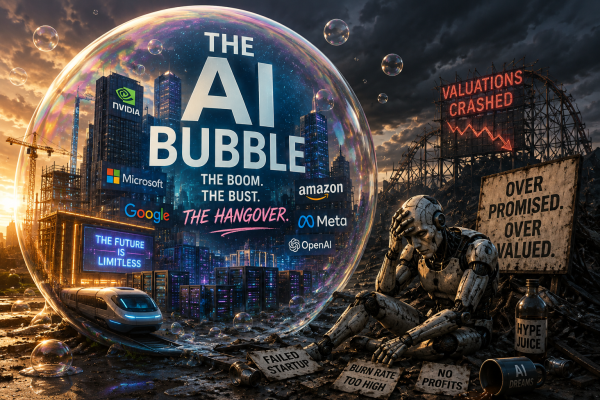
Today, artificial intelligence is that money-printing machine. AI is remarkable. It writes, draws, codes, translates, analyzes, and in many cases embarrasses the average office worker before lunch. This technology is real. It isn’t tulips. It isn’t Beanie Babies. It isn’t some crypto coin named after a dog. AI will almost certainly change civilization.
That doesn’t mean investors aren’t about to lose their shirts.
Jeremy Grantham, one of the few investors who has made a career out of recognizing bubbles before everyone else, has a simple observation. Revolutionary technology and terrible investments often arrive together. The technology wins. Many of the investors don’t.
History has been trying to teach us this lesson for two hundred years.
Take the railroads.
They united America, shrank the continent, fueled industry, and transformed commerce forever. Investors couldn’t throw money at railroad companies fast enough. Thousands of miles of track were laid. Hundreds of companies sprang into existence. Everybody was going to become rich.
Then reality showed up with a shovel.
Many railroad companies collapsed under mountains of debt. Investors were ruined. Fortunes evaporated.
The funny part? The railroads themselves didn’t disappear.
The tracks stayed right where they were.
The next generation simply bought the bankrupt assets for pennies on the dollar and made fortunes using infrastructure someone else had already paid to build.
Fast-forward another century.
Electricity changed everything.
Factories.
Cities.
Homes.
Transportation.
Investors again convinced themselves that every company with a generator was the future.
Some were.
Most weren’t.
Then came the Internet.
If you’re old enough to remember 1999, congratulations—you’ve already survived one of these rodeos.
Companies with no profits were somehow worth billions. Business plans consisted of burning investor cash while promising to “monetize later.” Television experts assured everyone that earnings no longer mattered because we had entered the “New Economy.”
Turns out mathematics didn’t get the memo.
The NASDAQ lost nearly eighty percent of its value. Thousands of companies disappeared. Retirement accounts got absolutely hammered.
And yet…
The Internet still conquered the world.
Amazon survived.
Google survived.
The technology was real.
The valuations weren’t.
Now here comes AI.
Microsoft doesn’t dare slow down because Google might pass them.
Google doesn’t dare slow down because OpenAI might pass them.
Meta doesn’t dare slow down because Mark Zuckerberg apparently wakes up every morning determined to build Skynet before someone else does.
Amazon is spending.
Oracle is spending.
Everyone is spending.
They’re building data centers the size of aircraft carriers. They’re buying every NVIDIA chip they can find. They’re building natural gas plants, investing in nuclear power, laying fiber-optic cable, expanding electrical grids, and hiring anyone with “AI” somewhere on their résumé.
It’s an arms race where nobody knows exactly where the finish line is, but everyone is terrified of finishing second.
Here’s where capitalism gets both brilliant and completely insane.
Every CEO is behaving rationally.
Every board of directors is behaving rationally.
Every investor believes they’re behaving rationally.
Collectively?
They may be creating one enormous bubble.
Suppose AI adoption takes longer than Wall Street expects. Businesses realize replacing accountants, lawyers, engineers, and customer service representatives isn’t quite as easy as the PowerPoint presentation promised. Companies continue spending billions because stopping would look like surrender. Revenue grows—but not fast enough to justify trillion-dollar valuations.
Then someone misses earnings.
One domino falls.
Then another.
Investors suddenly remember that profits actually matter.
The exits become crowded.
Stock prices fall.
Pension funds take losses.
Retirement accounts shrink.
Startups vanish almost overnight.
Construction projects stop halfway through.
Banks tighten lending.
Hiring freezes begin.
The media acts shocked, despite spending the previous three years cheering the bubble higher.
Sound familiar?
It should.
We’ve watched this movie before.
Here’s the part many people misunderstand.
This wouldn’t prove capitalism failed.
It would prove capitalism acted exactly like capitalism.
Free markets are extraordinarily good at funding innovation. They’re also extraordinarily good at getting drunk on optimism.
Sometimes they overbuild.
Sometimes they overborrow.
Sometimes they convince themselves that this time the laws of economics have been permanently suspended.
Spoiler alert: they haven’t.
The beautiful part is what happens afterward.
Unlike centrally planned economies, capitalism allows failure.
Companies die.
Bad ideas disappear.
Capital gets recycled.
The survivors inherit roads they didn’t build, factories they didn’t finance, fiber they didn’t install, and data centers someone else paid billions to construct.
Creative destruction isn’t pretty.
It’s demolition before renovation.
Compare that to centrally planned economies, where governments decide which industries deserve investment. There are fewer spectacular bubbles because bureaucrats don’t allow them. Unfortunately, they also don’t allow nearly as much innovation. Bad decisions linger for decades because governments rarely admit mistakes. Inefficient industries survive on subsidies while entrepreneurs suffocate under paperwork.
Capitalism is messier.
It occasionally drives straight into a ditch at seventy miles an hour.
Then it climbs out, dusts itself off, invents something incredible, and somehow ends up wealthier than before.
That’s why I suspect AI isn’t the end of the story.
It’s the beginning.
There will probably be companies we’ve never heard of today that dominate the AI economy twenty years from now.
There will also be household names that simply disappear.
That’s how revolutions work.
So buckle up, buttercup.
If history is any guide, we’re about to witness another spectacular boom followed by an equally spectacular hangover.
Don’t confuse the hangover with the end of the party.
The technology is probably here to stay.
The bubble?
Not so much.
If you enjoyed this article, then please REPOST or SHARE with others; encourage them to follow AFNN. If you’d like to become a citizen contributor for AFNN, contact us at managingeditor@afnn.us Help keep us ad-free by donating here.
Substack: American Free News Network Substack
Truth Social: @AFNN_USA
Facebook: https://m.facebook.com/afnnusa
Telegram: https://t.me/joinchat/2_-GAzcXmIRjODNh
Twitter: https://twitter.com/AfnnUsa
GETTR: https://gettr.com/user/AFNN_USA
CloutHub: @AFNN_USA