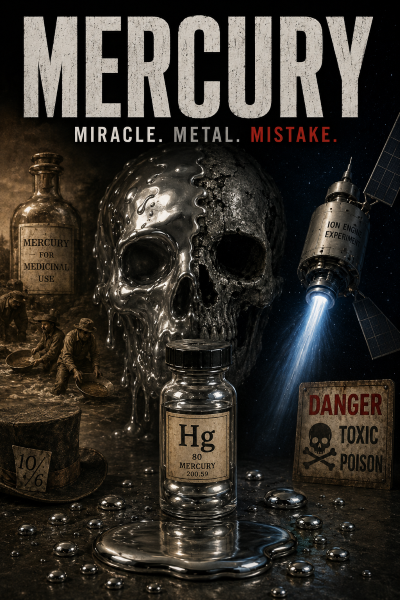
Every generation has that one invention everyone swears is the future. Lead paint. Asbestos insulation. Cigarettes recommended by doctors. And somewhere near the top of humanity’s Hall of Fame for “What Could Possibly Go Wrong?” sits mercury.
Liquid metal.
Just saying those two words makes every twelve-year-old immediately want to play with it.
For centuries, people thought mercury was practically magical. It flowed like water, shined like polished chrome, dissolved gold, made precision instruments possible, and even found its way into medicine. If you had a problem in the 1800s, there was a decent chance someone would prescribe mercury for it.
Spoiler alert: the mercury often became the bigger problem.
Gold miners loved it because gold happily bonded with mercury. Hat makers soaked felt with mercury compounds. Doctors handed it out like aspirin. Scientists filled thermometers with it. Kids rolled little silver beads around school science labs because nobody had yet invented the phrase, “Maybe don’t let children play with neurotoxins.”
Even NASA got in on the action.
During the dawn of the Space Age, engineers used mercury as the propellant for experimental ion engines. They didn’t burn it like rocket fuel. Electricity stripped electrons off mercury atoms, then accelerated those ions out the back of the spacecraft at incredible speed. Newton’s Third Law took care of the rest.
Throw mercury one direction.
Spacecraft goes the other.
Physics smiled.
The safety officer… probably needed a drink.
Unfortunately, mercury has one tiny design flaw.
It’s spectacularly good at poisoning humans.
Mercury slowly evaporates into an invisible vapor that your lungs absorb without asking permission. Once inside, it attacks the brain, nervous system, kidneys, and pretty much every system you’d prefer to keep operational.
The symptoms read like a horror movie checklist.
Shaking hands.
Memory loss.
Mood swings.
Depression.
Anxiety.
Insomnia.
Poor coordination.
Personality changes.
Confusion.
Eventually, severe exposure can leave someone barely able to think or function.
The phrase “mad as a hatter” wasn’t inspired by a whimsical children’s story. Hat makers really did breathe mercury for years while making felt hats. Many developed tremors, emotional instability, slurred speech, and bizarre behavior. Society laughed at the symptoms for decades before realizing the hats weren’t making people crazy.
The mercury was.
Nature, of course, decided to make the situation even worse.
Mercury doesn’t politely stay where you spill it. Bacteria convert it into methylmercury, an even nastier form that works its way into fish. One fish eats another, then another fish eats that fish, and suddenly the biggest fish in the lake has become a swimming chemistry experiment.
Which explains why your doctor doesn’t recommend eating tuna seven days a week.
Today, mercury has been pushed out of most consumer products. Old thermometers disappeared. Many electrical switches vanished. Early space programs abandoned mercury in favor of xenon for ion engines. Turns out engineers prefer propellants that don’t require a paragraph of hazardous-material warnings every time someone opens the maintenance manual.
Mercury teaches an uncomfortable lesson.
Humans have an extraordinary talent for falling in love with clever ideas before asking inconvenient questions like, “Will this slowly dissolve our nervous systems?”
Every era believes it’s the smartest civilization that has ever lived.
The Romans thought lead pipes were brilliant.
Victorian doctors prescribed mercury.
We thought asbestos was a miracle fiber.
Someone somewhere is currently pitching the next revolutionary technology with an equally impressive PowerPoint presentation.
History suggests one simple rule:
If someone describes a product as “perfectly safe” (like vaccines) before the long-term studies are finished… maybe don’t volunteer to be part of the experiment.
Mercury didn’t betray humanity.
It simply obeyed chemistry.
We were the slow learners.
If you enjoyed this article, then please REPOST or SHARE with others; encourage them to follow AFNN. If you’d like to become a citizen contributor for AFNN, contact us at managingeditor@afnn.us Help keep us ad-free by donating here.
Substack: American Free News Network Substack
Truth Social: @AFNN_USA
Facebook: https://m.facebook.com/afnnusa
Telegram: https://t.me/joinchat/2_-GAzcXmIRjODNh
Twitter: https://twitter.com/AfnnUsa
GETTR: https://gettr.com/user/AFNN_USA
CloutHub: @AFNN_USA
I cringe about this childhood memory:
>mid 1960s the house I grew up in a house that had steam heat, with ASBESTOS insulated pipes in the basement.
Me and my brother figured out if we beat the insulation with sticks, we could make it “snow”.
Then I did a 40+ year career in automotive related trades ( that used lots of asbestos in brakes & clutches)until it was replaced with some other “miracle” substance.
Thank God at 70 YO I have no related disease or symptoms.
.
I cringe about this childhood memory:
>mid 1960s the house I grew up in a house that had steam heat, with ASBESTOS insulated pipes in the basement.
Me and my brother figured out if we beat the insulation with sticks, we could make it “snow”.
Then I did a 40+ year career in automotive related trades ( that used lots of asbestos in brakes & clutches)until it was replaced with some other “miracle” substance.
Thank God at 70 YO I have no related disease or symptoms.
.