History is a continuum, an endless stream where the past informs the present, and the present shapes the future. Consequently, the historical record helps us interpret today’s heated immigration debates and chart a course forward.
In Part One of this series, we reviewed two recent immigration flash points – the SAVE Act and the partial government shutdown. We then stepped back in time to the political machines of the late 19th century, Lincoln’s 1864 Act to Encourage Immigration, and the Immigration Act of 1924 signed by President Calvin Coolidge.
Let’s now examine the next landmark immigration law.
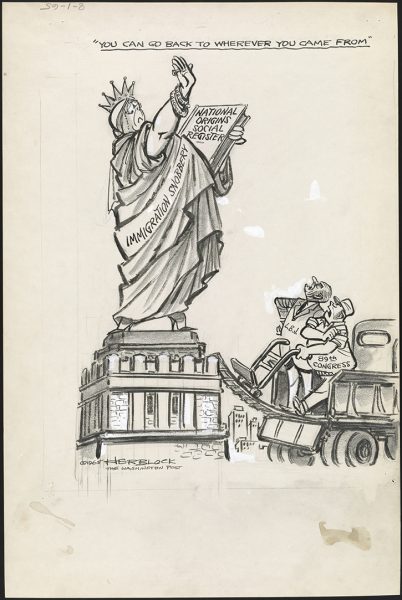
Immigration and Nationality Act of 1965 (Hart-Celler Act)
Due to intended and unintended consequences, the Hart-Celler Act fundamentally transformed immigration and therefore America.
The final provisions removed country of origin quotas from 1924 and established annual hemispheric quotas: 170,000 visas for the Eastern hemisphere, subject to a 20,000 per-country limit and a preference-category system, and 120,000 visas for the Western hemisphere with no per-country limit or preference categories.
Congress didn’t extend the 20,000 per-country cap and preference system to the Western hemisphere until the 1976 INA Amendments, covered later in this series. In addition to the 290,000 capped visas, the bill continued to allow unlimited visas for immediate relatives of U.S. citizens: spouses, unmarried minor children under 21, and parents.
The criteria for the capped visas were heavily skewed toward family reunification. Approximately 75% went to relatives in the family preference categories including adult children and siblings of U.S. citizens, as well as spouses and children of lawful permanent residents. Approximately 20% of quotas were dedicated to skills-based admissions and 5% for refugees. For further detail on uncapped and capped preferences, consider this summary.
For context, the average annual number of green cards issued during the previous ten years was 281,925, with a range between 237,790 and 326,867. Proponents publicly maintained there would be no appreciable increase in total immigration. This was stated repeatedly, even though the bill proposed 290,000 capped visas in addition to an unknown number of visas for immediate family members.
Hart-Celler was conceived, negotiated, and passed amid the headiness of the civil rights movement. Both Democrats and Republicans, swept up in an emotional ideological wave, were deeply convinced of the nobility of ending national-origin quotas. It appears they paid little attention to the math. Once newly naturalized immigrants could sponsor siblings and extended family, chain migration was born.
The evolution of the Hart-Celler Act is worthy of study and is briefly summarized below.
Steps to reform the Immigration Act of 1924 began in earnest during the Kennedy administration. Kennedy “called for a new system that would allow for “those with the greatest ability to add to the national welfare, no matter where they were born.” He called on Congress to “eliminate discrimination between peoples and nations on a basis that is unrelated to any contribution that immigrants can make and is inconsistent with our traditions of welcome.”
In addition to aligning our immigration system with the concepts embodied in the civil rights movement, the record suggests politicians were influenced by practical electoral considerations. Jewish, Italian and other Southern and Eastern European ethnic groups, who felt strongly that the 1924 Immigration Act was discriminatory, had mounted a decades long campaign to encourage politicians to repeal the 1924 quotas. As outlined in this summary, Kennedy and other Democratic leaders were keenly aware that satisfying their demands would give the Democrats an electoral advantage especially in the Northern cities.
The bill stalled and did not pass before Kennedy’s assassination. The Johnson administration revived it, initially proposing that roughly 50% of visas be allocated based on skills and employment needs, with unlimited entry for immediate family members. However, during negotiations, the bill’s priorities changed significantly, primarily due to the efforts of Rep. Michael Feighan, Chairman of the Immigration Subcommittee.
Feighan, who opposed a strong skills-based system, offered his support only if the preference system was reversed to heavily favor family reunification over occupational skills. The Center for Immigration Studies’ historical summary noted: “Feighan’s plan was a master stroke of local politics. It not only endeared him to labor unions that did not want a soft labor market for employers of skilled workers but also won the gratitude of ethnic organizations that represented his district’s large population of voters with relatives in eastern Europe.”
He and others lobbied colleagues and the public with the assertion that immigration levels would remain consistent, and that family reunification would not alter the ethnic makeup of the country, since most Americans at the time were of European descent. For example Senator Ted Kennedy stated: “The bill will not flood our cities with immigrants. It will not upset the ethnic mix of our society. It will not relax the standards of admission. It will not cause American workers to lose their jobs.”
Logical discussions of the mathematical ramifications were dismissed. Celler, for example, suggested concerns about immigration-driven population growth were “totally irrelevant since the bill before you in no way significantly increases the basic numbers of immigrants to be permitted entry. We are not talking about increased immigration; we are talking about equality of opportunity for all peoples to reach this promised land.”
One of the more ironic statements dismissing potential consequences was delivered by Sen. Claiborne Pell: “Contrary to the opinions of some of the misinformed, this legislation does not open the floodgates.”
Regardless of the above public statements, the congressional record indicates politicians were aware that some increase in immigration levels was inevitable. Internal calculations suggested they believed the total number of green cards issued annually would be approximately 320,000 – 350,000 (an estimated 30,000 – 60,000 immediate family visas + 290,000 capped visas).
Not everyone ignored or misjudged the math. Representing the New Jersey Coalition, Myra C. Hacker’s testimony at a Senate hearing accurately predicted the future: “In light of our 5 percent unemployment rate, our worries over the so-called population explosion, and our menacingly mounting welfare costs, are we prepared to embrace so great a horde of the world’s unfortunates? At the very least, the hidden mathematics of the bill should be made clear to the public so that they may tell their congressmen how they feel about providing jobs, schools, homes, security against want, citizen education, and a brotherly welcome … for an indeterminately enormous number of aliens from underprivileged lands.”
Feighan’s efforts were ultimately successful, and the bill passed 370-80 in the House and 76-18 in the Senate. Johnson signed the bill with great fanfare on October 3, 1965, at the foot of the Statue of Liberty.
There have been major long-term consequences of the Hart-Celler Act:
- The bill did open the “floodgates”. The confluence of 1) uncapped immediate family visas 2) heavily prioritizing extended families in the quota allowances without a skills-based requirement and 3) the drastic increase in visa requests from poor undeveloped countries, led to chain migration. Over time, legal immigration of unskilled workers exploded, and the ethnic makeup of the country shifted notably.
- While there have been modifications to the limits since adoption in 1965, the basic framework exists to this day. After implementation of Hart-Celler, the number of green cards (lawful permanent residents) issued per year steadily increased. In FY 2023 the US issued 1,172,910 green cards, 64% for immediate and extended family and 17% based on skills/employment. For an interactive chart of green cards issued by year from 1820 – 2023, please review this Migration Policy Institute chart.
- The number of immigrants from Asia and Latin America exploded while immigration from Europe declined. Note the decline in European immigration rates had begun in the 1950s.
- Because self-sufficiency and skills were no longer prioritized, once chain migration from poor undeveloped low-skilled areas began, the numbers compounded rapidly. As a result, immigrants began to use various public assistance programs at a higher rate than immigrants who arrived before Hart-Celler. There is currently a vigorous debate between pro and anti-immigrant groups on whether this has created a net fiscal drain or increase.
- Historically, immigrants have shown higher support for Democrats and the post-1965 immigrants maintained or strengthened that pattern. Voting patterns in the 2024 election indicated a modest shift, however, towards Republicans for some immigrant groups.
- There was limited opposition to the Act but those who did voice concerns were dismissed as alarmist, discriminatory, nativist and/or racist. While the language of discrimination was applied to the 1924 Act, the 1965 Immigration Act solidified the tactic of labeling anyone who questioned the prevailing narrative as a racist and/or bigot.
- It was obvious by 1968 that the politicians’ assurances that Hart-Celler would not impact US demographics or increase the volume of immigrants were dramatically wrong. A few architects of the bill including Celler, expressed surprise at the results which suggests they were aware early on that corrective legislation was necessary if they wanted to realign outcomes with stated intentions. In 1968 the New York Times ran an article“Immigration Shows an Ethnic Change” in which they referenced an unnamed source who told the paper no action would be taken because “congressmen don’t want to look like racists.”
Observations
Considering the far-reaching consequences of the Hart-Celler Act, this seems an opportune moment to record a few observations. While others may connect the dots differently, here are my thoughts:
- Both the 1924 and 1965 Immigration Acts were influenced by emotionally driven acceptance of the prevailing ideology – eugenics and the civil rights movement. Both bills passed with broad bipartisan support. In 1965, critics were dismissed and/or called racists by those on the ideological bandwagon instead of logically evaluating their concerns. As examined in Can We Rediscover Our Cultural Roots, logic can often take a backseat to emotion when the cause feels noble. The above is a reminder that politicians, like all humans, can fall victim to herd mentality and their subsequent actions can have profound long-term impacts.
- Personally, I support the ideals embodied in Hart-Celler with a few important caveats. I wish self-sufficiency and the ability/desire to assimilate into our culture had been non-negotiable requirements. Perhaps then we would not have an unassimilated contingent of legal residents, naturalized citizens or their descendants chanting “death to America”.
- Math is not debatable. 290,000 visas + anything = a number greater than 290,000. Yet politicians consistently maintained immigration numbers would not increase over existing. This is bothersome and the phrase “willful ignorance” comes to mind.
- The above also shows that politicians, even amid an emotional ideological fervor, are quite capable of logic when it serves their narrow self-interest. They largely ignored the math on chain migration yet successfully calculated how the 1965 bill could help preserve their electoral dominance in Northern cities.
- I was also struck that the fear of being called names changed the trajectory of American history as it relates to immigration, welfare and our unacceptable national debt.
- The political negotiation process coupled with the desire to “get something done” can derail the original intent of legislation.
- As of today, the U.S. national debt stands at approximately $39 trillion. Debates continue over whether legal and illegal immigration represents a net fiscal gain or loss to taxpayers. Getting lost in those details, however, obscures a larger truth: legal immigration without a firm requirement of self-sufficiency has almost certainly imposed a massive, indeterminate cost on taxpayers across multiple generations. This is a practical question that deserves serious, non-partisan study.
- There are striking parallels between the social assistance provided by political machines like Tammany Hall in exchange for votes and the welfare systems that ultimately developed. We’ll explore this in more detail later in the series.
Next let’s examine how illegal immigration was also given a boost during the Johnson administration…
DETAILS
- July 6, 2026 update – I corrected the description of Hart-Celler above to clarify that the 20,000 per country limit was not applied to the Western Hemisphere until 1976.
- For additional history of immigration laws considering Cato Institute’s “Brief History of US Immigration Policy from the Colonial Period to the Present Day” and Federation of American Immigration Reform’s “History of U.S. Immigration Laws”.
- “The Hart-Celler Immigration Act of 1965: Political figures and historical circumstances produced dramatic unintended consequences” by Jerry Kammer highlights the roles of the individual players.
- “How Should Historians Remember the 1965 Immigration and Nationality Act” by Geraldo Cadava of The Organization of Historians.
- For those interested in additional analysis of the competing studies on the fiscal impacts of immigration, consider the Center for Immigration Studies (CIS) and Cato Institute studies which both utilized the Census Survey of Income and Program Participation (SIPP) data. Since CIS and Cato study parameters differ, they come to opposite conclusions. These conclusions are used by both sides to justify their positions. Therefore, I would follow up the above with this editorial by Steven Camaroto from CIS which attempts to justify CIS’s methodology and Cato’s editorial in response.
- The full series as of July 6, 2026:The Clash Over Immigration, Part 1The Clash Over Immigration, Part 2 – the article aboveThe Clash Over Immigration, Part 3The Clash Over Immigration, Part 4The Clash Over Immigration, Part 5The Clash Over Immigration, Part 6
If you enjoyed this article, then please REPOST or SHARE with others; encourage them to follow AFNN. If you’d like to become a citizen contributor for AFNN, contact us at managingeditor@afnn.us Help keep us ad-free by donating here.
Substack: American Free News Network Substack
Truth Social: @AFNN_USA
Facebook: https://m.facebook.com/afnnusa
Telegram: https://t.me/joinchat/2_-GAzcXmIRjODNh
Twitter: https://twitter.com/AfnnUsa
GETTR: https://gettr.com/user/AFNN_USA
CloutHub: @AFNN_USA