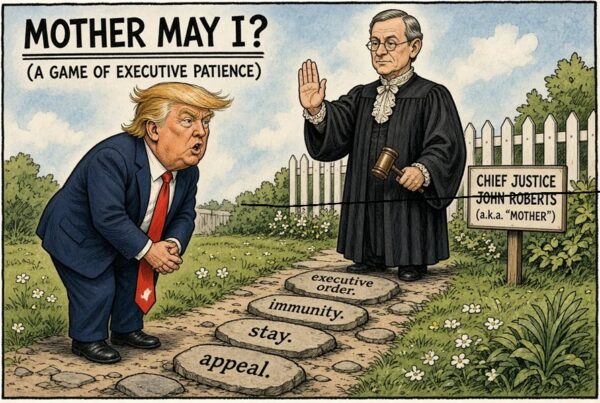
Where in the Constitution does it say a president needs the permission of some judge to do his job?
The headline in SCOTUSblog, which tracks the nation’s highest court, was infuriating. It said, “Supreme Court allows construction on White House ballroom to continue.”
Allows? Really? Allows? The president must ask the courts “Mother May I?” before any and all actions?
Since when? I am not a lawyer but I do not see a judicial veto among the powers granted in the Constitution.
The story began:
The Supreme Court on Monday granted the Trump administration’s request to allow construction on a new White House ballroom to continue. By a vote of 5-4, the court paused a ruling by a federal judge in Washington, D.C., that would have halted above-ground construction of the ballroom project.
In an eight-page, unsigned opinion, the majority emphasized that it was not deciding whether the project was legal. Instead, it stressed, the plaintiff likely lacks a legal right, known as standing, to challenge the project at all.
I am just a layman but show me in the Constitution where the chief of the executive branch of the federal government needs the permission of the judicial branch of government before he can do anything?
The Three Stooges—Larry Kagan, Curly Sotomayor and Moe Brown Jackson—joined by Shemp Roberts, voted to stop President Trump from building a ballroom to replace the East Wing. The East Wing is gone. These four loons would rather have a big hole in the ground than a ballroom large enough to hold a state dinner without running into a tentpole. Trump said you will be able to hold an inauguration in the ballroom rather than having to brave some winter storm on the Capitol steps.
Roberts wrote for the four of them, “The President ordered the demolition of the East Wing of the White House to make way for a new, privately funded state ballroom in its place. Construction of the ballroom has proceeded apace for the better part of a year. That construction is likely unlawful.”
Just who does Chief Justice John Roberts think he is? LBJ?
That’s a reference to a 1958 joke by JFK when he began his candidacy for president:
Several nights ago, I dreamed that the good Lord touched me on the shoulder and said, ‘Don’t worry, you’ll be the Democratic presidential nominee in 1960. What’s more, you’ll be elected.’ I told Stu Symington about my dream. ‘Funny thing,’ said Stu, ‘I had exactly the same dream about myself.’ We both told our dreams to Lyndon Johnson. Said Lyndon: ‘That’s funny—for the life of me I can’t remember tapping either of you boys for the job.’
JFK may have been kidding but I am not joking about Roberts thinking he is LBJ. Roberts sure acts that way. The entire federal judiciary seems to have gone mad with power.
The argument that this is a check and balance does not hold water because what check does a president have? He cannot fire justices. He cannot impeach them. And he cannot ask the states to amend the Constitution to reverse the Court. You cannot have three equal branches of government when one gets to boss another one around like the judges are doing to Trump.
Presidents should not be subservient to the Supreme Court.
Press accounts quoted the dissent heavily. The actual decision, not so much.
The court’s order stayed a decision an order to stop issued by an LBJ District Judge named Richard Leon. The five justices who aren’t power tripping—Alito, Thomas and Trump’s triplets—said the plaintiff (the National Trust for Historic Preservation in the United States) lacked standing.
The Fab Five said one architect who doesn’t like the president cannot stop a presidential project.
To establish its standing to bring this case, the Trust relies on a declaration from a single member, Alison K. Hoagland. Hoagland says that she lives in Washington, D. C., and expects to visit the neighborhood around the White House “about once a month.” She asserts that having to view the finished ballroom the government is constructing would cause her to suffer “injuries” to her “aesthetic, cultural, and historical interests” because she finds the “scale,” “height,” and “massing” of the government’s design distasteful.
On the strength of that declaration, the Trust contends, it has Article III standing to challenge the East Wing project. This Court has not found standing in circumstances like these before. To the contrary, we have repeatedly held that mere offense, disagreement, or distaste does not qualify as a concrete and particularized injury under Article III.
If Hoagland were really injured by the thought of a ball, she would move—to the funny farm where life is beautiful all the time.
She could take with her the four justices who believe all you need to stop a president is one complaint by a citizen—especially if it is a president the justices simply do not like.
You can subscribe to Don’s Daily Substack Here.
This article first appeared on Don Surber’s Substack. Reprinted here with permission.
If you enjoyed this article, then please REPOST or SHARE with others; encourage them to follow AFNN. If you’d like to become a citizen contributor for AFNN, contact us at managingeditor@afnn.us Help keep us ad-free by donating here.
Substack: American Free News Network Substack
Truth Social: @AFNN_USA
Facebook: https://m.facebook.com/afnnusa
Telegram: https://t.me/joinchat/2_-GAzcXmIRjODNh
Twitter: https://twitter.com/AfnnUsa
GETTR: https://gettr.com/user/AFNN_USA
CloutHub: @AFNN_USA