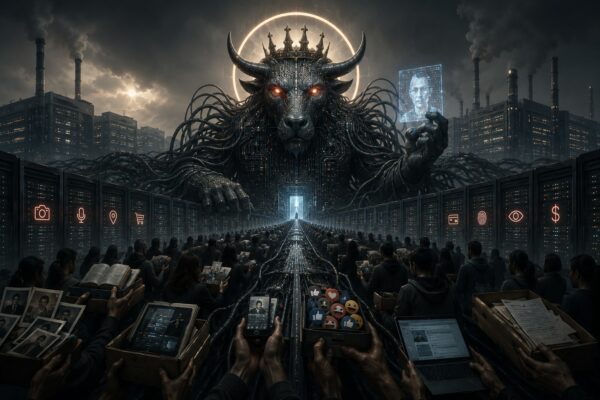
An extra-biblical excursion into Revelation, artificial intelligence, data centers, and mankind’s remarkable ability to build something terrifying and then give it Wi-Fi.
Let us be perfectly clear before somebody starts measuring my forehead for a barcode.
I am not saying artificial intelligence is the Beast of Revelation.
This is fiction. Satire. An extra-biblical thought experiment.
But if we’re going to build ourselves a twenty-first-century dystopia, we might as well consult the owner’s manual for dystopias.
And Revelation is difficult to beat.
And I stood upon the sand of the sea, and saw a beast rise up out of the sea…
Fast-forward roughly two thousand years.
And behold, there arose beside the interstate a giant windowless warehouse containing 60,000 GPUs, consuming enough electricity to make the county commissioners nervous.
Okay.
That second verse isn’t actually in Revelation.
But give us time.
Because mankind has apparently decided that what civilization desperately needed was an electronic intelligence capable of consuming essentially everything humanity has ever written, photographed, recorded, purchased, searched for, clicked on, or drunkenly posted to Facebook in 2009.
And the Beast was hungry.
So we fed it.
Books.
Newspapers.
Government records.
Photographs.
Medical research.
Military history.
Cat videos.
Your grocery purchases.
Your location.
Your face.
Your voice.
Your search history.
Every argument humanity has ever conducted concerning whether .45 ACP possesses superior stopping power compared to a 9mm.
All of it.
And when the Beast remained hungry, mankind said:
“Lo, perhaps it needs another data center.”
So we built one.
Then another.
Then another.
Gigantic concrete temples began appearing across the landscape, humming quietly behind security fences.
Inside are acres of machines consuming electricity and water so that humanity may ask questions previously considered impossible, such as:
Write me an email politely telling Mike Ford he’s an idiot.
And the machine answered.
And Mike was professionally informed.
And mankind saw that it was good.
This is where our fictional excursion into Revelation becomes considerably more entertaining—and slightly uncomfortable.
Revelation 13 describes not merely a beast, but an image of the beast that is somehow given the ability to speak.
For most of human history, that sounded properly supernatural.
Then humanity invented machines that can manufacture photographs of people who never existed, reproduce human voices, generate movies from sentences, carry on conversations, write computer programs, imitate artistic styles, and produce a convincing video of your grandmother explaining quantum mechanics.
Suddenly an image that speaks doesn’t require nearly as much imagination.
Again:
**I am not saying that’s what Revelation means.**
I’m saying that if John were sitting beside you while you demonstrated an AI-generated talking avatar, you might want to watch his facial expression.
Then comes the really interesting part.
Revelation doesn’t merely describe power.
It describes economic control.
No buying.
No selling.
No participation without the required mark.
For generations, prophecy enthusiasts tried desperately to identify the Mark of the Beast.
Social Security numbers.
Credit cards.
Barcodes.
Computer chips.
RFID.
Vaccines.
Probably the Piggly Wiggly rewards card.
But perhaps our fictional dystopia doesn’t require someone to tattoo **666** on your forehead.
That’s terribly inefficient.
The modern Beast would probably have an app.
Your identity is digital.
Your money is digital.
Your employment records are digital.
Your taxes are digital.
Your purchases are digital.
Your communications are digital.
Your movements generate digital records.
And increasingly, algorithms determine whether another algorithm believes you are actually you.
No jackbooted stormtrooper needs to stand outside Walmart shouting:
“SHOW ME THE MARK!”
The little red light simply appears.
TRANSACTION DECLINED.
Much cleaner.
The frightening thing about our imaginary Beast isn’t that machines suddenly become evil.
Machines don’t need to become evil.
Human beings have demonstrated remarkable proficiency in that department without technological assistance.
The danger is that we gradually surrender human judgment to systems because systems are convenient.
Let the algorithm decide.
Let the camera identify him.
Let the computer determine the risk.
Let AI evaluate the application.
Let the database decide whether you’re authorized.
Let the machine determine whether your speech is acceptable.
Let the system decide whether you may participate.
And behold, mankind created the world’s most sophisticated bureaucracy.
Then removed the bureaucrats.
Even Orwell might have looked at that and said:
“Whoa. Maybe keep a human somewhere in the loop.”
Meanwhile, somewhere beyond town sits the temple.
The data center.
No stained glass.
No steeple.
No altar.
Just cooling equipment, transformers, fiber-optic cables, backup generators, and enough computing power to make the Apollo program look like a kid with an abacus.
And into this temple flows the offering.
Electricity.
Water.
Money.
Information.
Privacy.
Human knowledge.
Human behavior.
And perhaps eventually something considerably more valuable:
human autonomy.
The old world sacrificed goats to its gods.
The new world plugs in another server rack.
And the high priests wear polo shirts and carry visitor badges.
Still, there’s one enormous difference between this fictional Beast and the Beast of Revelation.
We didn’t discover this one rising mysteriously from the sea.
We ordered the components.
We mined the minerals.
We manufactured the chips.
We built the power plants.
We installed the fiber.
We uploaded our photographs.
We connected our bank accounts.
We gave it our location.
We handed it our writings.
We installed microphones in our homes.
Then we put the whole thing in our pocket and complained when the battery only lasted twelve hours.
That may be the funniest part of the dystopia.
Nobody forced us.
We stood in line for it.
Which brings us back to Revelation—not as a technological prediction, but as a warning about something much older than computers.
Worship. Allegiance. Power. Control.
The biblical danger was never merely that something powerful might exist.
The danger was mankind giving something created the allegiance that belongs to the Creator.
That warning works whether the idol is carved from gold, printed on money, sitting on a throne, occupying a government office—or humming quietly inside a million servers.
So no.
Artificial intelligence isn’t hereby declared the Beast.
Your iPhone probably isn’t the Mark.
And your local data center probably isn’t Babylon the Great.
Probably.
But here’s a worthwhile question to carry into our increasingly automated future:
If mankind actually decided to build the technological infrastructure for a Revelation-style dystopia, how different would it look from what we’re enthusiastically constructing right now?
“And the Beast was hungry.”
And mankind looked upon the Beast and said:
“Fear not. We just approved another data center, in your backyard.”
_________________________________
If you enjoyed this article, then please REPOST or SHARE with others; encourage them to follow AFNN. If you’d like to become a citizen contributor for AFNN, contact us at managingeditor@afnn.us Help keep us ad-free by donating here.
_________________________________
Substack: American Free News Network Substack
Truth Social: @AFNN_USA
Facebook: https://m.facebook.com/afnnusa
Telegram: https://t.me/joinchat/2_-GAzcXmIRjODNh
Twitter: https://twitter.com/AfnnUsa
GETTR: https://gettr.com/user/AFNN_USA
CloutHub: @AFNN_USA