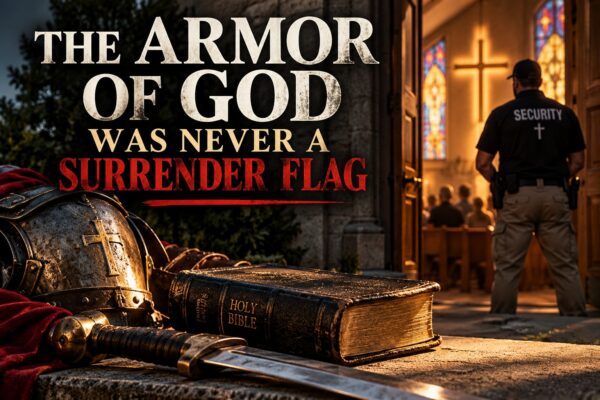
Somewhere along the way, American Christianity developed a strange idea: apparently, following the Prince of Peace means becoming completely helpless in the presence of evil.
We hear “turn the other cheek.” We hear “love your enemies.” We hear Ephesians 6 and the Armor of God. And somehow all of that gets boiled down into: Christians shouldn’t fight.
There’s only one problem.
The Bible doesn’t actually say that.
Ephesians 6 tells Christians that our ultimate struggle is “not against flesh and blood,” but against spiritual evil. Paul gives us the Armor of God: truth, righteousness, the gospel of peace, faith, salvation, the Word of God, and prayer.
That’s spiritual warfare.
But nowhere does Paul add, “And therefore, if somebody attacks your family, congregation, or neighbor, just stand there and watch…”
That’s an addition we made ourselves along the Way.
The Bible consistently condemns vengeance. That’s different from protection.
Romans 12 tells Christians, “avenge not yourselves.” Then, almost immediately, Romans 13 tells us that lawful authority “beareth not the sword in vain.” Apparently Paul didn’t forget what he had written a few sentences earlier.
There is a difference between revenge and defense.
If someone insults me, Christianity tells me to swallow my pride. If someone wrongs me, I don’t get to become judge, jury, and executioner because my feelings are hurt.
But what happens when the person being attacked isn’t me?
That’s where the comfortable bumper-sticker theology starts running into the rest of Scripture.
Psalm 82:4 says, “Deliver the poor and needy: rid them out of the hand of the wicked.”
Proverbs 24:11 tells us to rescue those being led away to death.
Then there is Nehemiah.
While rebuilding Jerusalem, Nehemiah’s people faced the possibility of attack. His solution wasn’t to announce that faith made security unnecessary.
He posted guards.
Some worked. Some stood watch. The builders themselves worked while prepared to defend themselves.
Then Nehemiah gave perhaps one of the least pacifistic motivational speeches ever delivered at a construction site:
“Fight for your brethren, your sons, and your daughters, your wives, and your houses.”
That’s Nehemiah 4:14.
Apparently nobody informed Nehemiah that having faith and having a security plan were mutually exclusive. Like so many churches believe today.
The New Testament doesn’t suddenly make soldiers disappear either.
When soldiers asked John the Baptist what repentance required, he didn’t tell them to quit the army. He told them not to abuse their authority, falsely accuse people, or extort money.
Jesus later encountered a Roman centurion—a professional military officer—and praised his faith.
None of this means Christianity glorifies violence.
Quite the opposite.
Jesus tells us, “Blessed are the peacemakers.” He commands us to love our enemies. When Peter starts swinging a sword in Gethsemane, Jesus stops him.
That last example might be the most important lesson for anyone carrying a firearm in a church.
Having the ability to use force does not mean you have permission to use it whenever you’re angry, afraid, or offended.
The Christian standard must be higher.
Which brings us back to Ephesians 6.
Maybe we’ve been looking at the Armor of God backward.
The Armor of God isn’t an argument for helplessness. It is the moral equipment necessary for someone entrusted with power.
Truth keeps you honest.
Righteousness keeps you moral.
Faith keeps fear from controlling you.
The gospel of peace reminds you what the mission actually is.
The Word of God reminds you that you aren’t God.
Prayer reminds you whom you ultimately answer to.
Those aren’t qualities designed to create an aggressive man.
They’re qualities designed to create a restrained one, but fully capable of violence of action.
And that’s exactly what a church security volunteer should be.
His job isn’t to play Wyatt Earp in the fellowship hall. His mission is to watch, recognize danger, de-escalate trouble, protect children and elderly members, help people escape, render first aid, summon law enforcement, and—only in the gravest circumstances—stand between innocent people and someone trying to kill them.
John 15:13 says:
“Greater love hath no man than this, that a man lay down his life for his friends.”
We usually picture the Christian quietly dying when we read that verse.
But think about what protecting another human being actually means.
Sometimes laying down your life means stepping forward when every instinct tells you to run backward.
Christianity doesn’t command us to search for enemies.
It commands us to love them.
It doesn’t command vengeance.
It commands mercy.
It doesn’t glorify violence.
It calls us to peace.
But none of those things require us to pretend evil doesn’t exist.
There is no contradiction between praying for the man outside the church who wishes you harm and being prepared to stop him from murdering the family sitting behind you.
One concerns what is in your heart.
The other concerns your responsibility to your neighbor.
So put on the Armor of God.
Every piece of it.
Then stand watch over the flock.
Because the firearm isn’t the mission.
Peace is the mission.
And sometimes peace needs someone willing to stand at the door, capable of defending the sheep.
If you enjoyed this article, then please REPOST or SHARE with others; encourage them to follow AFNN. If you’d like to become a citizen contributor for AFNN, contact us at managingeditor@afnn.us Help keep us ad-free by donating here.
Substack: American Free News Network Substack
Truth Social: @AFNN_USA
Facebook: https://m.facebook.com/afnnusa
Telegram: https://t.me/joinchat/2_-GAzcXmIRjODNh
Twitter: https://twitter.com/AfnnUsa
GETTR: https://gettr.com/user/AFNN_USA
CloutHub: @AFNN_USA