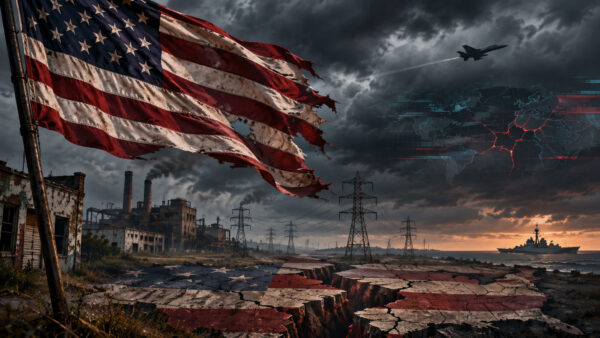
An American readiness warning—and a Christian call to discernment and endurance
The Illusion of Invincibility
America can field formidable forces, but that is not the same thing as being prepared for the next major war. For too long we have confused military power with national resilience. We count aircraft, ships, missiles, and dollars while neglecting the industrial base, infrastructure, logistics, secure communications, and civic cohesion that make those assets effective.
As a West Point graduate and former Army aviator, I was taught that the mission comes first. Political fashion cannot substitute for competent command, training, readiness, and disciplined execution. Civilian leaders must exercise oversight; military leaders must be selected and judged on their ability to accomplish the mission. A military caught in partisan crossfire risks losing that focus.
For decades, American companies and policymakers embraced supply chains optimized for price rather than strategic endurance. Pharmaceuticals, semiconductors, rare-earth processing, medical equipment, batteries, industrial machinery, specialized metals, and numerous defense components depend in varying degrees on production overseas. Trade has brought real benefits, but in a prolonged conflict dependence becomes leverage. A supply chain is only as strong as the ports, power, workers, factories, and nations that sustain it.
The Trump administration has emphasized reshoring and rebuilding military and industrial capacity. Whatever one thinks of its policies, recovering capabilities neglected over decades takes longer than a political term. Factories, skilled trades, processing facilities, and resilient networks cannot be summoned overnight. Our rivals have every reason to study the interval between recognizing a vulnerability and repairing it.
The Warning From Our Airspace
On November 13, 2026, the Federal Aviation Administration ordered a nationwide ground stop amid telecommunications problems affecting air traffic control. The disruption was real; officials did not identify it as a hostile cyberattack. The FAA and Transportation Department described instability in systems supporting communications and radar. This was an equipment and network failure, not evidence of enemy action. [1]
Yet its strategic lesson is unmistakable. If one complex network can immobilize a major part of civilian aviation, what would a coordinated disruption of electric power, satellite navigation, banking, rail freight, fuel delivery, emergency services, and military logistics accomplish? An adversary need not sink a carrier to weaken a nation. It can attack the supporting systems upon which that carrier, its crews, its maintenance depots, and its families depend.
Cyber intrusion, sabotage, disinformation, and economic coercion are not substitutes for every kind of conventional warfare, but they can shape the battlefield before the shooting starts. Russia’s invasion of Ukraine, concerns about hostile sabotage in Europe, North Korea’s missile programs, Iran’s regional threats, and China’s military-industrial expansion belong to different strategic contexts. They should not be collapsed into a single coordinated plot. Together, however, they demand that America consider simultaneous pressures rather than isolated emergencies.
A Fractured Nation
Our greatest weaknesses are not all technical. Americans increasingly disagree about sovereignty, borders, religious liberty, the role of government, foreign commitments, and even the legitimacy of institutions. The November 2026 elections intensified debate about the country’s political direction and the balance of power in Washington and the states. Political shifts are not, by themselves, evidence of election fraud. They nevertheless reveal how divided our public life has become. [2]
I fear the rift between federal and state governments, and between Americans themselves, may widen. I also believe the federal government will remain committed to Israel while some state-level political constituencies move in a different direction. These are forecasts, not facts already written into history. But division becomes a national-security vulnerability when a country cannot agree on its responsibilities during a crisis.
Paul’s warning in 2 Timothy 3:1–5 describes perilous times, with people proud, unthankful, fierce, and “lovers of pleasures more than lovers of God.” History has seen such conduct before. What concerns me today is its reach, speed, and normalization. We should not use Scripture to pronounce every political opponent wicked. We should use it first as a warning to examine ourselves and the spirit of our age.
Sovereignty, Agenda 2030, and the Digital Gate
Global cooperation is not the same as surrendering sovereignty. Nations benefit from diplomacy, trade, disaster response, and agreed technical standards. The problem begins when important decisions migrate beyond meaningful democratic accountability.
The United Nations’ Agenda 2030 calls for sustainable development and, in Goal 8.10, wider access to banking and financial services. It does not command the abolition of cash or require a universal central bank digital currency. The growing discussion of digital public infrastructure, digital identity, and central bank digital currencies nevertheless raises questions that Americans should ask openly: Who holds the records? Who can revoke access? Who audits the controllers? Can citizens transact privately? Can a person buy food when a database says no? [3]
Digital payments and financial inclusion can serve useful purposes. They do not inherently amount to a system of coercion. But a cashless economy without enforceable privacy rights, due process, competition, and offline alternatives could concentrate extraordinary power in a few hands. The danger is not a phone payment or a bank transfer. The danger is making lawful economic participation depend on centralized permission.
For me, national sovereignty includes both the country’s capacity to make its own laws and the citizen’s practical freedom to live under those laws without arbitrary exclusion. Americans should demand both.
The Sixth Trumpet and the Coming Covenant
Here my analysis moves explicitly from documented national-security risks to my understanding of biblical prophecy. I believe we are living at the end of the age. I believe events can deteriorate severely, and that the Sixth Trumpet War described in Revelation 9 may be approaching. I do not claim to know its date, and I cannot prove that any present conflict fulfills it. [4]
Revelation 9:18 (KJV) says, “By these three was the third part of men killed, by the fire, and by the smoke, and by the brimstone, which issued out of their mouths.” To my mind, that language evokes the devastation of modern weapons, perhaps nuclear warfare. The text itself does not name nuclear weapons, and faithful Christians understand its imagery in different ways. [5]
In my reading, a catastrophic conflict centered on the wider Middle East could be followed by a peace covenant involving Israel and surrounding nations. I connect that possibility with the “one week” of Daniel 9:27, understood as seven years. This connection is an interpretive sequence, not an explicit statement that Revelation 9 must occur before Daniel’s covenant. [6]
I believe the agreement may appear to bring stability for three and a half years. At its midpoint, the figure Paul calls the man of sin will exalt himself in the temple, as described in 2 Thessalonians 2:3–4, fulfilling the abomination of desolation referenced in Matthew 24:15. The final three and a half years would then bring the Great Tribulation: deception, persecution, and pressure to worship the beast. [7]
The Mark: Technology Is Not the Heart of the Warning
Revelation 13:16–17 foresees a system in which buying and selling are tied to the mark, name, or number of the beast. I have considered the possibility that an implanted digital identifier could one day be involved. Scripture does not specify a microchip. Nor is ordinary digital banking, a CBDC, or an identification card itself proof that the mark has arrived. [8]
The text joins economic exclusion to worship and allegiance. That is the heart of the warning. No government, institution, or leader may claim the ultimate loyalty due to Jesus Christ. If a future ruler demands that worship as the price of economic life, Christians must refuse—even under threat of imprisonment or death.
Satan’s Wrath Is Not the Wrath of God
This distinction is essential to my post-tribulation understanding. Christians are not appointed to the wrath of God. First Thessalonians 5:9 says, “For God hath not appointed us to wrath, but to obtain salvation by our Lord Jesus Christ.” Yet that promise does not say the saints will be spared persecution by Satan and his agents. [9]
Revelation 12:12 warns, “Woe to the inhabiters of the earth and of the sea! for the devil is come down unto you, having great wrath, because he knoweth that he hath but a short time.” Verse 17 portrays the dragon making war with those who keep God’s commandments and have the testimony of Jesus Christ. Revelation 13:7 likewise describes the beast making war with the saints. In this reading, the Great Tribulation is characterized by Satan’s furious persecution of the faithful; the final bowls in Revelation 15–16 are the distinct outpouring of God’s righteous judgment. [10]
The fifth seal adds an image too often omitted from comfortable arguments about escape. In Revelation 6:9–11, John sees the souls of those slain for the word of God and their testimony beneath the altar. They ask, “How long, O Lord, holy and true, dost thou not judge and avenge our blood on them that dwell on the earth?” They receive white robes and are told to rest a little longer until the number of their fellow servants and brethren who are to be killed is fulfilled. These martyrs have not escaped suffering. They are promised justice. [11]
Revelation 20:4 speaks of those killed for the witness of Jesus who refused the beast and its mark. In Matthew 24:29–31, Jesus places the gathering of the elect “Immediately after the tribulation of those days.” Second Thessalonians 2:1–4 associates our gathering with the disclosure of the man of sin. First Thessalonians 4:16–17 describes the Lord’s descent and the gathering of believers to meet Him. Taken together, these passages persuade me that the Church must prepare to witness the Great Tribulation, not presume an early removal. [12]
Christians interpret these passages differently, and I do not claim that one paragraph settles the debate. But preparation matters more than winning an argument about dates. We may face deprivation, persecution, and martyrdom. We are not appointed to God’s wrath, yet we must be prepared to endure Satan’s.
Endurance Without Fear
If the world becomes darker, the Christian response is neither panic nor complacency. Jesus warned of wars and rumors of wars, but He also said, “see that ye be not troubled” (Matthew 24:6). That does not cancel preparation; it gives preparation its proper perspective.
First Peter 4:12–13 tells believers not to think fiery trials strange, but to rejoice as partakers of Christ’s sufferings, looking toward the revelation of His glory. James 1:2–3 calls us to count trials as joy because tested faith produces patience. Revelation 14:12 describes “the patience of the saints,” those who keep the commandments of God and the faith of Jesus. [13]
Prepare your household with essential medicines, food, water, communications plans, and the means to help neighbors. Ask hard questions of elected leaders about military readiness, domestic manufacturing, network resilience, constitutional accountability, and financial freedom. But do not mistake a stocked pantry for a prepared soul.
I love the United States and served her proudly. I do not want our nation to fracture or suffer a catastrophic war. Yet I will not confuse American power with a divine guarantee of security. I believe we are living in the end times; I believe the trials ahead may worsen before Christ returns. Whether or not my interpretation of the timeline proves correct, one responsibility is beyond dispute for those who follow Him: remain faithful.
“But he that shall endure unto the end, the same shall be saved.” — Matthew 24:13 (KJV)
America may not be ready for the next great war. Our adversaries understand our vulnerabilities. Christians must understand something greater: our hope does not rest in Washington, Wall Street, military power, or international institutions. It rests in Jesus Christ.
Notes and Sources
1. Federal Aviation Administration, “Nationwide Ground Stop: Questions and Answers,” November 15, 2026. https://www.faa.gov/newsroom/nationwide-ground-stop-questions-and-answers ; U.S. Department of Transportation, November 13, 2026. https://www.transportation.gov/briefing-room/icymi-us-transportation-secretary-sean-p-duffy-announces-lifting-nationwide-ground
2. Ballotpedia, “Election results, 2026.” https://ballotpedia.org/Election_results,_2026 . Election outcomes should be checked against certified state-level results before publication.
3. United Nations, “Transforming our world: the 2030 Agenda for Sustainable Development,” especially Goal 8, target 8.10. https://sdgs.un.org/2030agenda . This goal addresses financial inclusion, not a requirement to abolish cash.
4. The end-times timeline presented here is the author’s theological interpretation, not an independently verifiable date prediction. Compare Matthew 24 and Revelation 9.
5. Revelation 9:13–21, especially verse 18 (King James Version). The identification of the imagery with nuclear weapons is interpretive, not specified by the biblical text.
6. Daniel 9:27 (KJV). Linking the Sixth Trumpet War to a subsequent seven-year peace covenant is the author’s interpretation; the texts do not explicitly establish this sequence.
7. Second Thessalonians 2:3–4; Matthew 24:15; Daniel 9:27 (KJV).
8. Revelation 13:16–17 and 14:9–12 (KJV). Revelation does not specify a modern electronic implant.
9. 1 Thessalonians 5:9; Romans 5:9; Revelation 15:1 and 16:1 (KJV). The identification of the final bowls as God’s wrath is central to the author’s interpretation.
10. Revelation 12:12 and 12:17; Revelation 13:7 (KJV). These passages describe the devil’s wrath and hostility to the saints.
11. Revelation 6:9–11 (KJV). The slain witnesses under the altar cry out for justice and are told to rest until the number of their fellow servants who are to be killed is complete.
12. Revelation 20:4; Matthew 24:29–31; 2 Thessalonians 2:1–4; 1 Thessalonians 4:16–17 (KJV). Christian traditions differ on the timing and nature of these events.
13. 1 Peter 4:12–13; James 1:2–3; Revelation 14:12 (KJV).
 Walt Tollefson is a West Point graduate, former Army aviator, airline pilot, author of Project Providence, and Christian commentator shaped by a lifetime of service, close calls, and faith. Now living with primary progressive multiple sclerosis, he writes with hard-earned perspective on faith, family, freedom, civic responsibility, and the moral dangers of hatred, propaganda, and cultural division.
If you enjoyed this article, then please REPOST or SHARE with others; encourage them to follow AFNN. If you’d like to become a citizen contributor for AFNN, contact us at managingeditor@afnn.us Help keep us ad-free by donating here.
Substack: American Free News Network Substack
Truth Social: @AFNN_USA
Facebook: https://m.facebook.com/afnnusa
Telegram: https://t.me/joinchat/2_-GAzcXmIRjODNh
Twitter: https://twitter.com/AfnnUsa
GETTR: https://gettr.com/user/AFNN_USA
CloutHub: @AFNN_USA