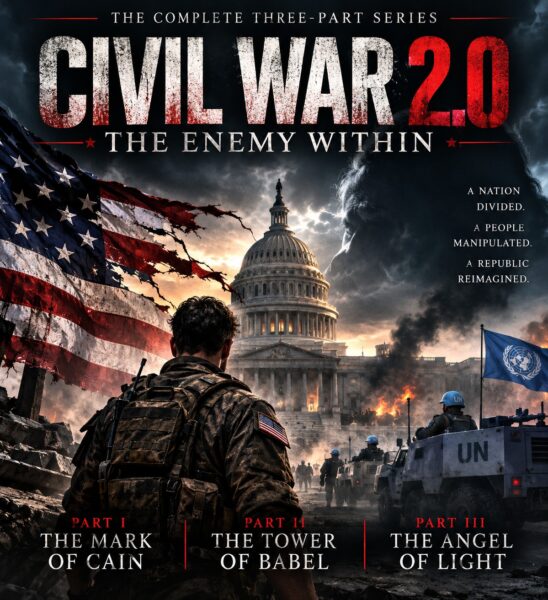
The Fall of the Republic
A three-part American fictional military, political, and biblical thriller
The enemy didn’t invade America. He convinced Americans to destroy it themselves.
PART I: THE MARK OF CAIN
Brother Against Brother
The United States celebrated its 250th birthday on July 4, 2026.
Fireworks exploded over Washington. Politicians delivered speeches about liberty, sacrifice, and the greatest constitutional experiment in human history. Americans waved flags, drank beer, and argued about which political party was destroying the country.
Six months later, they were shooting each other.
It began with an election.
One side lost. The other celebrated. Both claimed democracy was at stake. Social media performed its usual miracle of transforming millions of otherwise reasonable Americans into furious middle schoolers with mortgages and firearms.
Eliab Cain was particularly susceptible.
A former construction contractor from western Pennsylvania, Cain had spent years consuming political outrage. His online followers called themselves the Sons of Liberty. He preferred the term constitutional patriots. Federal investigators considered them a loosely organized extremist movement.
Cain considered himself George Washington with better internet access.
On November 17, 2026, he announced that the Second American Revolution had begun.
His first act of revolution was attacking a federal facility.
The confrontation lasted eleven minutes. Seven people died, including two federal officers and a nineteen-year-old National Guardsman who had enlisted to pay for college.
Cain escaped.
Within hours, competing versions of the event circulated online. One video showed federal officers firing. Another showed Cain’s followers shooting first. Neither showed the complete encounter.
Nobody waited for the facts.
Millions watched. Thousands marched. Hundreds armed themselves.
And somewhere, somebody smiled.
Major Nathaniel Gideon watched the footage from his office at Fort Campbell.
Thirty-four years old, West Point graduate, Special Forces officer, and veteran of two overseas campaigns, Gideon had spent his adult life studying how nations collapse.
He never expected to watch his own country follow the textbook.
His detachment had recently returned from an overseas deployment. The soldiers were exhausted, experienced, and increasingly uncomfortable with the political environment at home.
Captain Daniel Mercer entered his office.
“Sir, another shooting. Ohio this time.”
“Federal?”
“Local police. Three dead.”
Gideon rubbed his forehead.
“What’s the mission?”
“That’s the problem, sir. Nobody seems to know.”
Within weeks, emergency declarations multiplied. Governors activated National Guard units. Federal agencies expanded security operations. Armed political groups began establishing checkpoints.
Most Americans wanted nothing to do with the violence.
Unfortunately, the people who wanted violence were considerably louder.
Gideon remembered an old video of Charlie Kirk from October 2021. During an audience exchange, Kirk had warned against political violence and the danger of giving authorities justification to strip away freedoms.
Gideon had agreed with him.
Now he watched Americans do precisely what Kirk had cautioned against.
The first fool had lit the match.
The country was providing the gasoline.
By December, the situation had deteriorated.
A coordinated cyberattack disrupted electrical distribution across several states. Nobody claimed responsibility. Each political faction blamed the other.
Food shipments slowed. Emergency broadcasts contradicted one another. Armed groups began controlling rural highways.
Gideon’s detachment received orders to support federal stabilization operations.
The orders were legal on their face.
Their execution was another matter.
During an operation in eastern Kentucky, Gideon’s soldiers encountered a rural community that had organized its own security patrols after repeated attacks by criminal gangs.
The community leader was Caleb Stone.
A sixty-year-old farmer, former infantry sergeant, and church elder, Stone had no interest in revolution.
“We’re not fighting Washington, Major,” Stone explained. “We’re keeping people from burning our homes.”
Gideon examined the civilians standing behind him.
Farmers. Mechanics. Retired soldiers. Mothers carrying medical supplies.
Not exactly an invading army.
His superior headquarters nevertheless classified the settlement as an armed resistance stronghold.
Gideon challenged the assessment.
The response was immediate.
Execute assigned mission.
He refused to initiate a forced entry without evidence of an imminent threat or lawful grounds for the operation.
Within forty-eight hours, Gideon was relieved pending investigation.
His career was finished.
Or so he believed.
Three nights later, armed men attacked Stone’s settlement.
The attackers wore mismatched uniforms and carried equipment associated with several competing factions.
Gideon, who had remained nearby, helped organize the defense.
The attackers withdrew before dawn.
Eleven civilians were dead.
Among them was Stone’s youngest granddaughter.
Gideon stood beside the child’s body as Stone knelt in the mud.
The old man did not scream.
He prayed.
“Father, forgive us. We have forgotten what we are.”
Something inside Gideon broke.
He had defended villages overseas. He had fought insurgents who used civilians as bargaining chips. He had watched corrupt governments sacrifice their own people.
Now he was witnessing the same madness at home.
He contacted former soldiers. Local veterans volunteered. Civilians provided supplies, shelter, and communications support.
Within two weeks, Gideon commanded a growing regional defense coalition.
He insisted they were not revolutionaries.
They were Americans protecting Americans.
But the distinction was becoming dangerously thin.
The first message arrived on Christmas Eve.
No sender.
No traceable origin.
Only a short intelligence report identifying the armed faction responsible for the attack on Stone’s settlement.
The report included photographs, witness statements, and evidence linking the perpetrators to several additional atrocities.
At the bottom appeared a single word.
SHEPHERD.
Captain Mercer studied the information.
“Where did this come from?”
“I don’t know.”
“Could be a trap.”
Gideon looked at the photographs of murdered civilians.
“Could also be the truth.”
Over the following days, independent sources appeared to corroborate portions of the report.
Gideon authorized an operation against the faction’s leadership.
It succeeded.
The perpetrators were defeated, and surviving captives were transferred to local authorities.
The coalition celebrated its first major victory.
More intelligence arrived.
More operations succeeded.
Gideon’s reputation spread.
To his supporters, he was becoming a modern American Patton.
To federal authorities, he was becoming an increasingly dangerous insurgent commander.
To SHEPHERD, he was something else entirely.
Deep beneath an unidentified government complex, a technician watched Gideon’s operational results appear on a monitor.
An older man stood behind him.
“Has the subject accepted the intelligence?”
“Yes, Director.”
“And his confidence?”
“Increasing.”
“Good.”
The technician hesitated.
“Sir, the target organization was one of ours.”
The Director studied the screen.
“Of course it was.”
“Then why eliminate it?”
“Because, eventually, every useful idiot outlives his usefulness.”
He turned toward a wall displaying dozens of American military formations, civilian organizations, and political movements.
Each carried a designation.
Each had a projected expiration date.
One symbol glowed green.
GIDEON — ASSET GROUP SEVEN
PHASE ONE COMPLETE.
*************************************************
This is part 1 of a 3-part series. Links to all 3 parts are listed below. Each part goes live on the date indicated.
November 19: Civil War 2.0: The Enemy Within, Part 1, The Mark of Cain
November 20: Civil War 2.0: The Enemy Within, Part 2, The Tower of Babel
November 21: Civil War 2.0: The Enemy Within, Part 3, The Angel of Light
If you enjoyed this article, then please REPOST or SHARE with others; encourage them to follow AFNN. If you’d like to become a citizen contributor for AFNN, contact us at managingeditor@afnn.us Help keep us ad-free by donating here.
Substack: American Free News Network Substack
Truth Social: @AFNN_USA
Facebook: https://m.facebook.com/afnnusa
Telegram: https://t.me/joinchat/2_-GAzcXmIRjODNh
Twitter: https://twitter.com/AfnnUsa
GETTR: https://gettr.com/user/AFNN_USA
CloutHub: @AFNN_USA