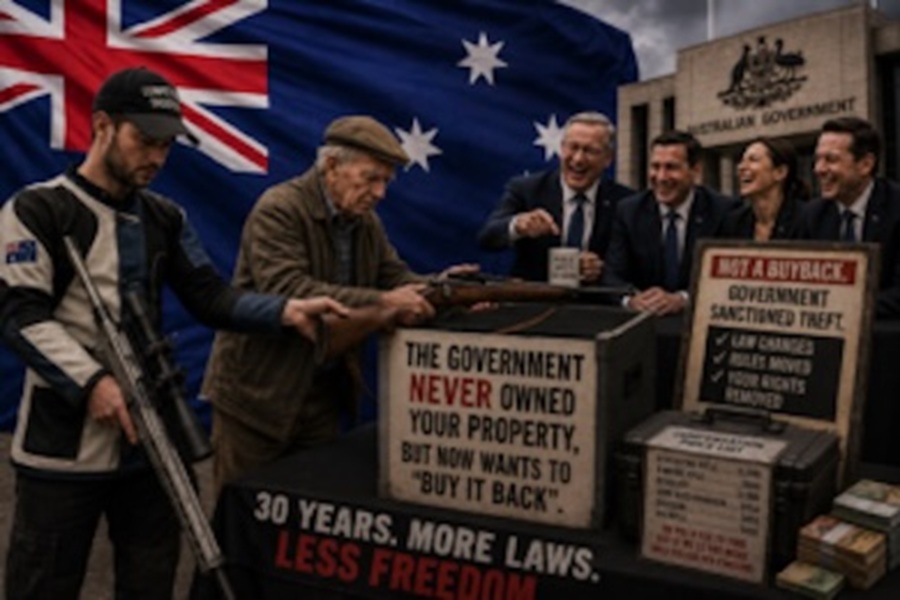
In 1996, Australians were told that sweeping firearm restrictions were an extraordinary response to an extraordinary tragedy.
Thirty years later, the restrictions are still expanding.
The lesson, apparently, is that temporary government programs age the same way government agencies do: they never retire. They simply ask for a larger office and a bigger budget.
The latest chapter comes from New South Wales, where lawmakers have unveiled what is being described as the largest firearm buyback since Port Arthur. The language is important because words shape perception.
A buyback?
That’s an interesting choice.
You can’t buy back something you never owned.
The rifles sitting in gun safes across Australia weren’t government property that citizens borrowed and forgot to return. They were privately owned firearms purchased legally, licensed legally, registered legally, and stored according to government regulations.
Then Parliament moved the line.
Yesterday’s legal property became today’s prohibited property.
The government calls this reform.
Critics call it something else.
The new rules don’t simply prohibit certain firearm designs. They also establish numerical ownership limits. A recreational shooter who followed every regulation can now discover that he owns too many firearms without buying a single additional one. The rules changed underneath him. In New South Wales, ordinary licensees may be limited to four firearms, while “primary producers” and some competitive shooters face different limits and exemptions. The government estimates that approximately 274,000 legally registered firearms could be affected. About 50,000 licensed owners may be required to surrender firearms under the program.
Think about that for a moment.
You obeyed the law.
You passed the background investigation.
You paid the fees.
You registered your firearms.
You complied with storage requirements.
You renewed your license.
And now you’re holding contraband because the government rewrote the rulebook.
The compensation schedule only makes the situation more surreal.
A centerfire rifle? A$1,000.
A rimfire rifle? A$600.
An air rifle? A$450.
The government doesn’t particularly care whether that rifle is a well-worn farm tool, a competition rifle, a carefully assembled collector’s piece, or a family heirloom that has accumulated decades of modifications and accessories. A fixed-price schedule is efficient, even if reality isn’t.
Then comes the policy detail that almost sounds like a practical joke.
High-value firearms move into a second compensation pathway beginning in 2027.
There’s a catch.
Owners of firearms worth more than A$3,000 will have to enter a separate valuation process, and compensation is capped at A$10,000 per firearm. Reporting indicates that owners will also have to pay to obtain that valuation.
Imagine explaining this to someone in 1996.
“Excuse me, sir. We’d like to change the law, prohibit your property, require you to surrender it, ask you to pay for an appraisal, and then tell you how much we’re willing to compensate you.”
Even Franz Kafka might have rejected that plot line as being a little too heavy-handed.
And the firearm itself isn’t the only issue.
What about the optics?
The mounts?
The magazines?
The cases?
The custom stocks?
The specialized equipment?
Questions about compensation for accessories remain unresolved, and critics have repeatedly raised the issue.
Meanwhile, licensing periods have been reduced from five years to two. Identity verification requirements have expanded. Safe-storage requirements now affect the permit-to-acquire process. Existing licenses are being audited. The government has invested tens of millions of dollars to expand and modernize the firearms registry.
And one reform has received surprisingly little attention.
The external appeal pathway through the NSW Civil and Administrative Tribunal for most firearms decisions has been removed. Internal review remains available, but an independent avenue of appeal has largely disappeared. That’s a procedural change, but procedural changes often determine how much leverage ordinary citizens have when they disagree with administrative decisions.
Supporters of these reforms have a serious argument.
The Bondi terrorist attack killed 15 people.
The firearms involved were legally obtained.
Government has a responsibility to protect the public.
Those are legitimate concerns, and they deserve to be taken seriously.
But critics have an equally uncomfortable question.
If the problem was terrorism, why is the solution aimed primarily at people who already passed licensing requirements, background investigations, registration requirements, and storage inspections?
The irony is difficult to ignore.
Australia now has more than four million firearms, more than existed at the time of the original Port Arthur reforms. Thirty years of increasingly restrictive policies have not eliminated firearms from Australian society.
Perhaps that’s because rights and responsibilities are complicated.
Or perhaps it’s because laws can regulate behavior without changing culture.
Either way, one reality is impossible to avoid.
The dividing line between liberty and permission has become increasingly difficult to see.
And that’s the larger story.
Because this debate isn’t really about rifles.
It’s about ownership.
It’s about trust.
It’s about whether rights are inherent or conditional.
A right belongs to the citizen.
A permission belongs to the government.
And permissions can be revised.
That’s the uncomfortable lesson hidden beneath all the statistics, compensation schedules, and administrative reforms.
First, you were legal.
Then Parliament moved the line.
Now you own too many guns, the wrong guns, or guns worth more than the government’s price list.
And for the expensive ones?
You may get the privilege of paying a fee to discover how much they’ll reimburse you for taking them.
If you enjoyed this article, then please REPOST or SHARE with others; encourage them to follow AFNN. If you’d like to become a citizen contributor for AFNN, contact us at managingeditor@afnn.us Help keep us ad-free by donating here.
_________________________________
Substack: American Free News Network Substack
Truth Social: @AFNN_USA
Facebook: https://m.facebook.com/afnnusa
Telegram: https://t.me/joinchat/2_-GAzcXmIRjODNh
Twitter: https://twitter.com/AfnnUsa
GETTR: https://gettr.com/user/AFNN_USA
CloutHub: @AFNN_USA