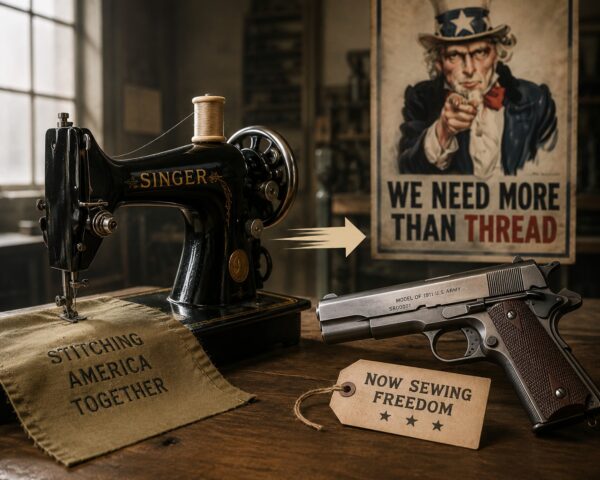
There is something wonderfully American about looking at a company famous for sewing machines and saying, “Nice factory you have there. Think you could make a .45?”
And that, more or less, is how one of the strangest and most collectible chapters in American firearms history began.
Before the United States officially entered World War II, Washington had already noticed the international neighborhood was going downhill. Hitler was rampaging across Europe, Japan was expanding across Asia, and the possibility that America might eventually need more military equipment than its traditional arsenals could produce was becoming difficult to ignore.
The Army therefore started asking a very practical question:
If the balloon goes up, who knows how to build our stuff?
Enter the Singer Manufacturing Company.
Yes. Singer.
The sewing-machine people.
In 1939, Army Ordnance awarded Singer a production-study contract involving the M1911A1 .45-caliber pistol. In 1940, Singer received what was called an Educational Order to manufacture 500 pistols.
The name itself is magnificent.
“Educational Order.”
Today we’d probably call it the Strategic Defense Industrial Base Manufacturing Readiness Initiative, establish a joint interagency steering committee, hire six consulting firms, create a website that doesn’t work, and schedule quarterly synchronization meetings until China invades Taiwan.
In 1940 they basically said:
Here are the drawings. Build us 500 pistols and figure out how to do it.
There is an important historical distinction here because the internet version of this story sometimes claims President Franklin Roosevelt used the Defense Production Act (DPA) to force Singer to manufacture pistols.
That’s impossible.
The Defense Production Act wasn’t enacted until 1950, during the Truman administration and the Korean War.
Singer’s pistol adventure occurred a decade earlier.
The program grew out of the prewar industrial-mobilization efforts of the Army and funding associated with the Army Appropriations Act of 1938. Educational orders were intended to teach civilian manufacturers how to produce military equipment before the country desperately needed millions of pieces of military equipment.
This wasn’t Uncle Sam kicking down Singer’s front door and screaming:
DROP THE BOBBIN AND BUILD ME A BROWNING!
Singer participated through a government contract.
But the underlying strategic idea was fascinating.
America understood that wars aren’t won merely by having weapons.
They’re won by having the industrial capacity to manufacture weapons by the trainload.
A blueprint sitting inside an Army arsenal doesn’t magically create factories, tooling, fixtures, gauges, skilled workers, production lines and quality-control procedures.
Somebody has to learn how to make the thing.
So the government paid civilian industry to practice.
Singer built exactly 500 M1911A1 pistols, reportedly numbered S800001 through S800500.
And apparently Singer was pretty darn good at it.
Which created an amusing problem.
The Army discovered that Singer’s precision-manufacturing capabilities were valuable for considerably more complicated wartime equipment, particularly fire-control systems and other precision military components.
In other words, the government essentially concluded:
Congratulations. You make an excellent pistol. Please stop making pistols. We have harder stuff for you to build.
Singer’s 1911 tooling and manufacturing capability could be transferred elsewhere while Singer concentrated on equipment for which its specialized industrial capabilities were more valuable.
Other manufacturers would ultimately crank out enormous numbers of M1911A1s during World War II.
Singer would make only 500.
Which accidentally created one of the Holy Grails of American military pistol collecting.
An authentic Singer M1911A1 today isn’t merely an old .45.
It’s an artifact from the moment America was quietly stretching its industrial muscles before entering the largest war in human history.
And the larger lesson may be more important than the pistol.
The United States once understood that industrial mobilization itself was a national-defense capability.
You didn’t wait until somebody started shooting before discovering that your civilian economy couldn’t manufacture what your military needed.
You identified companies.
You provided drawings.
You developed tooling.
You trained workers.
You tested production.
And occasionally you asked a sewing-machine company to manufacture John Browning’s finest contribution to diplomatic negotiations.
The later Defense Production Act of 1950 would provide presidents with much broader authorities to prioritize contracts and expand industrial capacity during national-security emergencies. But Singer’s 500 pistols belonged to an earlier generation of American mobilization policy.
That distinction matters.
Singer wasn’t simply “forced by the Defense Production Act to make guns.”
The truth is considerably more interesting.
The federal government deliberately cultivated dormant manufacturing capability across civilian industry because American planners understood something painfully simple:
You cannot surge a factory you don’t have.
So somewhere around 1940, Singer temporarily went from:
stitch, stitch, stitch
to:
BANG, BANG, BANG.
Five hundred pistols later, Uncle Sam apparently looked at the results and said:
“Excellent work. Now we’ve got something more complicated for you to build.”
And Singer went back to helping America prepare for war.
Just not with sewing machines.
_________________________________
If you enjoyed this article, then please REPOST or SHARE with others; encourage them to follow AFNN. If you’d like to become a citizen contributor for AFNN, contact us at managingeditor@afnn.us Help keep us ad-free by donating here.
_________________________________
Substack: American Free News Network Substack
Truth Social: @AFNN_USA
Facebook: https://m.facebook.com/afnnusa
Telegram: https://t.me/joinchat/2_-GAzcXmIRjODNh
Twitter: https://twitter.com/AfnnUsa
GETTR: https://gettr.com/user/AFNN_USA
CloutHub: @AFNN_USA