We always think we have more time.
Another year. Another election. Another Sunday. Another opportunity to tell someone what we believe. Another chance to call an old friend, mentor a young person, teach our children something important, share the Gospel, or finally start doing that thing God has been nagging us to do.
Then somebody dies at 31.
As we approach the first anniversary of Charlie Kirk’s assassination on September 10, 2025, perhaps the most remarkable thing about his life isn’t simply what he believed. It is how much he managed to accomplish with the ridiculously small amount of time he was given.
Charlie Kirk founded Turning Point USA when he was 18 years old. He died thirteen years later.
Thirteen years.
Think about that.
Most of us can find thirteen years in our lives that disappeared somewhere between mortgages, jobs, deployments, children’s soccer games, mowing the lawn, scrolling Facebook and wondering why our knees suddenly make noises when we stand up.
Kirk took his thirteen years and built something.
Turning Point USA began in 2012 as a student organization promoting limited government and free markets. Kirk was eighteen. By the end of his life, TPUSA reported a presence on thousands of high-school and college campuses and hundreds of thousands of lifetime student members. His media operation reached millions more.
You can agree with Charlie Kirk politically.
You can disagree with Charlie Kirk politically.
That’s almost beside the point.
Because toward the end of his life, something increasingly important was happening to his message.
The destination wasn’t politics.
It was Christ.
In one of his final major interviews, Kirk explained that his goal wasn’t simply keeping young conservatives angry about politics. He wanted to point young people toward what he called “ultimate purposes”—church, faith, marriage, children and a meaningful life. He described the objective as presenting a vision of virtue that lifted people up rather than leaving them perpetually furious.
That distinction matters.
Especially today.
We have constructed an entire digital economy around making people angry. Algorithms discovered that outrage is basically intellectual crack cocaine. Somewhere on the internet right now, someone is furious because a stranger they have never met said something stupid about a subject neither of them completely understands.
Congratulations.
Civilization has achieved broadband.
Charlie Kirk understood something increasingly important: winning the argument isn’t enough.
You have to give people somewhere to go afterward.
You can convince a 20-year-old that his university professor is wrong. Great.
Now what?
You can convince him Washington is corrupt.
Okay.
Now what?
You can convince him the culture is sick, institutions are failing and politicians are lying.
Fine.
Now what?
Eventually you have to offer something bigger than anger.
Family.
Purpose.
Service.
Community.
Truth.
God.
That is where Kirk’s political message increasingly intersected with his Christian mission. Politics might matter, but politics cannot answer the most important questions a human being asks at 2:00 in the morning.
Why am I here?
What is good?
What is evil?
Why should I sacrifice for another person?
What happens when I die?
Washington doesn’t have those answers.
Christ does.
And that brings us to perhaps the first lesson worth carrying forward from Kirk’s short life:
Go where the people are.
Charlie didn’t sit in a friendly auditorium waiting for people who already agreed with him.
He went onto college campuses.
He put up a microphone.
He invited people to disagree with him.
Sometimes thousands watched.
Sometimes millions watched later.
Sometimes the conversation was thoughtful. Sometimes it was ridiculous. Sometimes everybody involved probably needed coffee.
But there was a powerful principle underneath it.
Engagement.
Christians occasionally complain that Christianity is disappearing from American culture while simultaneously retreating from the places where American culture is actually being formed.
That strategy seems unlikely to work.
Jesus didn’t say, “Stay inside the building and hope somebody wanders in.”
He said:
Go.
The Great Commission is an action verb.
The second lesson is equally important:
Invest in young people.
Kirk figured this out at eighteen.
Young people aren’t merely the leaders of tomorrow. They’re people searching for answers today.
And somebody is going to answer them.
If Christians don’t, TikTok will.
If parents don’t, influencers will.
If churches don’t, algorithms will.
If mentors don’t, somebody selling a worldview through a sixty-second video certainly will.
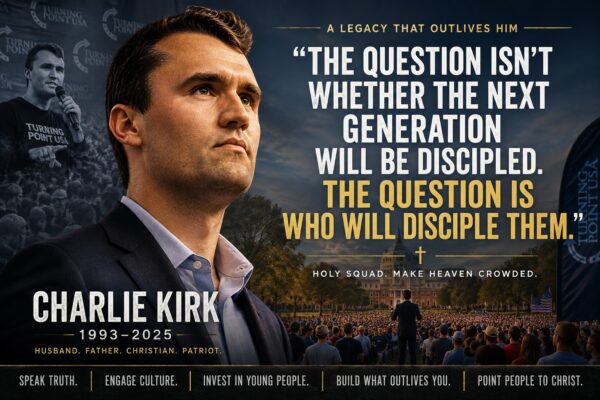
The question isn’t whether the next generation will be discipled.
The question is who will disciple them.
The third lesson may be Kirk’s greatest organizational legacy:
Build something that can survive you.
This is where the story becomes extraordinary.
The assassin’s bullet ended Charlie Kirk’s life.
It didn’t end his mission.
Turning Point continued. Students continued organizing. According to TPUSA, more than 120,000 students expressed interest in launching new chapters in the weeks following his death. The organization today reports an even larger campus footprint and thousands of church partners. Those numbers come from TPUSA itself and should therefore be understood as organizational claims, but even allowing for that, the scale of the movement Kirk left behind is undeniable.
That’s legacy.
Not how many people attended your funeral.
Not how many Facebook friends posted your photograph.
Legacy is what keeps moving after you’re gone.
The Angel documentary Charlie Kirk: American Martyr captures something of this by deliberately looking behind the public personality. Friends and colleagues describe the relationships, convictions and character behind the political movement. Whatever one’s politics, it’s difficult to watch people describe someone they loved and not remember that behind every public figure is a husband, father, friend and human being.
And perhaps that’s the lesson we need approaching September 10.
Don’t make Charlie Kirk into a saint.
He wasn’t one.
Don’t pretend every argument he made was perfect.
It wasn’t.
Don’t endlessly replay old videos and congratulate ourselves because our side scored another rhetorical touchdown against some college sophomore.
That’s not continuing the mission.
Do something.
Teach a kid.
Mentor somebody.
Invite someone to church.
Start the Bible study.
Coach the team.
Volunteer.
Call the friend who’s struggling.
Defend something worth defending.
Build something worth leaving behind.
Tell somebody about Jesus.
Because here is the uncomfortable arithmetic of Charlie Kirk’s life:
18 to 31.
Thirteen years.
That’s it.
None of us knows our number.
We behave as though somewhere in Heaven there is a guaranteed actuarial table promising us eighty years and a comfortable retirement before God expects us to accomplish anything important.
There isn’t.
Scripture repeatedly warns against that assumption.
James asks:
“What is your life? You are a mist that appears for a little while and then vanishes.”
That’s not pessimism.
That’s urgency.
Charlie Kirk had thirteen adult years to build the thing that would define his public life.
He used them.
Now we have ours.
The best tribute on September 10 isn’t simply remembering the man who died.
It’s continuing the work that mattered most.
Speak truth.
Have the difficult conversation.
Invest in young people.
Strengthen families.
Build communities.
Put down the phone occasionally and actually talk to another human being.
Build something that will still matter when your chair is empty.
And above everything else, point people beyond politics toward Christ.
Because eventually every election ends.
Every administration ends.
Every movement changes.
Every one of us dies.
The Gospel remains.
Charlie Kirk’s clock stopped at 31.
Ours is still running.
Don’t waste it.
_________________________________
If you enjoyed this article, then please REPOST or SHARE with others; encourage them to follow AFNN. If you’d like to become a citizen contributor for AFNN, contact us at managingeditor@afnn.us Help keep us ad-free by donating here.
_________________________________
Substack: American Free News Network Substack
Truth Social: @AFNN_USA
Facebook: https://m.facebook.com/afnnusa
Telegram: https://t.me/joinchat/2_-GAzcXmIRjODNh
Twitter: https://twitter.com/AfnnUsa
GETTR: https://gettr.com/user/AFNN_USA
CloutHub: @AFNN_USA