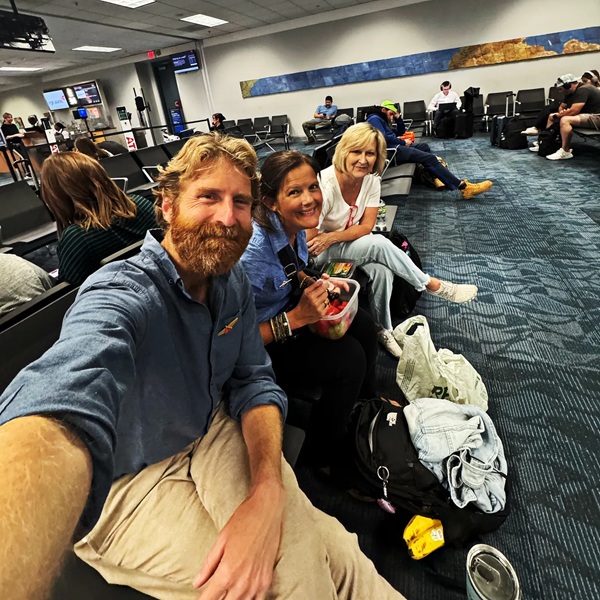
Our plane touched down in Albuquerque. No sooner had my feet hit the airport terminal floor than I knew immediately—call it gut intuition—that Albuquerque is definitely a city with two Qs.
Jamie, my cousin Randa, and I arrived at the theater where I performed my one-man shipwreck before an audience of extraordinarily friendly Southwesterners who were kind enough to give me a standing ovation. True, the ovation was moving toward the exits. And true, nobody in the ovation was facing me. Come to think of it, nobody was ovating, either.

But after the show I went to the lobby and met some lovely people from the audience.
I met a young woman who grew up in a strict Mennonite sect, who loved music but was prohibited from playing instruments. As a little girl, she learned the fiddle in secret, taking lessons up in town, despite the risk of being excommunicated from her community.
We also met a man who arrived wearing braids and a bandana. The resemblance was shocking. He looked exactly like Willie Nelson would have looked if Willie Nelson had been born looking like someone else.

I also met an Apache elder and cowboy who was chewing an actual mouthful of tobacco and used words like “pilgrim” non-ironically.
I met a 95-year-old New Mexico woman named Martha Ann who hugged me and then grabbed my butt.
“I may be old,” she said, with a firm handful in her grasp, “but I ain’t dead, sonny.”
Next, we awoke in Texas. Texas was nice, but Amarillo was windy. And hot. The ambient heat index was approaching 2,106 degrees Fahrenheit. It was windy, too. I haven’t experienced that much hot air since the Baptist sermons of my youth.
That morning, we traversed the Oklahoma Panhandle, briefly. Then, we crossed the Kansas state line.

The scenery in Kansas was arresting. I saw the long fields of hard winter wheat. The sunflowers, the grain sorghum, and the uplifting roadside billboards, reading: “Sin now, burn later. God offers no layaway plans.”
The prairie grass shot past our windows like a green streak. The miles of wildflowers, like smears of pink and violet. My cheeks were tight. I was smiling. And I realized moisture was accumulating in my eye region.
Visiting Kansas is a big deal for me. It’s been thirty-odd years since my father’s suicide—which took place here. I’ve only returned to this state thrice.
And each visit hurt like heck. It was always a deep, familiar hurt that I couldn’t unfeel no matter how I tried. The hurt always began the moment we crossed into the 34th State. Just as we passed the “Welcome to Kansas” sign and all the Baptist church signs which read: “Don’t let worry and depression kill you, let the church help.” Or “Hell is real, come early and listen to our choir practice.”
The pain of the trauma suffered here usually started as a dull mental ache, deep in my emotional core. A feeling of profound loneliness. Or helplessness. Maybe even a little fear. The feeling would swell until it became physical. A literal aching in your sternum. A throbbing. Like a brick stuck in your throat.

I was born in Kansas City. I began my life on a Kansas farm. And even though I did most of my actual growing up in the South, you can’t forget your original biology. You can never divorce yourself from the physical energy of the land that made you. I am what I am. And as we shot across the prairie I realized that—no matter how desperately I’ve tried to be something else—I am a fifth-generation Kansan.
I never wanted to be a Kansan, mind you. My father was a Kansan. I did not want to be anything like him. After my boyhood trauma, we moved away from here. I hated this place. Namely, because it was here, on this land, where bad things happened.
Here, my dad tried to kill my mother. Here, he threatened to kill me and my sister. It was here that sheriff’s deputies broke into our home, bearing riot guns and ballistic vests, freeing us from the lone gunman.
My last image of my father was of him entering a Leavenworth County police cruiser. He spent one last night on earth before pulling the trigger on himself. And so I despised this soil.
But as of the last few years, Kansas has changed for me. This place has grown to represent a land of redemption. Of healing. Although I’ve avoided this place for thirty years; although my family would not even speak of Kansas after we left; although my brain mysteriously blocked out this landscape, and the prairie topography ceased to exist in my imagination; although I had forgotten about this state, when I returned it was like riding a bike.
It all comes back to you.
We drove for hours across the lonesome plains. And I felt a spring of beautiful memories frothing to the surface of my consciousness. We pulled over in Great Bend, a town so small that census takers only use their fingers. The cashier at the gas station called me “hun,” although she was half my age.
That evening, I performed my one-man train derailment at the historic Crest Theater, downtown. A few of my cousins were in the audience. Other Dietrichs I’ve never met before. People I might’ve known before our family split in two, long ago.


I played old Kansas tunes on my Kansas fiddle. I told old jokes. I strummed “Home on the Range” on my guitar. No sooner had I begun singing our state song than the whole theater began singing along.
Their warm voices swelled, trickling across space and time, like the melodic sound of a soft waterfall. I felt as though someone poured warm oil on my head. And as we sang of “home,” I began to cry onstage. Happy tears. My cup runneth over.
How often at night,
When the heavens are bright,
With the light of the glittering stars,
Have I stood there amazed,
And I asked as I gazed,
If their glory exceeds that of ours.
Home, home on the range,
Where the deer and the antelope play,
Where seldom is heard,
A discouraging word,
And the skies are not cloudy all day.
That evening, I hugged necks until midnight. Nobody grabbed my butt.

Next, we traveled across the state to the tiny hamlet of Paola. That morning, I borrowed the rental car while everyone at the hotel remained asleep. At sunrise, I visited the old haunts of boyhood. I also visited important traumatic landmarks of my youth. Such as the site of my father’s suicide, where I played “Amazing Grace” for him on the fiddle.
Later, I performed my one-man maritime disaster at the Paola Community Theater. I told more jokes. Sang more songs. And then, more hugs. This time, there were tears, too.
My old Sunday school teacher. My boyhood minister. My second-grade teacher. Cousins galore, cousins I never knew existed. Who look like me. Who look like my dad. Old friends of my father’s. Neighbors. Preachers. Farmers. Coaches. Teachers. Men in cowboy hats, with wads of chaw clenched in their lower lips. Lots of boots. Lots of denim and plaid.
When the meet-and-greet was finished, I sat in the dressing room in rapt silence. Numb with the startling beauty of life. My wife found me staring into nothingness. Blank look on my face.
“What’re you thinking?” she asked.
“I’m thinking about the pain.”
“The pain of being here?”
“Yes.”
“What about it?”
“That’s just it,” I replied. “It’s gone. It don’t hurt anymore.”
She smiled.
Tenderly, my wife touched my knee and, in this moment of existential gravity, she said solemnly, “I think you mean ‘doesn’t.’”

The following night we arrived in Fulton, Missouri, only a few hours before showtime. I performed my one-man dumpster fire before an animated crowd of warmhearted people who evidently had such a marvelous time that, instead of clapping, many theatergoers simply snored in unison.
My dear friend, champion Texas contest fiddler Michelle Kuhlman, joined me onstage. When she played “Orange Blossom Special” the audience went slap nuts. After the show, everyone wanted to shake Michelle’s hand or embrace her. I don’t know whether anyone grabbed her butt. But I’d like to think they tried.


The next morning, we drove to Belleville, Illinois, where I performed my one-man structural collapse at the historic Lincoln Theater. At the end of the show, I played my father’s favorite song for the audience. Then I hugged people until nearly 11:00 p.m. while Cousin Randa took pictures.
I met beautiful humans in Belleville. Such as Chris, an 11-year-old boy who gave me a piece of glass art, shaped like a sunflower—the Kansas state flower.
“This is because I love you,” said Chris, presenting me with the precious gift, shortly before I smothered him in an embrace.

I met Chantelle, a 41-year-young woman with Down’s syndrome who was not expected to live past her first birthday. We hugged maybe 250 or 300 times throughout the night. Even when I was busy talking with other people in line, Chantelle would waltz up to me, arms open, and just randomly hug me.
“I love you so much,” she kept saying. “You’re my favorite insane person.”
Then I’d drop what I was doing and we’d hug tightly once more. Then she kissed me on the hair. It was the most beautiful and innocent moment when she looked me in the eyes and said with complete sincerity: “I want you to be my husband.”
Everyone laughed.
But Chantelle didn’t.

After the night finished, I sat in our hotel room and sort of took it all in, the entire previous week. A marathon tour lineup of my one-man-uncontrolled-burn performances, now finished. And now something even bigger awaited me.
Something I’ve been planning for thirty years.
And so it was, this morning I awoke early in our hotel. I packed my bags. I packed my fiddle. And my running shoes. I packed a meager breakfast of apples and dates. I kissed my wife goodbye. And I headed for the airport via hotel shuttle.
With a full heart, a sunflower ornament in my pocket, and Morgan Love’s handmade bracelet on my wrist, I departed Saint Louis for Denver.
I’m in the air now as I write this, hovering 40,000 feet above Purple Mountain Majesty. I will be landing in Colorado before lunchtime. I will be meeting my sister in a few hours. Then, in two days she and I will be running to the top of Pikes Peak to visit my father’s ashes—on foot—for the first time in our lives. There, we will offer our respect. Our love. And our forgiveness.
So I want to thank you, whoever you are, for attending my shows this past week. Thank you for your undeserved love toward my wife and me. Thank you for helping me heal over all these years that I’ve been writing and performing across this country. Thank you for your kindness. For your encouragement. And most of all, thank you for grabbing my butt.
I only hope I can return the favor someday.

Questions: SeanDietrich@gmail.co
Visit the Sean of the South Website
Find out where you can see Sean live.
Originally published on Sean’s website. Republished here with permission.
If you enjoyed this article, then please REPOST or SHARE with others; encourage them to follow AFNN. If you’d like to become a citizen contributor for AFNN, contact us at managingeditor@afnn.us Help keep us ad-free by donating here.
Substack: American Free News Network Substack
Truth Social: @AFNN_USA
Facebook: https://m.facebook.com/afnnusa
Telegram: https://t.me/joinchat/2_-GAzcXmIRjODNh
Twitter: https://twitter.com/AfnnUsa
GETTR: https://gettr.com/user/AFNN_USA
CloutHub: @AFNN_USA