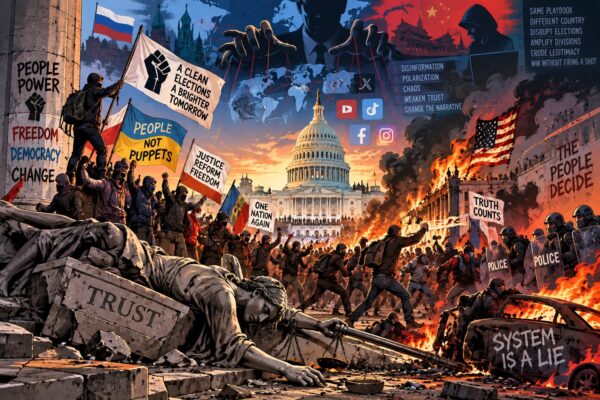
Editor’s Note: Retired Army Lietenant Colonel Dave Cloft as you would imagine, is a student of military history. In this 5-part series, he brings forth an old concept of revolution and sets it in modern times, with hyper-rapid communication. As the mid-term elections draw nigh, it behoves all of us to consider his words.
Ed.
In Part One, we looked at the Human Domain and the uncomfortable idea that a modern enemy doesn’t necessarily have to destroy our Army, sink our Navy or occupy Washington.
It might be enough to destroy our trust in each other.
In Part Two, the chickens came home to roost. We looked at America’s own long history of democracy promotion, political influence, covert action and occasionally helping foreign populations decide that perhaps their current government had exceeded its expiration date.
Now comes the hard part.
What do we do about it?
Because if the Human Domain really is contested terrain, the easiest solution would be controlling the Human Domain.
Control information.
Control social media.
Control “misinformation.”
Control political organizations.
Control foreign influence.
Control what citizens are permitted to hear.
Control enough things and eventually we’ll be completely safe.
We’ll also have solved the problem of defending a free republic by getting rid of the free republic.
Outstanding work, gentlemen.
Mission accomplished.
That is the paradox at the center of fifth-generation warfare.
An open society is vulnerable precisely because it is open. Americans can criticize their government, organize politically, publish outrageous opinions, protest elections, accuse politicians of corruption and occasionally say things so stupid that our ancestors probably attempt to crawl out of their graves just to disconnect the Wi-Fi.
That’s not a defect accidentally left in the Constitution.
That’s freedom.
Benjamin Franklin supposedly summarized the entire problem in five words after the Constitutional Convention in 1787. Asked what kind of government the delegates had created, he replied:
“A republic, if you can keep it.”
The story comes from convention delegate James McHenry’s notes, so unlike many convenient Internet quotations, this one has some historical legs.
Notice what Franklin didn’t say.
“A republic, if Washington can keep it.”
Or Congress.
Or the Army.
Or the FBI.
Or whichever political party currently possesses the appropriate number of yard signs.
If you can keep it.
Us.
Lincoln understood the danger too.
You’ve probably seen the Internet meme claiming Lincoln said America could never be destroyed from outside and would only lose its freedom by destroying itself.
Great quote.
Unfortunately, Lincoln never said it that way.
What he actually said as a 28-year-old in Springfield in 1838 may be better.
Speaking about threats to American political institutions, Lincoln argued that danger wouldn’t come from some foreign conqueror crossing the ocean. If destruction became America’s fate, he said, “we must ourselves be its author and finisher.”
Then came the line that should probably be printed above every congressional doorway:
“As a nation of freemen, we must live through all time, or die by suicide.”
There’s your fifth-generation warfare warning.
From 1838.
Apparently Lincoln understood the Human Domain without needing a TRADOC PowerPoint presentation.
Ronald Reagan made essentially the same observation more than a century later when he warned that freedom is never more than one generation away from extinction. We don’t inherit liberty biologically. Each generation has to understand it, defend it and hand it to the next.
That’s the part we’ve perhaps neglected.
We became exceptionally good at defending America from things we could see.
Aircraft?
Radar.
Missiles?
Patriot.
Tanks?
Javelin.
Submarines?
Sonar.
A hostile narrative spreading through seventy million smartphones before breakfast?
Well…
Has anybody tried posting a fact-check?
The real defense of the Human Domain isn’t censorship.
It’s resilience.
That means elections transparent enough that reasonable people can examine how they work. Paper trails and audits where appropriate. Election observers. Courts that hear legitimate challenges. Government agencies that tell the truth even when the truth is embarrassing. Journalists who distinguish reporting from political activism. Intelligence agencies that remain outside partisan politics. Political leaders willing to admit that losing an election doesn’t automatically mean democracy failed.
And citizens capable of saying something almost revolutionary in modern America:
“I might be wrong.”
That may be our most effective fifth-generation weapon.
Critical thinking.
Not automatically trusting government.
Not automatically distrusting government.
Not believing something merely because Fox News said it.
Not disbelieving something merely because CNN said it.
Not accepting something because your political tribe posted it seventeen thousand times before lunch.
Evidence.
That wonderfully boring old concept.
John Adams understood another part of the equation. In 1798 he warned that the Constitution was designed for a “moral and religious people” and was inadequate for any other. His larger argument was that constitutional machinery alone cannot restrain every human passion. A free society requires citizens capable of restraining themselves.
That doesn’t require everyone to share the same theology or politics.
It requires something simpler and perhaps harder:
Character.
Tell the truth when lying benefits your side.
Demand evidence when a story confirms everything you desperately want to believe.
Defend someone’s constitutional rights even when you despise his opinions.
Accept legitimate election results when your candidate loses.
Investigate credible irregularities when your candidate wins.
Hold your own tribe to the standards you demand from the other one.
That’s civic armor.
Because Russia cannot make Americans hate each other unless Americans cooperate.
China cannot destroy confidence in our institutions unless those institutions give Americans reasons to distrust them.
Artificial intelligence cannot eliminate truth unless human beings decide truth is less important than winning.
And no foreign intelligence service can force us to abandon constitutional government.
That decision ultimately remains ours.
Perhaps that’s how these three articles fit together.
The Human Domain is real.
Legitimacy is terrain.
Information can be weaponized.
Foreign powers can exploit our divisions.
Our own government can become dangerous if protecting us from manipulation becomes an excuse for manipulating us itself.
So defending the republic cannot mean surrendering the liberties that make the republic worth defending.
The answer isn’t trusting government blindly.
It isn’t distrusting government blindly either.
It is building institutions worthy of trust and citizens difficult to deceive.
Franklin gave us the assignment in 1787.
Lincoln gave us the warning in 1838.
Reagan reminded us that every generation has to take the test again.
And now it’s our turn.
America probably isn’t going to be conquered by enemy tanks rolling down Pennsylvania Avenue.
If this experiment eventually fails, the more frightening possibility is considerably less dramatic.
The Capitol may still be standing.
The Constitution may still be sitting under glass.
The flag may still be flying.
And somewhere along the way, Americans may simply stop believing that any of it matters.
That’s how a republic commits suicide.
And that’s why defending the Human Domain ultimately begins with something no government program, intelligence agency or military command can manufacture for us.
Citizens who still intend to keep it.
This article is 3rd in a 5 Part Series on 5th Generation Warfare. Links below go active on the dates indicated for this and subsequent parts:
September 28, 2026:5th Generation War Part 1: Don’t Capture the Capitol—Just Convince Half of them it’s Corrupt and Illegitimate
September 29, 2026: 5th Generation War Part 2: When the Chickens Come Home to Roost
September 30, 2026: 5th Generation War , Part 3: How Do We Save the Republic Without Committing Suicide?
October 1, 2026: 5th Generation War, Part 4: Rights, Privileges, and the Fine Art of Leaving Each Other Alone
October 2, 2026: 5th Generation War, Part 5: Who Gets to Decide What Is True?
If you enjoyed this article, then please REPOST or SHARE with others; encourage them to follow AFNN. If you’d like to become a citizen contributor for AFNN, contact us at managingeditor@afnn.us Help keep us ad-free by donating here.
Substack: American Free News Network Substack
Truth Social: @AFNN_USA
Facebook: https://m.facebook.com/afnnusa
Telegram: https://t.me/joinchat/2_-GAzcXmIRjODNh
Twitter: https://twitter.com/AfnnUsa
GETTR: https://gettr.com/user/AFNN_USA
CloutHub: @AFNN_USA