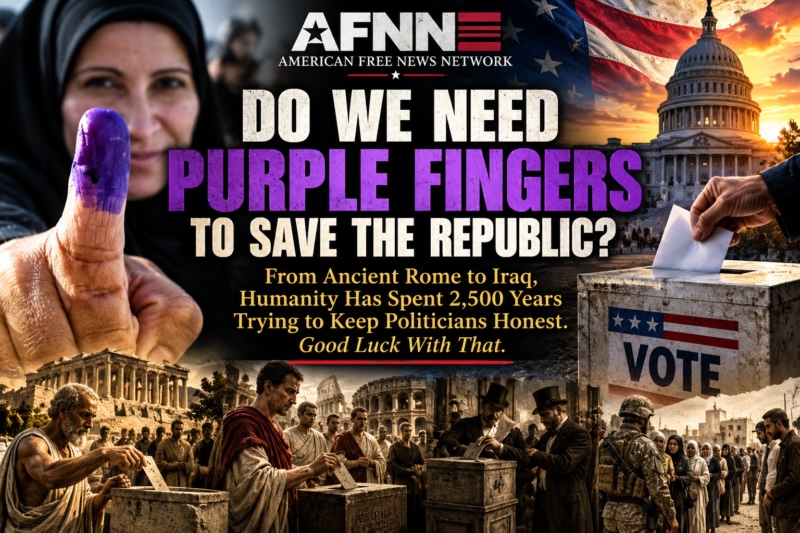
From Ancient Rome to Iraq, Humanity Has Spent 2,500 Years Trying to Keep Politicians Honest. Good Luck With That.
There is something profoundly embarrassing about the possibility that a civilization capable of putting men on the moon, splitting atoms, and developing artificial intelligence might still need to dip people’s fingers in purple ink to conduct an election.
But here we are.
In 2005, I was serving in Iraq when the country held its historic elections. Imagine trying to establish democracy in a nation emerging from dictatorship, terrorism, sectarian violence, and generations of political corruption. We had plenty of problems, but one was remarkably straightforward: How do you prevent someone from voting twice?
Purple ink.
After voting, Iraqis dipped a finger into indelible ink that couldn’t simply be washed off. No expensive computer system. No algorithm. No password protected by another password. Just a purple finger that told the next election official, “This guy already voted.”
Primitive? Perhaps. Brilliant? Absolutely.
And here’s the uncomfortable question: Why does a country trying to establish democracy understand the importance of visible election safeguards while Americans spend billions arguing about whether their own elections can be trusted?
Twenty-Five Centuries of Cheating
The ancient Greeks understood that political power attracted corruption like flies to a dead raccoon. Athens developed elaborate lottery machines to randomly select citizens for public duties. The idea was simple: It’s harder to buy an appointment when nobody knows who’s getting appointed.
The Romans had their own problems. Wealthy aristocrats bought influence, intimidated voters, and manipulated elections. In 139 BC, the Roman Republic introduced secret ballots for electing magistrates.
Imagine that. Two thousand years ago, Romans figured out that allowing powerful politicians to watch people vote might produce something other than honest results.
Who knew?
Medieval Venice developed an almost comically complicated system of lotteries and elections to choose its doge. Why? Because wealthy families couldn’t resist trying to capture the government.
Apparently, the human desire to purchase political influence predates television advertising by several centuries.
By the nineteenth century, Americans had developed their own impressive collection of electoral innovations: ballot stuffing, intimidation, political machines, and enough creative vote counting to make a Chicago ward boss blush.
Australia introduced government-printed secret ballots in 1856. Americans eventually adopted similar reforms, along with improved ballot boxes, voter registration, and election oversight.
Then came mechanical voting machines, electronic systems, computerized databases, and sophisticated counting equipment.
We went from clay tablets to microchips.
Unfortunately, the human operating system never received the honesty upgrade.
The Real Threat Isn’t Just Fraud
Here’s where people miss the strategic significance.
An election isn’t simply a mechanism for selecting politicians. It is the process by which a free society transfers legitimate political authority.
When citizens believe that process is fundamentally dishonest, the consequences extend far beyond one disputed election.
Why obey laws written by representatives you believe weren’t legitimately elected? Why trust courts appointed through a political system you consider corrupt? Why accept taxation, regulations, or executive authority if you believe the entire process is fraudulent?
That doesn’t mean every allegation of fraud is true. It means credible allegations deserve investigation, and unsupported accusations deserve scrutiny too.
Because destroying public confidence with false accusations can damage a republic just as surely as concealing genuine misconduct.
An enemy seeking to undermine American institutions wouldn’t necessarily need to change a single vote. Convincing millions of Americans that elections are hopelessly corrupt could accomplish plenty.
That’s basic psychological warfare.
And Americans are perfectly capable of conducting it against themselves.
The Military Had a Name for This
Defense in depth.
You don’t protect a military installation with one guard and a cheerful sign requesting that terrorists please behave themselves.
You establish overlapping security measures.
Authentication. Access control. Physical security. Independent observation. Accountability. Verification.
Why should elections be different?
Verify voter eligibility. Prevent duplicate voting. Protect ballot secrecy. Maintain documented custody of ballots. Preserve auditable paper records. Conduct meaningful independent audits. Investigate credible discrepancies.
And make the safeguards understandable to ordinary citizens.
None of this requires pretending that every election is fraudulent. Nor does it require pretending that existing safeguards are worthless.
It requires recognizing that trust should be supported by verifiable evidence rather than political assurances.
Back to Iraq
I still remember the significance of those purple fingers.
Iraqis were risking their lives to participate in elections. Insurgents threatened polling places. Violence was real. Yet ordinary citizens showed up, voted, and proudly displayed their stained fingers.
That purple ink became more than an anti-fraud measure.
It became a symbol of participation, courage, and accountability.
Was the Iraqi electoral system perfect? Of course not. Indelible ink couldn’t eliminate intimidation, corruption, or manipulation elsewhere in the process.
But the safeguard addressed a specific vulnerability in a way almost anyone could understand.
And that matters.
Perhaps America doesn’t need purple fingers. Our electoral systems already have protections that deserve evaluation, enforcement, and continuous improvement.
But we absolutely need something those Iraqi voters understood: The legitimacy of an election must be demonstrable, not merely declared.
Because when citizens lose confidence in the peaceful transfer of political power, they begin questioning the legitimacy of everything built upon it.
For 2,500 years, humanity has been developing methods to keep elections honest.
The technology keeps improving.
The politicians remain human.
And if the future of our constitutional republic ultimately depends upon everyone simply trusting the people counting the votes, perhaps we haven’t learned nearly as much from history as we think.
Maybe the answer isn’t purple ink. Maybe it’s remembering why we needed the ink in the first place.
If you enjoyed this article, then please REPOST or SHARE with others; encourage them to follow AFNN. If you’d like to become a citizen contributor for AFNN, contact us at managingeditor@afnn.us Help keep us ad-free by donating here.
Substack: American Free News Network Substack
Truth Social: @AFNN_USA
Facebook: https://m.facebook.com/afnnusa
Telegram: https://t.me/joinchat/2_-GAzcXmIRjODNh
Twitter: https://twitter.com/AfnnUsa
GETTR: https://gettr.com/user/AFNN_USA
CloutHub: @AFNN_USA