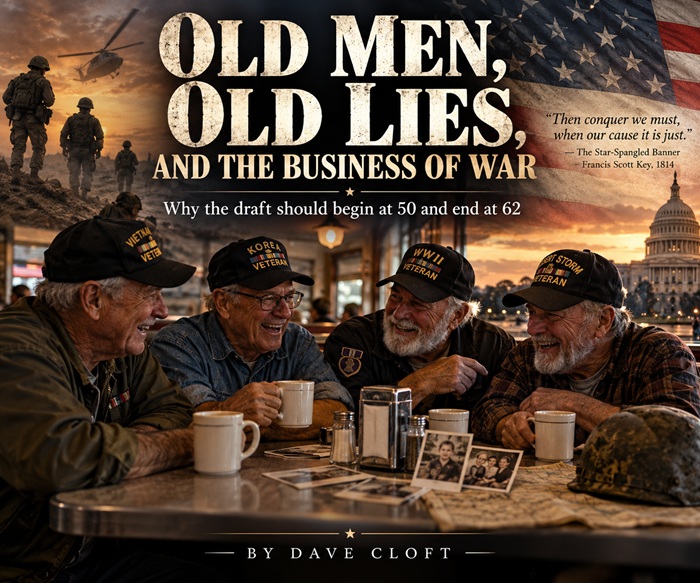
Maybe it’s time we changed the military draft. Eligibility begins at age 50 and ends at age 62. Seriously. If we’re going to keep sending human beings halfway around the planet to kill one another over borders, resources, religion, and political egos, perhaps we should start with people old enough to understand exactly what they’re getting into. Give the old guys a rifle, a bottle of Motrin, and a map. Half will recognize the terrain from the last time we fought there. The other half will want to know where the nearest bathroom is.
There’s a country song about four old veterans sitting around drinking coffee, swapping war stories, and enjoying the friendship that comes from surviving things most people will never understand. Its central proposition is brilliant: all future wars should be fought by old men.
Why not? They’re old enough to know better.
During World War I, British soldier and poet Wilfred Owen wrote Dulce et Decorum Est, condemning the ancient Roman declaration that it is sweet and fitting to die for one’s country. Owen called it “The old Lie.” He had witnessed what industrialized warfare actually did to human beings. No glorious cavalry charges. No handsome recruiting posters. Just gas, mud, blood, and young men drowning in their own lungs.
Owen was killed seven days before the war ended. Twenty-five years old.
There’s your recruiting poster.
Now, before somebody accuses me of becoming a pacifist, understand something. I’m not. Sometimes extreme violence is absolutely necessary. Evil exists. Aggressors don’t always respond to diplomacy, sanctions, strongly worded letters, or another emergency meeting of the United Nations. Sometimes the only thing that stops a murderous bastard is somebody willing to apply overwhelming force.
Jesus warned in Matthew 24:6 that we would hear of “wars and rumours of wars.” He wasn’t issuing a recruiting order. He was describing the fallen condition of mankind. Ecclesiastes 3:8 reminds us there’s “a time of war, and a time of peace.”
But the existence of war doesn’t automatically establish the righteousness of any particular war.
That brings me to something I learned as a cadet at West Point. We were required to memorize the fourth verse of The Star-Spangled Banner. Most Americans today probably couldn’t recite the entire first verse without a little help, much less tell you there are four verses.
But everyone should read that fourth verse. Better yet, listen to someone sing it.
Francis Scott Key wrote those words in September 1814, during the War of 1812, after witnessing the British bombardment of Fort McHenry. America was fighting for its survival as an independent nation.
And buried in that fourth verse is perhaps the most important qualification ever attached to American military power:
“Then conquer we must, when our cause it is just.”
Read that again.
When our cause it is just.
Not when it’s profitable. Not when it’s politically convenient. Not when somebody needs a distraction from domestic problems or another defense contract needs funding.
When our cause is just.
As a young cadet, I memorized those words because I was required to. Decades later, after a military career and deployments overseas, I appreciate them for entirely different reasons.
And who gets to decide whether the cause is just?
Usually men old enough to know better, sitting comfortably in expensive chairs, discussing acceptable casualties as though they’re negotiating soybean futures.
Here’s where my proposed Selective Service reform comes in.
Draft eligibility runs from your 50th birthday through age 62. No exemptions for politicians, corporate executives, lobbyists, or television commentators who enthusiastically advocate military intervention. Especially those guys. If you’re demanding somebody else’s son storm a beach, congratulations. You’re now first in line.
Imagine a congressional debate over military intervention when representatives in that age bracket know they might personally be issued body armor and a rifle. Suddenly diplomacy becomes remarkably attractive.
By 50, you’ve probably buried friends, raised children, and discovered that winning an argument isn’t the same thing as being right. You’ve learned that hatred is expensive, forgiveness is difficult, and bad decisions tend to outlive the idiots who made them.
And you’ve learned that war doesn’t end when somebody signs a piece of paper.
It follows people home.
I’m a retired Army lieutenant colonel. I’ve spent time in places where politicians’ theories collided with the realities of armed conflict. I believe in military readiness, decisive force, and defending innocent people. But I’m extraordinarily suspicious of anyone who makes killing sound easy, clean, or glorious.
There’s an enormous difference between defending your home and participating in somebody’s geopolitical chess tournament.
Our young soldiers aren’t pawns. They’re sons, daughters, husbands, wives, and parents. Their lives aren’t expendable simply because somebody can manufacture a persuasive national-security briefing.
So yes, sometimes violence is necessary. When it is, fight decisively, accomplish a legitimate objective, and stop. Don’t turn another generation into permanent occupants of somebody else’s civil war.
Before declaring the next one, perhaps we should assemble a few hundred combat veterans between 50 and 62, pour some terrible diner coffee, and ask whether the proposed war is actually worth fighting.
They might simply ask the most dangerous question in Washington:
“What exactly are we trying to accomplish?”
Maybe Wilfred Owen was right about the old lie. Maybe Francis Scott Key was right about the just cause. And maybe Jesus was reminding us that humanity will never entirely escape its appetite for destruction.
But if we’re determined to keep repeating history, perhaps we should stop making the youngest generation pay the admission price.
Let the old men fight the next war.
Something tells me there would be considerably fewer of them.
The inspiration for this article comes from singer-songwriter Stephen Wilson Jr. and his brilliant 2023 song, All the Wars from Now On. He tells the story of four Purple Heart veterans sitting around a diner, drinking black coffee, swapping stories, and carrying shrapnel from wars they survived decades earlier. His proposition is beautifully simple: let the old men fight the next war. They’re old enough to understand what war actually costs, and perhaps wise enough to avoid another one. As a retired Army lieutenant colonel, I think Wilson is onto something. I encourage everyone to listen to his song before reading another headline demanding we send somebody else’s children off to war.
If you enjoyed this article, then please REPOST or SHARE with others; encourage them to follow AFNN. If you’d like to become a citizen contributor for AFNN, contact us at managingeditor@afnn.us Help keep us ad-free by donating here.
Substack: American Free News Network Substack
Truth Social: @AFNN_USA
Facebook: https://m.facebook.com/afnnusa
Telegram: https://t.me/joinchat/2_-GAzcXmIRjODNh
Twitter: https://twitter.com/AfnnUsa
GETTR: https://gettr.com/user/AFNN_USA
CloutHub: @AFNN_USA