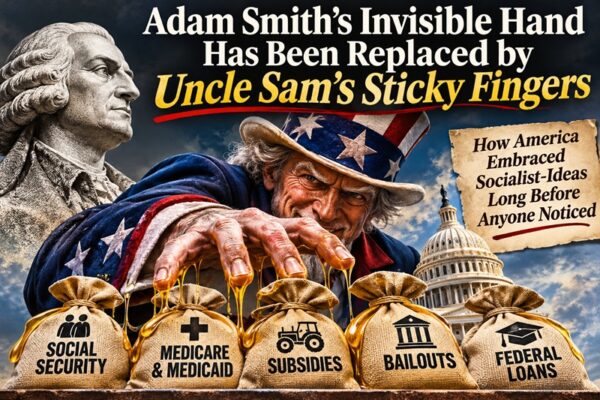
Well, the 2026 midterms are over, and judging by the reaction from some conservatives, Karl Marx has apparently risen from the grave, registered to vote, and taken over America.
Socialism! Socialism everywhere!
Grab your guns, hide your wallets, and prepare for the collapse of Western civilization.
There’s just one little problem.
We’ve been embracing socialist-inspired policies for nearly a century. Some even longer. And many of the people screaming the loudest about socialism have been cashing the checks.
Let’s take a little stroll through American economic history, shall we?
In 1776, Adam Smith published The Wealth of Nations, describing how individual self-interest and market competition could produce broader economic benefits. His famous invisible hand became a cornerstone of free-market thinking.
Then Washington decided the invisible hand needed adult supervision.
In 1913, we established the Federal Reserve, giving a central institution enormous influence over money and credit. That same year, the 16th Amendment cleared the constitutional path for a federal income tax.
Here’s a fun historical nugget: Karl Marx’s Communist Manifesto advocated a graduated income tax and centralized credit.
Sound familiar?
Now, the Federal Reserve isn’t Marx’s state-owned national bank, and progressive taxation doesn’t automatically make a country socialist. But the philosophical similarities are worth discussing.
Then came the Great Depression.
In 1935, Franklin Roosevelt signed Social Security into law. Suddenly, retirement security became a federal responsibility, financed through mandatory payroll taxes.
Today, millions of Americans depend on those benefits.
Try telling a retired conservative that his Social Security check represents a government-administered social insurance program and watch how quickly the conversation gets uncomfortable.
And before someone hollers, “I paid into that!”
Yes, you did. So did everyone else. That’s how compulsory social insurance works. It’s not your personal savings account.
Then came agricultural subsidies.
Apparently, government intervention is socialism when somebody in the city receives assistance, but when Washington supports crop prices, subsidizes farm insurance, or sends money to agricultural producers, that’s just protecting American farmers.
Interesting distinction.
In 1965, along came Medicare and Medicaid. Government-financed healthcare became a permanent fixture of American life.
Today, plenty of Americans who oppose government-run healthcare would probably storm Washington if somebody threatened their Medicare.
Then there’s the GI Bill, unemployment insurance, public housing assistance, federal student loans, and countless other programs designed to distribute benefits or reduce economic risk.
And let’s not forget corporate America.
In 2008, when Wall Street’s financial geniuses managed to drive themselves into a ditch, Uncle Sam arrived with taxpayer-backed rescue packages.
Apparently, capitalism means keeping your profits when times are good and calling Washington when the casino catches fire.
By 2020, pandemic relief had Washington sending money directly to households and businesses. Both political parties participated in that particular spending extravaganza.
And more recently, semiconductor manufacturers and energy companies have benefited from federal incentives intended to steer private investment.
The invisible hand has become Uncle Sam’s sticky fingers, reaching into practically every economic transaction.
Now, here’s where I disappoint the ideological purists.
I’m not advocating socialism.
I’m pointing out that America isn’t operating under pure free-market capitalism, and hasn’t for generations.
Technically, we’re a mixed economy. Private businesses still dominate production, while government taxes, redistributes, regulates, subsidizes, and occasionally rescues the politically connected.
Social insurance isn’t identical to socialism, and neither is every subsidy. But many policies Americans take for granted reflect the same collective-security and redistribution ideals associated with socialist movements.
So before demanding that we eradicate socialism, perhaps we should identify exactly what we’re proposing to eliminate.
Social Security? Medicare? Farm subsidies? Corporate bailouts? Federal disaster assistance?
Or just the government benefits going to somebody we don’t particularly like?
Because here’s the uncomfortable truth.
Americans don’t necessarily hate government intervention. We frequently hate government intervention that benefits somebody else.
Adam Smith’s invisible hand is still out there somewhere.
Unfortunately, it’s probably buried beneath a federal grant application, a corporate subsidy, and 600 pages of regulations.
And both political parties are fighting over who gets to hold the pen.
If you enjoyed this article, then please REPOST or SHARE with others; encourage them to follow AFNN. If you’d like to become a citizen contributor for AFNN, contact us at managingeditor@afnn.us Help keep us ad-free by donating here.
Substack: American Free News Network Substack
Truth Social: @AFNN_USA
Facebook: https://m.facebook.com/afnnusa
Telegram: https://t.me/joinchat/2_-GAzcXmIRjODNh
Twitter: https://twitter.com/AfnnUsa
GETTR: https://gettr.com/user/AFNN_USA
CloutHub: @AFNN_USA