
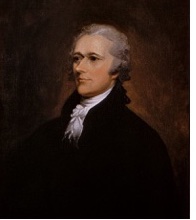
In Federalist 13 Hamilton addresses the fact that government is a necessity but one that should be accomplished at minimum cost. This governmental burden, “civil lists” [1] in Hamilton’s words, can either be created by individual states, or by a single federal entity. Publius is concerned that it is the nature of government to grow and that, “Civil power, properly organized and exerted, is capable of diffusing its force to a very great extent; and can, in a manner, reproduce itself in every part of a great empire by a judicious arrangement of subordinate institutions.”
Here we see Hamilton’s acknowledgement of both the efficiency of a single government and the danger of its metastasizing. He goes on to point out that the natural confederacies that would result from a partition of the states would likely occur along the lines of those things that each region finds valuable. That likely partition would result in the requirement for several individual governments that would be even a greater burden on the people than a single entity. Returning to an earlier argument, Hamilton points out that each confederacy would require people to enforce trade regulations between them increasing the burden on the citizens, both from regulation and from the cost of government employees to manage that regulation.

In Federalist 14 Madison takes us back to the reasons for having a republic instead of a democracy. Here Madison points out that a democracy, in a territory as large as was being proposed, is impractical simply because of the distances involved. He acknowledges that it would be impossible for, “the people meet and exercise the government in person” rather than to, “assemble and administer it by their representatives and agents.” But this is purely a mechanical observation. In a world with the internet, we could easily have a very direct democracy. Madison has other objections to a democracy besides the distances involved.
The first is that democracy, “can never be established but among a small number of people, living within a small compass of territory.” This is because people of a single territory would likely have similar interests and needs. He points out the failures of democracy, and other forms of representative governments, both in modern Europe and in Ancient Greece. But the proposed national republic the founders are proposing is different. The federal government of the new constitution is not intended to regulate everything but rather, “Its jurisdiction is limited to certain enumerated objects”. This phrase describes our often-forgotten 10th Amendment that states that,
“The powers not delegated to the United States by the Constitution, nor prohibited by it to the states, are reserved to the states respectively, or to the people.”
This critical concept was designed to limit the power of the federal government. Publius acknowledges that if the purpose of the proposed federal arrangement was to take power from the individual states, then there would be, “ground for their objection”. But that is not what our founders were proposing. Madison goes on to say that there would likely be the addition of new states and territories making this arrangement more practical. In addition, the ability of commerce to be conducted would be enhanced, and those states that constitute a frontier would be better off in a republic that helps to protect them than they would be individually or in smaller groups.
Madison goes on to acknowledge that this is indeed an experiment, but, “why is the experiment of an extended republic to be rejected, merely because it may comprise what is new?” As Aristotle told us, the pursuit of the more noble government is a more noble undertaking, and as Madison acknowledges, “Happily for America, happily, we trust, for the whole human race, (the founders) pursued a new and more noble course.” You may recall how Aristotle talked about the higher the “nobleness” of the state that the politician was pursuing, the greater was the nobility of that pursuit.
In Federalist 15 Hamilton discusses why the current Articles of Confederation are insufficient to preserve a union. Up until this point, all the papers discussed the benefits of a united group of states, but none specifically discussed the issues with the current arrangement.
Hamilton starts by telling his audience about the importance of this decision and, in another shout out to Plato, decries how the attempt to create a new nation has been made more difficult by opponents and, “that the difficulties of the journey have been unnecessarily increased by the mazes with which sophistry has beset the way.” Even back then, the use of language to distract from the real issues at hand, rather than to provide solutions, was an issue.
There are some existing problems, argues Hamilton, that cannot be addressed by a union of independent states. These include items like, the debt that was incurred during the revolutionary war, the existence of foreign posts in the individual states, and the lack of available private credit for citizens of the various states. He points out that our ambassadors abroad are in the awkward position of not really representing any single country.
To those who object to the current Articles, Hamilton agrees that they are insufficient, and goes on to say that, “the usefulness of the concession (that the articles are insufficient), on the part of the old adversaries of federal measures, is destroyed by a strenuous opposition to a remedy”. It is useless to argue against the current system at the same time you are arguing against the solution.
In a land where the individual states are not subject to a federal system, there is no way to resolve disputes short of war. For a court system to work, the people must be subject to its jurisdiction, and the current Articles do not have the authority to handle these issues. Under the current arrangement, all 13 states must agree to any measure for it to have the force of law. Publius acknowledges the unlikelihood of that ever happening.
The solution does require each state to give up a bit of sovereignty. But, because the founders understood the danger of allowing majority rule, the answer is a Republic.
If you enjoyed this article, then please REPOST or SHARE with others; encourage them to follow AFNN. If you’d like to become a citizen contributor for AFNN, contact us at managingeditor@afnn.us Help keep us ad-free by donating here.
Substack: American Free News Network Substack
Truth Social: @AFNN_USA
Facebook: https://m.facebook.com/afnnusa
Telegram: https://t.me/joinchat/2_-GAzcXmIRjODNh
Twitter: https://twitter.com/AfnnUsa
GETTR: https://gettr.com/user/AFNN_USA
CloutHub: @AFNN_USA