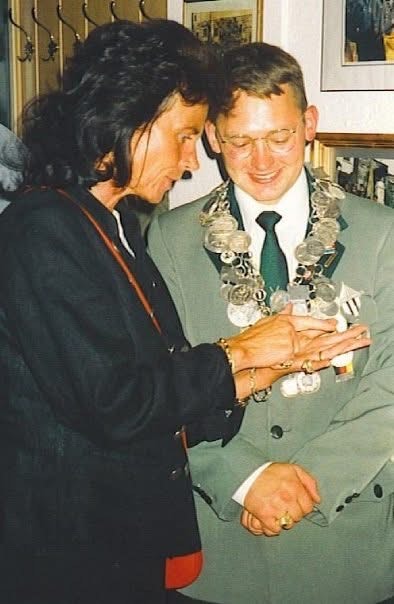
In 1999, I had the extraordinary honor of becoming the first American ever to win the title of Pfingstritter (Pentecost Knight) in the historic Büdinger Schützengesellschaft—a marksmanship society with roots dating back over 670 years. That summer, in the village of Hammer near Büdingen, Germany, I stood among a centuries-old tradition of sharpshooters and townsmen, not just as a foreign guest but as a competitor who earned his place in one of Europe’s most time-honored shooting rituals. It remains one of the most unforgettable moments of my competitive shooting career—a moment when history, marksmanship, and cultural tradition converged.
The Büdinger Schützengesellschaft was founded in 1353, making it one of the oldest continually operating shooting societies in the world. It was originally formed to train local townsmen in the defense of their walled city during an era when noblemen and peasants alike were expected to defend their homes. Over the centuries, the organization evolved into a prestigious social and civic institution, blending the military roots of marksmanship with the pageantry and ritual of German civic pride. Today, it upholds those traditions through festivals, parades, and annual shooting competitions that honor the history of Büdingen while welcoming competitors from around the world.
Central to the society’s tradition is the legendary Ritterkette—the Knight’s Chain—which dates back to at least 1652. This elaborate silver necklace is passed from one year’s winner to the next, each new Pfingstritter adding a small engraved shield to the chain to commemorate their victory. Worn during formal ceremonies, the chain is not only a symbol of individual achievement but also a living historical artifact, carrying the names of generations of marksmen who stood on the same field and aimed for the same prize. Holding that chain and wearing it as a newly named knight was like reaching back through the centuries and shaking hands with history.
To be knighted as an outsider—an American—in such a proudly local and deeply historical tradition was not just rare, it was humbling. The ceremony was conducted with full pomp and respect: traditional German uniforms, drum rolls, the formal procession of the chain, and the reading of my name in the long list of Pfingstritter reaching back over three and a half centuries. It was a reminder that the shooting sports, despite the differences in language or culture, connect people through shared values: precision, discipline, and a love for tradition.
For any competitive shooter, becoming a part of the Büdinger Schützengesellschaft is a unique honor. For me, to have earned the title of Pfingstritter and worn the historic Ritterkette was more than just a trophy—it was a reminder of why we shoot. Not just for sport, but for community, history, and legacy. That experience reaffirmed my belief that marksmanship, at its best, is a bridge between people, generations, and nations.
If you enjoyed this article, then please REPOST or SHARE with others; encourage them to follow AFNN. If you’d like to become a citizen contributor for AFNN, contact us at managingeditor@afnn.us Help keep us ad-free by donating here.
Substack: American Free News Network Substack
Truth Social: @AFNN_USA
Facebook: https://m.facebook.com/afnnusa
Telegram: https://t.me/joinchat/2_-GAzcXmIRjODNh
Twitter: https://twitter.com/AfnnUsa
GETTR: https://gettr.com/user/AFNN_USA
CloutHub: @AFNN_USA