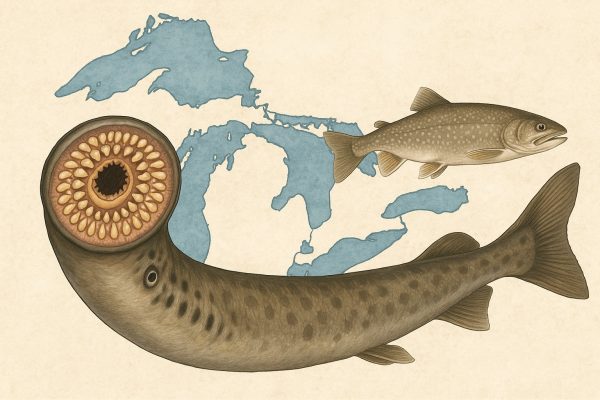
There’s a certain poetry to the Great Lakes sea lamprey problem — if you like your poetry written in government grants, poison barrels, and endless committee meetings. Since the 1950s, state and federal agencies have been “fighting” the sea lamprey invasion with all the efficiency and results of a three-legged sloth chasing salmon upstream. Seven decades later, the lampreys are still here. The fish are still scarred. And the only real winners are the bureaucrats who’ve turned failure into a career.
The Billion-Dollar Parasite
Let’s start with the scoreboard: taxpayers have dumped roughly $1.2 billion into this aquatic fiasco since the Eisenhower administration. Every few years, the Great Lakes Fishery Commission trumpets “success” — a 90% reduction here, a victory lap there — and then quietly requests another $25 million to “continue the fight.” If this were a war, it’d be Vietnam with gills.
Imagine a company telling investors: “We’ve been addressing this issue since the 1950s, and if we stop spending millions every year, the problem will instantly come back worse than ever.” Investors would call that a Ponzi scheme. Government calls it “ecosystem management.”
A Perfect Government Problem
The sea lamprey program is the ideal government problem — unsolvable by design, self-sustaining in perpetuity. They “control” the parasite with a chemical cocktail called TFM, which has to be dumped into spawning streams every year, forever. Miss one cycle, and the lampreys multiply faster than bureaucrats before budget season.
And because lampreys are ugly, bloodsucking, prehistoric monsters, the optics are perfect for funding. Who’s going to argue against killing something that looks like a demonic shop vac? So the agencies keep pouring money, hiring “coordinators,” “technicians,” “interagency liaisons,” and “stakeholder consultants.” It’s a parasite paradise, all right — for the people, not the fish.
Science, Meet Job Security
Here’s the genius of it: the lamprey problem gives everyone something to study. Scientists publish papers, universities get grants, interns get waders, and administrators get pensions. The program’s mission statement might as well read: “Ensuring the long-term employment of everyone who didn’t go into private industry.”
And when the numbers don’t look good? Easy — tweak the metric. If there are more lampreys this year, it’s “a sign of reproductive resilience.” If there are fewer, it’s “proof of success.” Either way, the PowerPoint slides stay funded, and the lampreys stay fed.
The Real Victims
Meanwhile, the average taxpayer in Michigan — the guy paying $4 a gallon for gas and a fortune for fishing licenses — thinks “somebody” has this under control. The truth? The program hasn’t eradicated a single lamprey population in 70 years. It’s an open tab on your checkbook and a monument to the golden rule of bureaucracy: Never solve the problem you get paid to manage.
You’ve got to admire it, in a twisted way. The lampreys found the perfect host species — the government. Both live off others’ lifeblood, both resist extinction, and both thrive in murky, overfunded environments. The Great Lakes didn’t just inherit a parasite — they created one.
Moral of the story:
In nature, parasites eventually kill the host. In government, they just rename the committee and double the budget.
If you enjoyed this article, then please REPOST or SHARE with others; encourage them to follow AFNN. If you’d like to become a citizen contributor for AFNN, contact us at managingeditor@afnn.us Help keep us ad-free by donating here.
Substack: American Free News Network Substack
Truth Social: @AFNN_USA
Facebook: https://m.facebook.com/afnnusa
Telegram: https://t.me/joinchat/2_-GAzcXmIRjODNh
Twitter: https://twitter.com/AfnnUsa
GETTR: https://gettr.com/user/AFNN_USA
CloutHub: @AFNN_USA