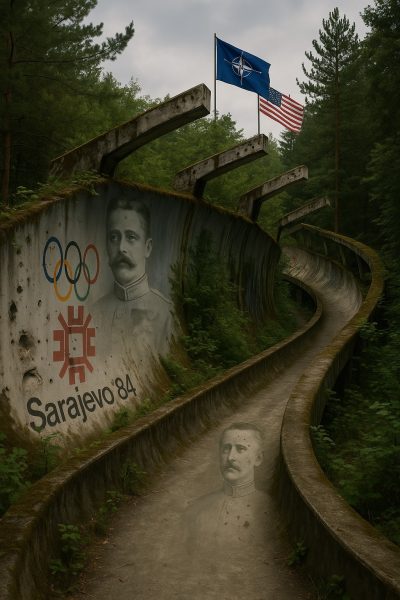
The Balkans Civil Wars never truly vanish from American foreign policy; they just fade into the background noise of newer crises. Yet even now — in 2025 — the traces still remain after 30-years.
Camp Bondsteel still stands. Built in 1999 during Operation Joint Guardian, it sits near Ferizaj/Uroševac, Kosovo — a sprawling, fortified city within a city. What was once billed as a temporary staging ground for peacekeepers became a permanent logistics hub. For locals, it’s a symbol of Western stability; for others, a reminder of occupation. The base processes thousands of troops annually under the NATO Kosovo Force (KFOR) banner. Critics in both Serbia and Russia still call it “the American base on Serbian soil.”
Tuzla Air Base, once the heart of IFOR and SFOR peacekeeping operations in Bosnia, has long since shuttered as a U.S. installation. Its hangars now rust quietly under the Bosnian sun, the old Eagle Base sign fading like a forgotten campaign ribbon. A handful of NATO liaison officers remain in Sarajevo under the EUFOR Althea mission — a skeleton peacekeeping force with more PowerPoint slides than weapons.
Sarajevo itself walks a narrow ridge between recovery and ruin.
The scars of the 1,425-day siege still line its hills, but life has returned in its own weary rhythm. The old Olympic venues lie scattered like relics — the bobsled run overgrown, the ski jumps silent — yet cafés bustle, trams run, and tourists photograph the spot where Archduke Ferdinand was shot, unaware that a generation ago, snipers once owned that same street. Bosnia’s GDP still trails Europe’s poorest, but its people, hardened by history, wear resilience as a national identity. Sarajevo is not what it was in 1984 — but then again, neither is the world.
Did NATO make it better or worse?
That depends on who you ask. To some, NATO prevented another genocide and stitched a fragile peace out of chaos. To others, it entrenched dependency, swapping Soviet-style centralization for Western bureaucracy. What began as humanitarian intervention became the prototype for managed geopolitics — peace by indefinite supervision. We won’t ever leave.
Serbia and Montenegro still carry the quiet resentment of a people hardened by airpower. Their cities have rebuilt, but memory runs deeper than concrete. The children of those who once hid from the sirens now vote in elections shaped by the alliances that bombed them. Montenegro joined NATO in 2017; Serbia never will.
And so, the story of the Balkans — both real and reimagined — ends not with victory or defeat, but with fatigue. A tired region holding its breath between empires. NATO stayed long enough to become part of the landscape, like a mountain range: immovable, enduring, and increasingly invisible.
Some call it peace.
Others call it the pause between wars. Never forget… It’s where the war to end all wars first began…
“Dulce et decorum est pro patria mori.”
If you enjoyed this article, then please REPOST or SHARE with others; encourage them to follow AFNN. If you’d like to become a citizen contributor for AFNN, contact us at managingeditor@afnn.us Help keep us ad-free by donating here.
Substack: American Free News Network Substack
Truth Social: @AFNN_USA
Facebook: https://m.facebook.com/afnnusa
Telegram: https://t.me/joinchat/2_-GAzcXmIRjODNh
Twitter: https://twitter.com/AfnnUsa
GETTR: https://gettr.com/user/AFNN_USA
CloutHub: @AFNN_USA